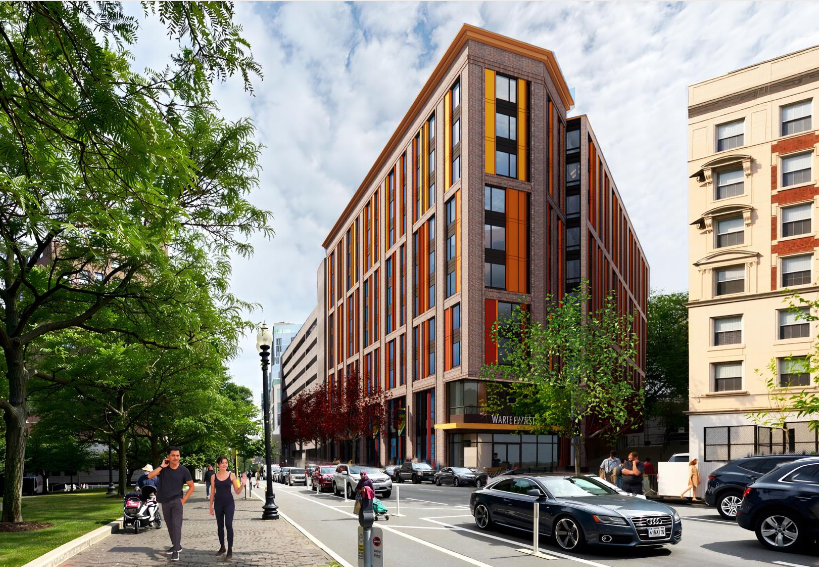
The 290 Tremont St. development was redesigned to eliminate 36 for-sale condominiums after loss of potential funding from a key state program. Image courtesy of Stantec
Facing reluctant investors and lenders, developers are pursuing changes designed to salvage projects teetering on the brink of financial feasibility.
Affordable housing developers removed for-sale condominiums from a Boston Chinatown project after losing a key state subsidy.
And some market-rate developers elsewhere in the region are seeking changes to affordability components and parking requirements, arguing that sites that could be used for housing creation will otherwise stagnate as scrapyards or parking lots without revisions.
“You don’t want to walk away from any housing at all, if you’ve got a project ready to go,” said Emily Haber, CEO of the Massachusetts Association of Community Development Corporations.
Affordable Condos Lose Funding Source
Since 2021, Massachusetts’ CommonWealth Builder program has won acclaim for providing a missing financial piece in affordable housing development: creation of for-sale condominiums. Developers can receive up to $150,000 per unit from MassHousing, making income-restricted condo construction feasible.
But with program funding declining and competition strong among developers, one major project in Boston eliminated for-sale condominiums and is moving ahead with an all-rental project instead.
Boston-based Asian Community Development Corp. and The Community Builders redesigned its all-affordable 290 Tremont St. project this summer.
After being notified by MassHousing of a moratorium on applications, developers eliminated all 36 of the planned for-sale condo units while adding 15 apartments. The changes reduced the building from 12 to 10 stories and square-footage by nearly 24,000 square feet, and shrank project costs from over $120 million to $99.4 million, according to Boston Planning Department documents. ACDC will rely on low-income housing tax credits to help finance the rental portion of the project, Executive Director Angie Liou said.
ACDC previously tapped into the CommonWealth Builder program for its 55 Hudson St. project, which will include 44 affordable condos and 66 apartments.
The CommonWealth Builder program – limited to Massachusetts’ 26 Gateway Cities along with Boston, Framingham and Randolph – was designed to help developers finance affordable home ownership units and build wealth for the buyers through real estate appreciation, narrowing Massachusetts’ racial home ownership gap.
The resale prices of traditional deed-restricted affordable condos are usually capped, a rule that doesn’t apply to CommonWealth Builder-financed units.
State Funding Shrank by $130M
Through MassHousing, the program has awarded over $175 million toward financing packages for 33 projects creating 804 homes across the state.
But MassHousing notified nonprofits and affordable housing specialists it was pausing accepting applications last summer. The Healey administration has allocated $45 million for the program over the next five fiscal years.
CommonWealth Builder’s diminished funding reflects competition with other programs in the administration’s $5.2 billion Affordable Homes Act bond bill, ranging from public housing repairs to low-income tax credits, Lt. Gov. Kim Driscoll said last week.
“We have to make sure that we have adequate resources moving forward,” Driscoll said. “This is one of our favorite programs, and definitely something that’s been successful for home ownership, so it is a priority.”
A MassHousing spokesperson declined to comment on the current status of CommonWealth Builder or specific changes to the program.
Affordable housing advocates say the program’s downsizing points to the need for new revenue sources, such as an increase in the deeds excise tax and a local option transfer fee on high-end real estate sales.
“There needs to be a harder conversation about revenue,” the Massachusetts Association of Community Development Corporations’ Haber said.

Builder Marc Kaplan is seeking Boston officials’ approval to reduce the number of income-restricted units on-site in its 3326 Washington St. project in Jamaica Plain. Instead, Kaplan proposes to pay into a city affordable housing fund. Image courtesy of Primary Development Group
Projects Seek Flexibility on Affordability
For-profit developers are likewise looking for new routes to groundbreaking, redesigning approved projects that started in an era of lower interest rates and in Boston, affordability requirements.
Three multifamily developers recently proposed changes to the Boston Planning Department designed to get projects closer to the finish line.
Eldev Washington LLC, an entity registered to builder Marc Kaplan of Wellesley, is seeking to reduce the number of income-restricted units on-site in its 3326 Washington St. project in Jamaica Plain.
The 43-unit apartment building originally would have included 10 income-restricted units, three of which would be eliminated. Boston’s inclusionary zoning rule allows developers to create affordable units off-site, subject to approval of the Boston Planning & Development Agency board, if they pay a fee into a city affordable housing fund.
The changes are necessary to make the project financially viable, according to a letter submitted by attorney Jeffrey Drago.
In Dorchester, developers of a 48-unit apartment complex are taking a different approach: they want to increase affordable units from 21 to 85 percent of the total.
Volnay Capital and PRC Group are seeking subsidies from the Mayor’s Office of Housing and state tax credits to make their 257 Washington St. project pencil.
Located on the site of a current junkyard, the development was approved in June 2024. The updated proposal includes income-restricted units for households earning 21 to 80 percent of area median income, and five units for former homeless families.

Steve Adams
Ditching Expensive Underground Parking
Allston Square is an over-400,000-square-foot, multi-building redevelopment at the intersection of Cambridge Street and Harvard Avenue, where City Realty Group previously modified plans to eliminate a for-sale component in favor of 344 apartments. The project cost was estimated at $127 million in 2023.
City Realty now is seeking to eliminate 109 parking spaces, including below-grade parking and automated parking systems.
Below-grade parking costs are now ranging from $125,000 to $175,000 per space, City Realty Group’s Clifford Kensington said in an interview. And the stacking parking systems that gained popularity in the past decade for small urban sites have problems with reliability, while some manufacturers have gone bankrupt.
Recent interest rate cuts by the Federal Reserve have yet to increase investors’ and lenders’ appetites for new construction, Kensington said.
“There hasn’t been quite the opening we were hoping to see,” he said. “We’re competing against money funneling into other parts of the country that don’t have the same build costs, restrictions and issues that come from building in Boston. They are getting the funding first.”