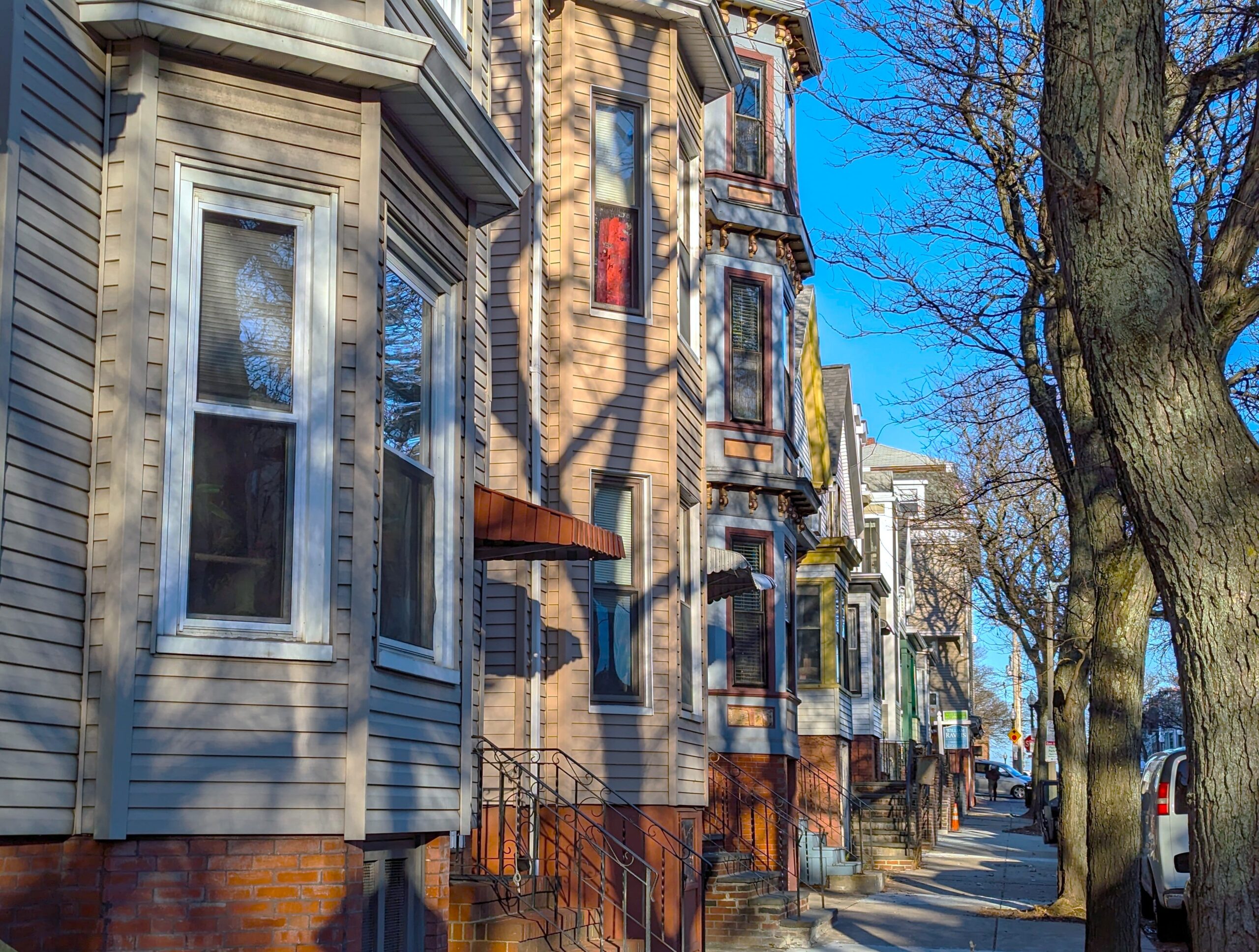
East Boston triple-deckers in 2023. Boston leaders say city renters need more time and help to move if their landlord converts their rental to an apartment. Photo by James Sanna | Banker & Tradesman Staff / File
For decades, supporters of two very different, two dueling visions have battled over how to tackle Boston’s dire housing crisis.
Former mayors Marty Walsh and the late Thomas M. Menino made a major push to get more housing of all types built, based on the reasonable assumption that increased supply of homes, condos and apartments would bring down prices and rents.
However, under Mayor Michelle Wu, the city’s approach has shifted away from a clear focus on boosting overall supply.
Instead, the Wu administration – and the City Council – has embraced hyper-regulation in a bid to solve the city’s housing affordability woes via government fiat, from ultra-high affordability restrictions to the mayor’s rent control proposal, only to see the latter shot down at the State House.
But a new push to extend Boston’s tough restrictions on converting apartments into condominiums faces no such obstacle, with Beacon Hill having passed enabling legislation years ago.
What’s Being Proposed
In a case of smart people with good intentions doubling down on a potentially problematic idea, the Boston City Council is poised to impose tough condo conversion regs onto small landlords with just four or fewer apartments.
Boston City Council President Liz Breadon and several of her colleagues have signed onto a proposed ordinance that would subject small landlords to roughly the same condo conversion rules and intensive review process as corporate landlords with hundreds or thousands of units have faced for years now.
Landlords with four or fewer units will have to give tenants at least a year of advance notice, a number that rises to two years or longer in the case of renters with disabilities or who are elderly.
The ordinance would also apply to owners of buildings of four units or fewer, except in cases where they are owner occupied. The property owner would also be required to pay anywhere from $10,000 to $15,000 in relocation assistance per unit, and, in the case of an empty unit, to the last renter of the apartment.
Meanwhile, the Mayor’s Office of Housing would be armed with wide latitude to reject applications by small property owners to convert rental units into condos.
Elected officials like state Sen. Lydia Edwards, herself a former Boston city councilor and current co-chair of Legislature’s Judiciary Committee, said the extension of the condo conversion ordinance is needed as triple-deckers across the city sell for seven-figure sums to developers reacting to a slow rental market with condo conversion plans.
Most Boston renters live in two- or three-unit buildings. Edward contends that extending the condo conversion ordinance will provide these tenants with time to look for another apartment and money to help pay for the move.
Tenants would also get a right of first refusal to buy their unit or another one in the building after the condo conversion under the planned regs.
Who Can Afford to Comply?
Regardless of whether you think this level of government control is a good thing, you should be noticing the scale of the proposal’s administrative burden.
This is a review and approval process clearly designed for a professional real estate firm with significant revenue coming in to pay for a lot of legal work.

Scott Van Voorhis
Who it is not designed for is the landlord who has owned two or three apartments for decades and, nearing retirement, wants to cash out by converting the units to condos or selling to a developer or building with plans for a conversion.
Under the regs, small landlords would be required to get both a preliminary and final conversion permit from the Mayor’s Office of Housing.
It’s a decision that rests on whether the building owner has complied with the 17-plus pages of Boston’s detailed rules and regulations.
It isn’t hard to see how a conversion could be dragged out or killed by the MOH for whatever reason, with little to fear in terms of political blowback.
By contrast, city officials might think twice about giving the runaround to a proposed condo conversion by large corporate landlords with lobbyists and friends in high places.
In the case of Boston’s condo conversion regulatoins, one size definitely does not fit all.
Scott Van Voorhis is Banker & Tradesman’s columnist and publisher of the Contrarian Boston newsletter; opinions expressed are his own. He may be reached at sbvanvoorhis@hotmail.com.