





Real estate appraisers say their numbers are dwindling and for a variety of reasons, there are very few newcomers entering the profession.
Recent regulatory changes have made it harder to get licensed and fees have been flat for quite some time. Add to that, a significant percentage of appraisers are either at or approaching retirement age, leaving many concerned about how the mortgage industry will adapt.
Richard Lipof owns Lipof Real Estate Services in Newton and has been appraising residential and commercial real estate throughout New England for 25 years. He said when the state started requiring appraisers to hold a bachelor’s degree and go through an apprenticeship, it set the bar for entry too high.
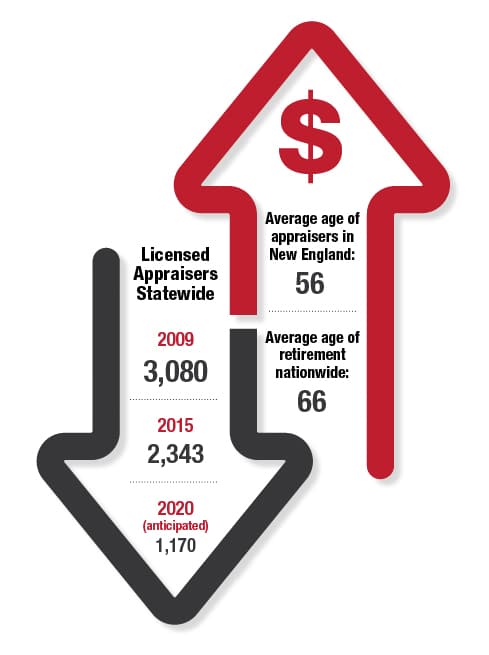
“The average age of an appraiser in New England is around 55 to 58 years old,” Lipof said. “They’re going to be retiring over the next 10 to15 years. Who is going to replace those people?”
Lipof said he has trained close to 70 people over the years, usually a few at a time, but that was when trainees could work more independently and earn money for themselves before sitting for their license. He said he stopped taking on trainees when lenders stopped accepting appraisals from trainees, unless they were physically supervised by an appraiser while they worked.
“The entire lending industry has effectively said they will no longer accept trainees,” Lipof said. “There’s no way I can take on a trainee. This is not an industry where we’re all getting rich. It’s a lot for a small company.”
Lipof said his office can normally issue an appraisal within about seven days of receiving an order, but as the number of appraisers dwindles, there will be fewer people to do the work. He’s afraid that might pressure lenders to rely more on computer programs, similar to the shift in banks’ assessment of smaller loan-to-value loans.
“The entire [process] is based on making the right loan for the right value,” Lipof said. “Appraisers are the most important part in the underwriting decision. The housing market in the Northeast is too diverse for computers to take over and do everything we do.”
Lipof said he also thinks the Fannie Mae’s Collateral Underwriter program, which captures appraisal information, tracks the consistency of appraisers’ work and issues a letter of warning to appraisers who submit inconsistent work, may also be a factor driving people out of the business.
 Lenders Will Have To Relax
According to the State Board of Registration of Real Estate Appraisers, there were 3,080 licensed real estate appraisers in the commonwealth in 2009. Currently there are 2,343 licensees, a decline of nearly 24 percent in six years.
Stephen Sousa, executive vice president at the Massachusetts Board of Real Estate Appraisers, a trade group, estimated he has received more notices of retirement from his members in the last year than he did in the last five years combined.
“Five years from now we could have half the number of appraisers out there that we have right now,” Sousa said. “There’s practically no one getting into the business today.”
Even so, he said he doesn’t think that computer programs can ever take the place of experienced appraisers, especially in New England, where the housing stock is so varied.
“For the majority of loans, they’ll still need an appraiser,” Sousa said. “Fewer appraisers will mean longer turnaround times and higher costs.”
Sousa said the best solution to the problem would be for lenders to go back to allowing trainees to perform appraisals under the supervision of an experienced appraiser, and covered by that appraiser’s insurance policy.
“Lenders have to realize their restrictions on the use of trainees is exacerbating the downward trend and they will have to relax those restrictions to see a trend reversal,” Sousa said. “The silver lining in all of this is that those appraisers still working in five years will be more highly paid and working under much better conditions.”
The New England appraisal industry has weathered similar contractions before, according to Michael Kemple, senior vice president at Bridgewater Savings Bank in Raynham.
“We’ve seen this before in the state of Maine,” Kemple said. “The number of appraisers dropped dramatically and we saw increased turnaround times and an increase in fees, just the sort of math problems you would expect.”
Kemple said the same thing could happen in Massachusetts, and the nationwide decline of appraisers has the entire industry concerned. He added that computer valuation programs have been around for 20 years and he doesn’t think they’ll ever replace appraisers, so something’s got to give.
“Appraisers make the same fees today or less than they did 10 years ago,” Kemple said. “And now [appraisal management companies] take anywhere from 20 to 40 percent of that. The math doesn’t make sense for someone looking to enter the profession. I think going forward we’ll see an increase in appraisal fees.”



