iStock photo
As the median single-family price in Massachusetts rose 47 percent between 2008 and 2020 and the median condominium price jumped 51 percent over the same period, recent Census data confirms suggestions in a decade’s worth of real estate sales reports and anecdotal evidence from real estate agents statewide: Significant numbers of Greater Boston workers chose longer commutes over more expensive housing closer to the urban core.
Commute-time data from the 2020 Census compiled and analyzed by rental listings site Apartment List shows the number of Worcester County residents who traveled 90 minutes or more each way more than doubled between 2010 and 2019, to 19,164. And in the Boston metro – defined by the Census Bureau as Essex, Middlesex, Norfolk, Suffolk and Plymouth counties, plus southeastern New Hampshire’s Rockingham and Strafford counties – that number grew from 55,511 to 98,918. Those figures represent 4.3 percent and 4 percent of each region’s workforce.
The Massachusetts region with the largest share of these “super commuters,” however, remained Cape Cod. While only 5,869 Cape residents qualified as such in 2019, that accounted for 5.9 percent of the area’s workforce, up from 4 percent in 2010.
The Providence, Rhode Island metro saw its share of super commuters grow from 2.3 percent to 3.3 percent of the workforce as its much-lower home prices – the 2020 median single-family sale price was $275,000 according to The Warren Group, publisher of Banker & Tradesman – and lively restaurant scene drew some Boston residents. And deeper into New Hampshire, the Manchester and Concord areas saw their shares of super commuters grow to 3.7 percent and 3.1 percent of the workforce, respectively.
Within Greater Boston, the increase in super-commuting did not appear to be confined to any one part of the suburbs or exurbs, but on the South Shore, rural parts of Essex County and suburban Norfolk County, the share of super commuters rose to 10 percent and, in some cases like Manchester-by-the-Sea and Marshfield, rose over 20 percent of all workers.
The change came as Boston grappled with dramatic increases in already-bad traffic congestion that made the region one of the most car-choked parts of the country.
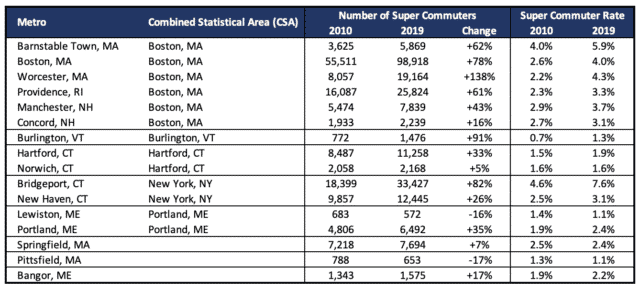
Source: Apartment List/2020 Census