
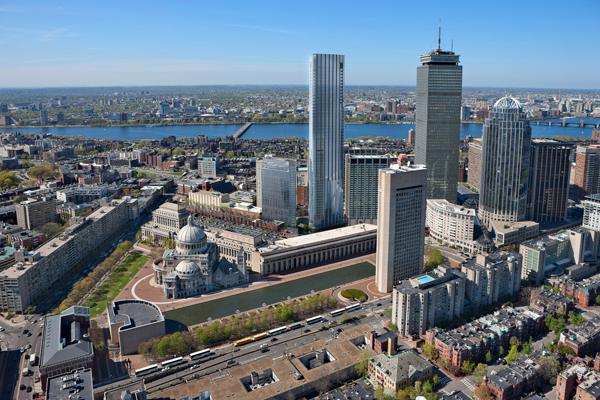
The Four Seasons Hotel & Private Residences in Back Bay will contain such high-end flourishes as 11-foot ceilings, bay windows and a private restaurant on the 50th floor.
The Four Seasons Hotel and Private Residences, the 61-story tower that has finally broken ground in Back Bay, will set the bar for luxury condo prices in Boston for years to come.
Prices won’t be available for several weeks, said developer Richard Friedman of Cambridge-based Carpenter & Co. But real estate experts predict the Four Seasons will test the market’s appetite for “junior New York” prices, with units selling for $2,000 to $2,500 per square foot.
“They’ll be at the top of the market,” Friedman said. “This is a higher-quality product than anybody’s ever built in Boston and the prices will reflect that.”
At 699 feet, the Four Seasons will become the tallest building completed in New England since the John Hancock Tower in 1976. Units will have 11-foot ceilings and fireplaces, with patios on the 12 highest floors. Fetching top dollar will be a trio of 8,000-square-foot penthouses on the 61st floor with oversized outdoor decks.
The glassy monolith between Christian Science Plaza and the Prudential Center won’t be completed until late 2017, but Friedman has reason to be optimistic, given the market’s reception to some of the city’s freshly-minted condo offerings.
Condo development screeched to a halt during the recession and took a backseat to the luxury rental boom before emerging in the last two years. Developers such as Newton-based National Development tested the waters with projects like Sepia at Ink Block South End, a mixed-use project at the former Boston Herald property.
Along with nearly 400 apartments, Sepia contains 83 condo units scheduled to open later this year. Approximately 80 percent of the condo units have sold for an average price of $1,075 per square foot, said Sue Hawkes, CEO of the Collaborative Cos. The Boston-based marketing company works with many of the region’s new condo properties.
“That’s pretty significant for that location. It’s very groundbreaking for the South End,” she said.
On the higher end, the 60-story Millennium Tower at Downtown Crossing has been marketing penthouse units on its upper five floors starting at $7 million, with the 13,000-square-foot top-floor unit listed for $37 million. Average prices are $1,300 per foot, Hawkes said.
Twenty Two Liberty, the Fallon Co.’s 14-story condo complex on the Fan Pier, has not released sales data. But industry chatter has the complex nearly sold out with average prices at $1,500 per square foot, exactly what developer Joseph Fallon predicted when the complex broke ground in October 2013.
“They had the fortune to absorb that product [with local buyers]. Frankly, I think that’s the end of the time we’re going to see that,” Hawkes said.
International Arrivals Could Pick Up Slack
Enter the international factor, which continues to play a major role in Boston’s condo resurgence. Foreign investment in Greater Boston commercial and residential real estate

New luxury condos hitting the market this year include Twenty Two Liberty, the Fallon Co.’s 14-story condo complex on the Fan Pier.
topped $4.6 billion in 2014, according to Riaz Cassum, a senior managing director at HFF in Boston.
To finance the $750-million Four Seasons project, Citi Private Bank raised capital from 150 investors, of whom 80 percent were international clients, Friedman said. And he predicted 30 percent of the condos will go to foreign buyers.
That could be necessary for the market to absorb the growing pipeline of high-end condo units under construction, including the 442 Millennium units and Related Beal’s 104-unit complex at Lovejoy Wharf, which is named 131 Beverly. The next wave of high-end properties will list prices in the $1,400 to $1,800 per foot range, Hawkes said.
“You’ve got people who didn’t live here who can write checks for large sums of money, and that group is going to be the difference-maker in the next few years,” she said. “Who owns the high end of the market? It’s not going to be local residents.”
Foreign capital also has been a steady source of financing for local multifamily developers, but origins have fluctuated with political and economic tremors.
Many Middle Eastern investors who were backing projects in the $20 million to $50 million range pulled out after 9/11 due to new travel security restrictions, said Young Park, president of Boston-based Berkeley Investments. German capital picked up the slack – until the recession hit. During the recovery, overseas institutional investors have shown a renewed interest in real estate. The reason: a desire for higher returns than those available from government bonds in the lingering low-interest rate environment.
“We have two German pension funds that are willing to invest in ground-up development. That’s a real paradigm shift in the way people look at real estate and risk in a market like Boston,” Park said.
Equity investments from the federal EB-5 program also are expected to help bankroll the next wave of condo development, Hawkes said. The program grants visas to foreign nationals who invest at least $1 million in U.S. ventures that create jobs.