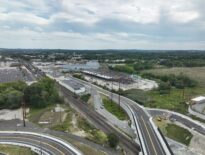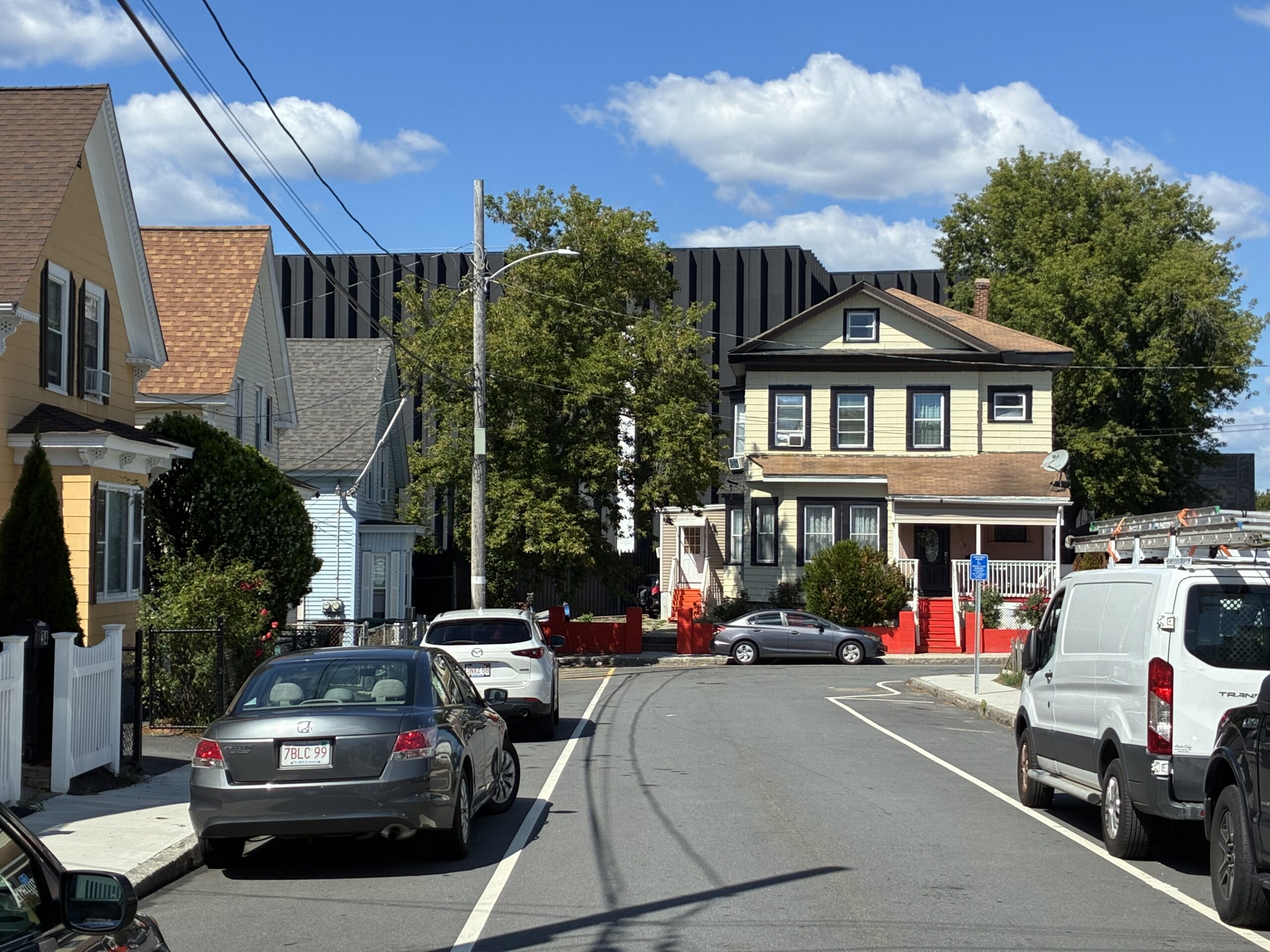
The Markley Group’s existing 352,000 square foot data center rises behind homes in Lowell. Photo by Steve Adams | Banker & Tradesman Staff
Gov. Maura Healey’s decision to give Massachusetts communities veto power over data center development could ring the death knell for a potential construction boom before it starts.
A grassroots backlash has prompted development moratoriums in a growing list of communities, while a lawsuit seeks to block expansion of Markley Group’s 352,000 square-foot facility in Lowell.
Now, communities will get a stronger voice under Healey’s executive order that gives them the first review of projects, and the leverage to negotiate community benefits agreements.
“It’s not saying data centers are not allowed here or they aren’t going to be developed here,” said M. Matthew Madden Jr., a partner at law firm Bowditch in Boston. “It’s saying these local communities and the ratepayers and taxpayers who live there will be on the front line of making these decisions.”
Healey’s order adds new risk calculations for data center developers who already need to factor in electrical capacity, utility upgrades and permitting timetables.
“It’s not as if you’re building a warehouse,” Madden added. “You’re building a warehouse with massive power demand. The risks are different. They require massive utility upgrades, interconnections and long lead times for the electrical equipment.”
Healey Shelves Financial Incentives
The new ground rules play out amid a national debate on the growth of data centers needed to provide cloud computer power for the AI industry, and their effects on economic competitiveness and the environment.
In June, the Healey administration halted a program giving sales and use tax breaks for data centers, part of a 2024 economic development bill she signed. Healey cited the need for protections against rising utility bills driven by data centers’ power requirements.
Last week’s executive order requires data center developers to gain approval for a benefits agreement from the local community before pursuing approvals through state agencies.
While praising Healey’s executive order as a good first step, Conservation Law Foundation attorney Adam Reynolds said additional regulations are needed for both new and existing data centers.
“We’d like to see the state put protections in through law to ensure data centers don’t drive up pollution or worsen climate change or threaten peoples’ health,” Reynolds said.
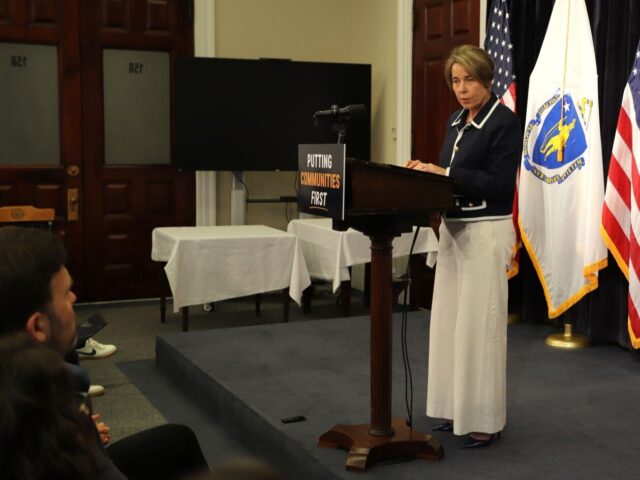
Gov. Maura Healey speaks about an executive order regarding data centers during a press conference on Tuesday, Sept. 8, 2026 at the State House. Photo by Katie Castellani | State House News Service
High Rates Deter Developers
Despite the growing controversy, short-term demand for hyperscale data centers in Massachusetts is likely to remain low, said Juan Arias, national director of U.S. industrial analytics at CoStar. The Bay State’s third-highest-in-the-nation commercial electricity rates – trailing only Hawaii and California – discourage data center developers, Arias said.
“What these hyperscale data centers are looking for is the most is accessible and cheap power,” he said.
A 2025 New Hampshire law that allows construction of small non-grid power plants tied to data centers has reportedly attracted interest from Google, Amazon and the owner of the Seabrook Nuclear Power Station. But local opposition has also emerged, forcing the withdrawal of a proposed data center in Nottingham.
The New Hampshire Bulletin reported this month that Eversource Energy is exploring the viability of a hyperscale data center on the site of a former coal-fired power plant in Bow, New Hampshire.
According to research by brokerage CBRE, Greater Atlanta leads the U.S. with 2,882 megawatts of data center capacity under construction in the first half of 2026.
By contrast, Massachusetts’ total existing data facility capacity is 168 megawatts at 58 facilities, according to researchers Baxtel Advisory.
Lawsuit Delays Lowell Expansion
Markley Group’s Lowell data center spans 352,000 square feet on a 14-acre property previously occupied by a Prince pasta factory. The Boston-based developer acquired the property in 2015 to complement its 900,000 square-foot data center at 1 Summer St. in Boston’s Downtown Crossing, the state’s largest data facility.
The Lowell expansion would add eight new 3,000-kilowatt generators.
A pending lawsuit by 10 residents claims the state Department of Environmental Protection approved a flawed air quality plan for the facility, located next to a densely settled residential neighborhood, in violation of air pollution control laws.
In August, a Middlesex Superior Court judge blocked installation of the new equipment while the case remains under review.
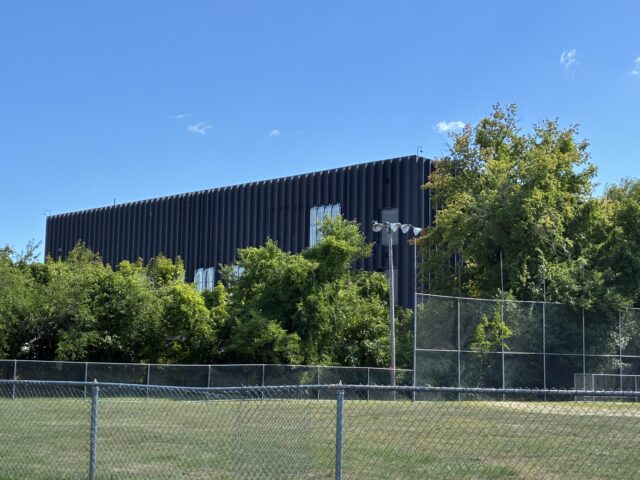
A group of residents are seeking court approval to block expansion of Markley Group’s 352,000 square-foot data center in Lowell, as viewed from the town’s Oliveira Park playground. Photo by Steve Adams | Banker & Tradesman Staff
Plymouth Enacts Moratorium
Many communities’ zoning laws lack specific definitions for data centers, prompting officials in some towns to scramble to enact regulations. This month, the Plymouth Select Board recommended a one-year moratorium on data center development.
Although no proposals have been submitted, officials said they need time to draw up a bylaw to regulate commercial developments that have a primary use as data storage and include high-performance servers, storage and networking equipment.
“There are a number of impacts that are unknown to a particular community,” Deputy Director of Planning and Development Michael Silveira said during a presentation.

Steve Adams
The board unanimously recommended that the Oct. 17 town meeting enact the moratorium, giving officials time to propose a bylaw.
“These giant AI farms cause water quality issues for the community. They sometimes increase the cost of electricity for the neighboring communities,” board member David Golden commented before voting in favor.
In Westfield, where Servistar Realty received approval for a $4 billion data center in 2021 but has yet to break ground, the City Council in July enacted a one-year moratorium on future data center proposals. The Franklin County town of Shutesbury enacted its own one-year moratorium in September 2025.
At least 16 Massachusetts communities already have taken steps to limit data centers through proposed or approved moratoriums, or outright bans on large-scale facilities, according to data compiled by Boston-based Hunneman.
“People are concerned, but municipalities have commercial buildings that are vacant, whether it be office or life science,” said Mark Fallon, Hunneman’s director of research and strategy. “This is where the demand is. This is what people are looking to build, and it’s going to generate tax revenues. The key issue is: Will the towns let them build, and will they be able to underwrite it?”