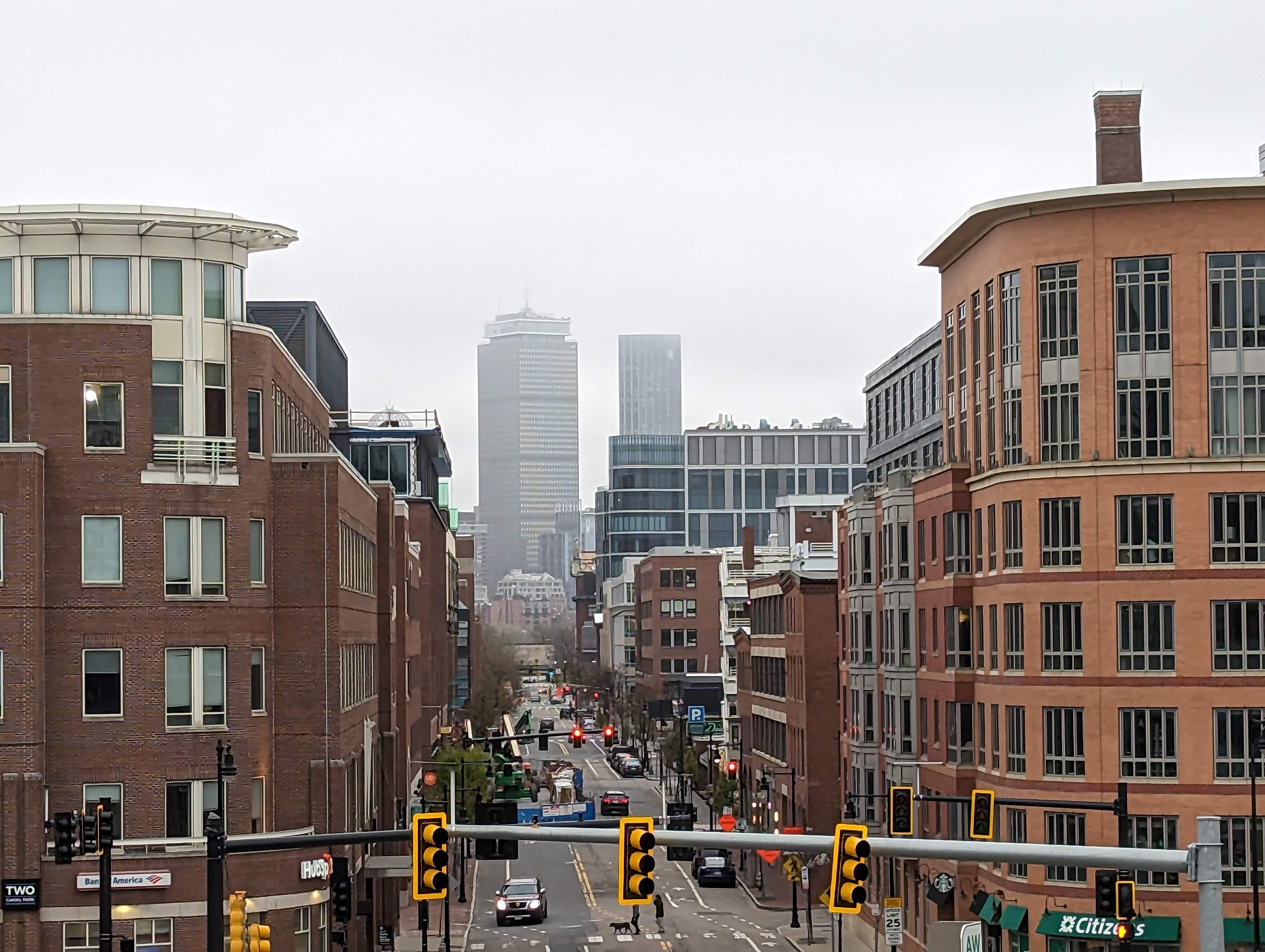
A majority of active lab tenants in Greater Boston are focusing on industry hub Cambridge as leasing options expand amid a 16 million-square-foot development pipeline. Photo by James Sanna | Banker & Tradesman Staff
The fundamentals of the nation’s largest life science market remained challenging throughout the first half of 2023. In Greater Boston, there has been a noticeable shift in the supply-demand balance, allowing tenants to choose from a variety of available spaces.
Vacancies are approaching levels not seen in over a decade, and average asking rents throughout the metro area have dropped by 6.3 percent since the historic peak in 2022. While new tenant demand, leasing activity and venture capital funding have adjusted from the pandemic-driven peak, the region’s development pipeline continues to exceed historical norms.
Currently, nearly 16 million square feet of new laboratory space is actively under construction, and demand has slowed to more sustainable levels, potentially leading to oversupply. Greater Boston remains the top destination for life science capital, with local firms raising over $3 billion in venture capital during the first half of 2023.
Deal velocity significantly slowed in the second quarter of 2023. Many early-stage and larger private companies are adopting a more conservative approach to their real estate needs, preserving cash and extending financial runways. Currently, there are 53 life science companies actively seeking space throughout the metro area, but total requirements have fallen to just 1.6 million square feet. Pre-pandemic, historical demand averaged approximately 2.5 million square feet, with demand reaching a frothy 5.4 million square feet in the fourth quarter of 2021.
Turbulent market conditions are creating more opportunities for users, with the majority of tenants focusing on core locations within Boston. Approximately 60 percent of active users are targeting Cambridge, and tenant interest is extending to Boston’s core suburban life science clusters, such as the Route 128 west market. Rising sublease options (currently at 2.3 million square feet) and the 1.5 million square feet of spec suites delivering by year-end 2024 provide tenants with more choices than ever, and this trend is expected to continue as new developments will be robust through 2025. Given the market’s uncertainty, tenant preferences may favor well-capitalized operators in core submarkets, as well as move-in-ready spaces.
Long-Run Outlook Remains Promising
Following a record-breaking 6.3 million square feet of deliveries in 2022, developers are on track to deliver another 7.8 million square feet of new space by the end of this year. Overall, Greater Boston’s laboratory inventory will have increased by 52 percent from 2021 to 2023.
As market conditions have adjusted, pre-leasing percentages have declined, with only 28 percent of space underway or being converted currently committed. While new projects continue to enter the pipeline, announcements have slowed considerably, and developers, particularly those proposing office-to-lab conversions, are reevaluating their plans. Operators are considering various uses beyond traditional research and development, including medical, office and advanced manufacturing.

Liz Berthelette
A few markets account for the majority of new construction, with 77 percent of active projects located in Cambridge, Boston’s Seaport, Somerville, Watertown and West – Route 128. The planning pipeline appears robust, although it remains unclear how much of the tens of millions of square feet of planned and permitted laboratory space will proceed in the near term. Without construction financing or significant pre-leasing, developers are less likely to initiate new projects.
Greater Boston’s laboratory sector presents a bifurcated outlook. While opportunities will emerge in the coming quarters, both tenants and investors will adopt a more risk-averse approach, benefiting established operators and biotech clusters. Continued interest in assets in core submarkets like Kendall Square will shape the short-term narrative.
With substantial new supply scheduled for delivery in the next 12 to 24 months, laboratory vacancies will rise further.
However, optimism about the long-term prospects of the life science sector and Greater Boston remains intact. New company formations and venture capital investments are likely to encourage tenants to expand in Greater Boston once a recovery takes hold. The region’s prominence as a global technology and biotechnology hub is unparalleled. An aging global population, the increasing pace of scientific discovery, and the growing emphasis on this industry will only strengthen the nation’s largest life science ecosystem.
Liz Berthelette is head of Northeast research and national life science research for Newmark.