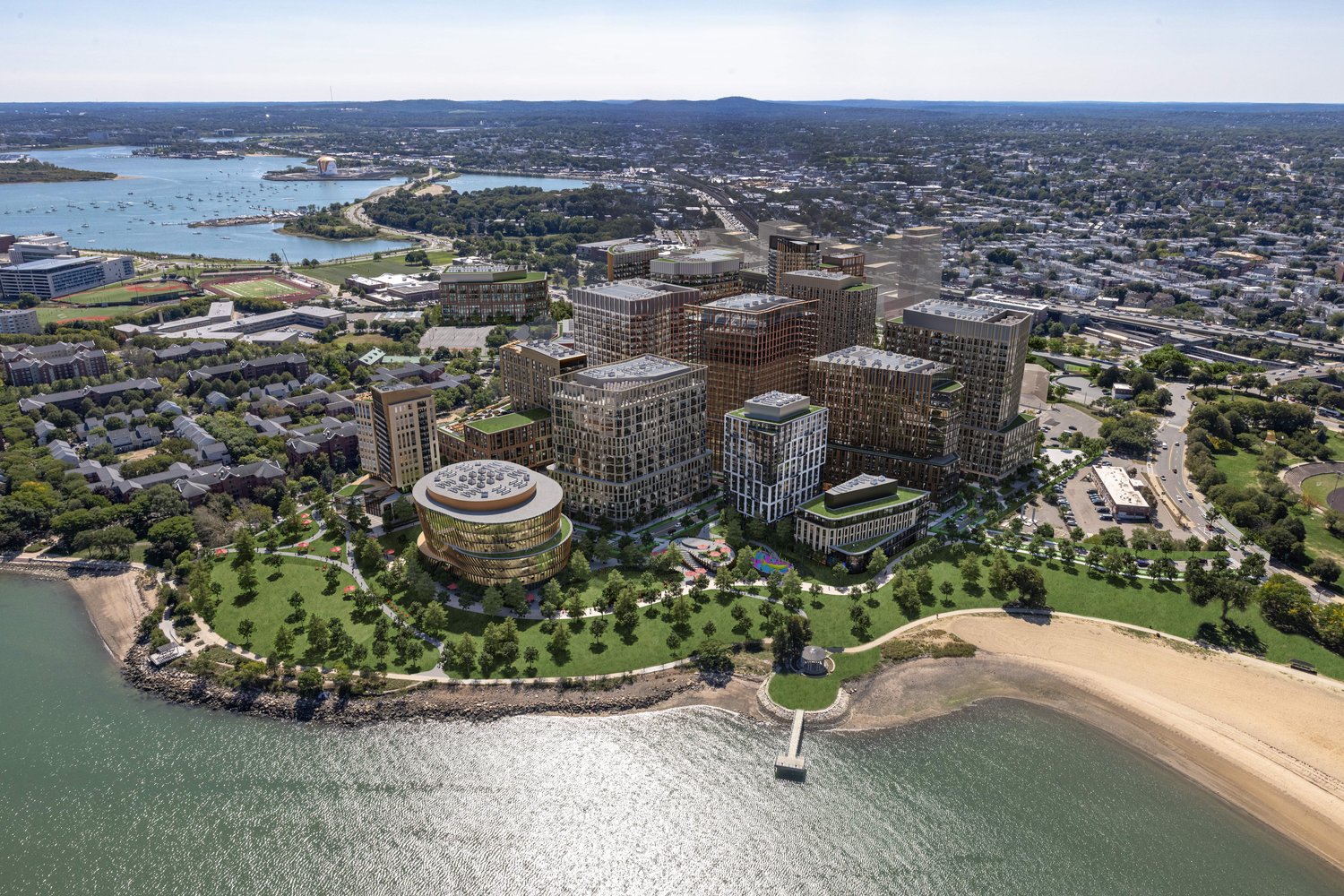
Approved in 2023, the Dorchester Bay City project would include 2,000 housing units on a 36-acre site at Columbia Point. Image courtesy of Stantec
The Healey administration’s nominations for the next round of federal Opportunity Zones in Massachusetts include the proposed New England Revolution stadium site in Everett, an emerging development corridor in South Boston and Harvard University’s Enterprise Research Campus in Allston.
The original federal Opportunity Zones program launched in 2017 and is set to expire Dec. 31. It was designed to stimulate investment in low-income neighborhoods, by letting real estate developers and operating businesses defer paying taxes on capital gains.
Some policy analysts say the original program failed to maximize its potential, however, by encouraging investment in major metropolitan areas already on the upswing.
A Brookings Institution report released last month concluded that investors favored Opportunity Zones in locations with existing demand, particularly for multifamily housing.
“When people traditionally think of economic development and incentives, they think of tools that are meant to increase demand: to increase jobs, for example, which then increases demand for housing and workers,” said Tracy Hadden Loh, one of the report’s authors and a fellow at the Brookings Metro research program. “Opportunity Zones are not doing that. They are responding to demand, and they’re going to places that have been unable to meet demand on their own because of other conditions such as poverty.”
Other observers say a lack of data reporting requirements made it difficult to assess the effects of the original program.
Changes approved under the 2025 One Big Beautiful Bill Act updated the program, allowing investors to defer capital gains for five years from each individual investment date, on a continuous rolling basis.
The Massachusetts Executive Office of Economic Development nominated 104 census tracts in 46 communities for the new program. The nominations, made public on Friday, would become final Jan. 1, pending approval by the U.S. Department of the Treasury.
Notable Districts Nominated
Here are some of the most notable districts included in the state’s nominations, which also includes the downtowns of nearly all of Massachusetts’ 26 Gateway Cities:
Amherst: The tract includes a large portion of the University of Massachusetts-Amherst campus, including the recently announced Food Innovation Hub research center.
Beverly/Gloucester Crossing/North Beverly: Includes the Cummings Center business campus and the newly-completed Beverly Landing multifamily development, along with potential additional commercial and residential development capacity.
Columbia Point, Boston: The peninsula includes the Dorchester Bay City site, which was approved in 2023 for nearly 2,000 housing units and 4.4 million square feet of office-lab space.
Dorchester Avenue, South Boston: Boston officials have approved several major developments in the past decade, including Core Investments’ On the Dot. The HYM Investment Group in September submitted preliminary plans for a 1.8 million square-foot mixed-use project at 314-420 Dorchester Ave.
Everett Docklands/Commercial Triangle: The area contains the epicenter of Everett’s recent multifamily construction boom and The Davis Companies’ Docklands mixed use development and The Kraft Group’s proposed New England Revolution soccer stadium.
Fall River and New Bedford: The adjacent South Coast cities are trying to attract market-rate housing and other developments following the arrival of MTBA commuter rail service, including New Bedford’s historic downtown and a former highway corridor that’s been turned into a boulevard to support up to 1,500 new homes.
Harvard Enterprise Research Campus, Allston: Harvard University and Tishman Speyer are partnering on development of the Enterprise Research Campus, which includes the 246-room Atlas Hotel, the David Rubenstein Treehouse conference center, an apartment complex and office/lab space. Roche’s Genentech subsidiary is the first tenant of the office-lab building, leasing 100,000 square feet.
MIT Cambridge: The tract includes portions of the MIT campus housing labs and research centers, where firms commercializing technologies can gain a competitive edge through the Opportunity Zone designation, according to a summary by the Healey administration.
Morrissey Boulevard, Boston: The commercial corridor includes 75 Morrissey Boulevard, which is approved for a pair of apartment towers.
Newmarket, Boston: Property owners recently renewed a Business Improvement District in the industrial heart of Boston, crediting a security program with reducing crime and open-air drug use. The district was rezoned in 2024 to allow a broader range of commercial uses.
South End, Boston: The district includes the former Flower Exchange site on Albany Street, where The Abbey Group of Boston received approval in 2018 for a 1.6 million square-foot office-lab development that has yet to break ground.
Union Square and East Somerville: An emerging development cluster around the MBTA Green Line Extension includes the 100 Chestnut St. lab project in Brickbottom and a potential apartment complex at 90 Washington St.
The State’s Map of New MA Opportunity Zones