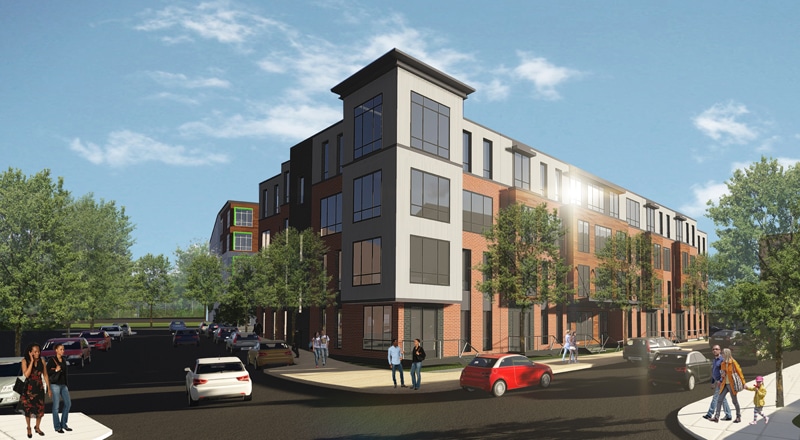
A 44-unit, all affordable apartment building at 25 Amory St. in Jamaica Plain’s Jackson Square neighborhood was approved last month.
Boston Mayor Marty Walsh’s ambitious Boston 2030 plan to manage the city’s expected population growth earns praise for meeting many of its lofty goals, but with more cuts in federal funding anticipated, making progress in creating affordable housing for Boston’s oldest and poorest residents is getting harder than ever.
First written in 2014, the plan has to date incorporated input from multiple city departments, housing advocates and roughly 14,000 residents. Progress on many of the metrics has been on or ahead of schedule thus far. Still, the most vulnerable populations struggle to find housing in the city.
The plan called for 53,000 units of new housing to be built by 2030. By the end of 2016, 12,001 had been built and another 7,237 were under construction, per the city’s two-year snapshot of its progress on the plan. Another 21,865 units are in the pipeline, putting the city 21 percent above its goal for 2016.
As a result of the increase in inventory, rents are beginning to decline in the older housing stock according to the two-year snapshot , and Sheila Dillon, director of Boston’s Department of Neighborhood Development, hopes that trend will continue.
“New development activity remains strong,” she said. “There are a lot of permit applications. People say the market is cooling, but we’re not seeing that. We’re pleased with the plan, but we’re concerned about the senior housing numbers.”
Loss Of Federal Funding Cuts Deep
Recent cuts to programs like the Housing and Urban Development’s Section 202 – funding dedicated to creating affordable housing for the elderly – means the city has to find creative new ways to provide financial incentives to developers to create housing for that population.
“The country has lost the federal 202 program, which was one of the best programs the federal government has ever had,” Dillon said. “It provided subsidies for elderly housing. That loss has been great. We’ve been putting out a lot of our land for this purpose. We issued an RFP on a beautiful site on the Neponset in Dorchester. There’s more money in the city’s budget for that purpose. We just haven’t seen the market respond to develop age-restricted development.”
For its part, MassHousing is trying to keep up with the demand for funding repairs to existing housing. The organization financed the preservation of seven low-income Boston apartment communities with $155.3 million in funds last year, a spokesperson for the department said. Tim Sullivan, executive director of MassHousing, echoed Dillon’s concerns that federal funding for affordable housing would see more cuts under the Trump administration.
“Of all kinds of housing,” Sullivan said, “building affordable housing is the most complicated because it’s the most resource-intensive. How we get at this is by new production. Unfortunately, my sense is there’s not going to be a lot more federal resources coming into the state.”
The city is also targeting existing affordable housing that is set to expire soon, trying to preserve those units as affordable. Dillon said it’s expensive and difficult, but vital.
“We track every single unit,” she said. “We know when the contracts are running out and we get ahead of them and talk to developers. It’s expensive because oftentimes there’s a sale involved. But it’s worth it, because if we lose them we’ll never, ever get them back.”
Of particular concern, Dillon says, are the 13A developments, which MassHousing is also focused on preserving. The affordability component on many of those protects has expired or will expire soon.
“Unlike federally funded developments, there are no tenant protections,” she said. “It’s probably our biggest challenge with preservation. We’re worried about them. That’s why since late 90s the city has required affordability in perpetuity.”
Advocates Focus On Low-Income Residents
Kathy Brown, coordinator for the Boston Tenants Coalition, has a lot of good things to say about Boston 2030. She also sits on Walsh’s Housing Task Force Boston and says the city is falling behind in meeting the housing needs of the poorest of the poor.
“I was recently at a ribbon-cutting in Jamaica Plain,” Brown said. “It was 39 units of affordable rental housing with many deeply affordable. The mayor came and spoke about how 2030 was going. A tenant spoke powerfully, too. It was all very nice, but there were 3,500 applicants for those 39 units.”
Brown said part of the problem is that the area median income (AMI) for the Boston census tract is skewed high by wealthy suburbs like Brookline, Lexington and Winchester. The median income for a renter in Boston is $41,000, she said; the Boston Planning & Development Agency calculates the AMI for a family of four at $103,400.
“I understand there has been some softening of rents and that’s good,” Brown said. “Low and moderate income people can’t afford market rents. So what if a rent goes from $2,400 a month to $2,200? It’s still way out of reach for many Boston residents.”
Sullivan said Massachusetts, and Boston in particular, are leading the country in creating housing for low income residents – Massachusetts is the only state in the country with a right to shelter law. Still, he concedes, there is much more work to be done.
“Of the 100 largest counties in the U.S., five of the top six counties for renting to residents with extremely low income are in Massachusetts and number one is Suffolk County, according to a study from the Urban Institute,” Sullivan said.
Brown praised the city for its accomplishments and for being so collaborative with hers and other organizations. She also said there is also a need for more and better policies to help low-income residents.
“Hopefully, the city will pass the notification ordinance where tenants are immediately notified of their rights when they’re being evicted,” Brown said. “We also hope just cause eviction will pass. Establishing the Office of Housing Stability is a really great thing. It’s focused on the issue of displacement. But you can’t build your way out of the affordable housing crisis.”
Brown thinks the city shouldn’t be selling public land to market-rate developers at all. She said public land should be set aside for the public.
“If the subsidies aren’t available to develop affordable housing, the city should just sit on it,” Brown said. “Put it in a landbank. Land is finite. It’s hard when the market is what it is. It’s a critical resource that we believe should be used for affordable housing. Not the top bidder. There are about 40,000 people on the public housing waiting list right now.”