King Street Properties is making a $45-million bet that “out-migration” of biotech and pharmaceutical companies from booming Cambridge is leading to ever stronger demand for laboratory space in the suburbs.
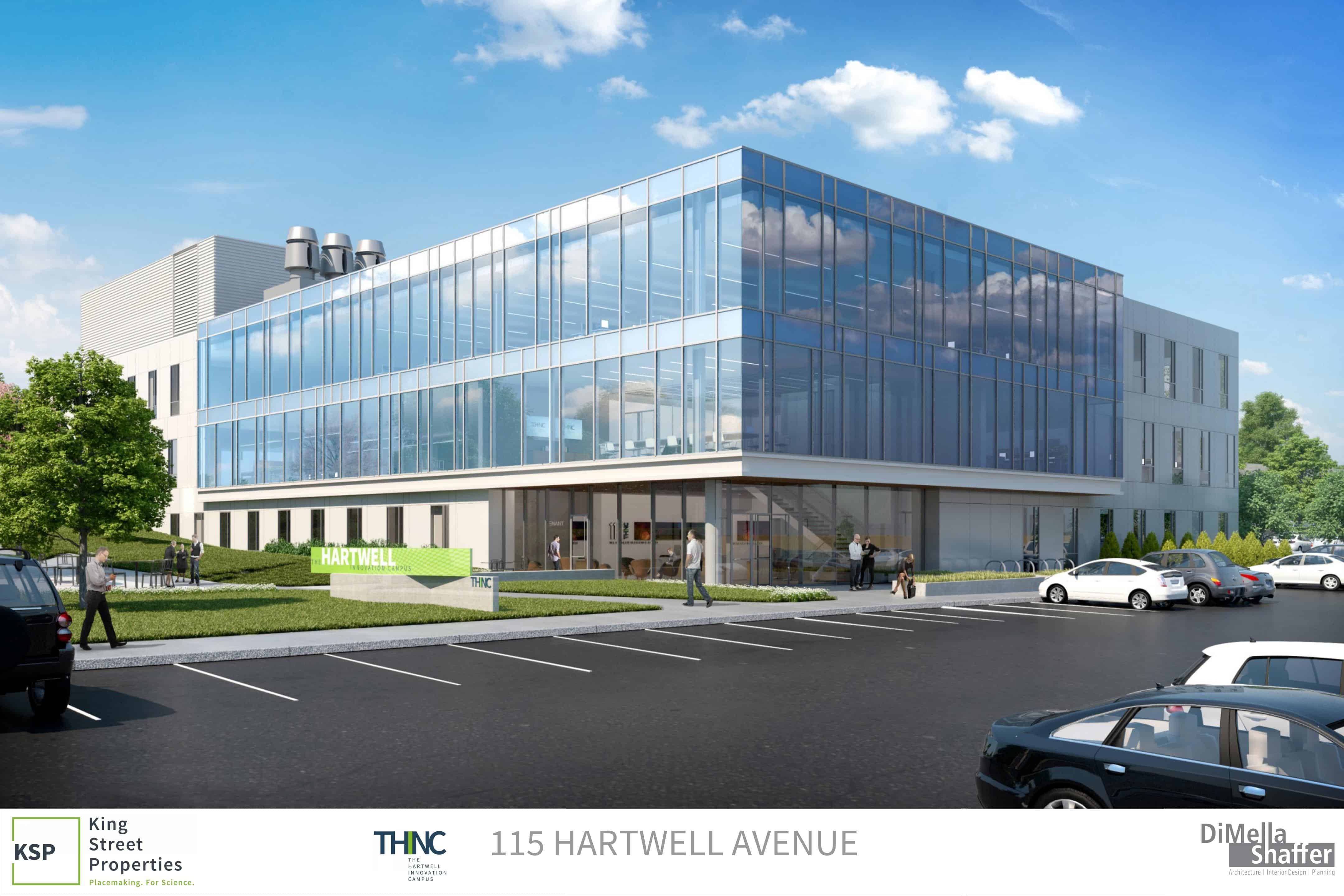
Earlier this fall, King Street, which has recently scooped up a number of lab space properties outside of Cambridge’s red-hot Kendall Square, broke ground on a new $45 million, 92,000-square-foot lab facility at 115 Hartwell Ave. in Lexington.
The catch: King Street Properties hasn’t signed up any tenants to fill the facility. It’s a pure speculative project on the developer’s part.
But Steve Lynch, a principal and co-owner of King Street Properties, believes it’s a low-risk bet to build a speculative lab facility in Lexington, considering the lack of available space in Cambridge’s Kendall Square. Skyrocketing rents for office and lab space there are putting the financial squeeze on many research firms.
“There’s a dogfight going on for available space in Cambridge,” said Lynch. “Simply put, Kendall Square is running out of space.”
So King Street is positioning itself to reap what it expects to be an increasing outmigration of tenants away from Kendall Square to other sections of Cambridge – and beyond, into the suburbs. King Street’s recent track record appears to bolster that theory.
Last fall, King Street bought Pfizer’s 200 CambridgePark Drive and 87 Cambridge Park Drive in the Alewife section of Cambridge. Since then, more than 300,000 square feet of lab space has already been leased.
Also last year, King Street spent $104 million to acquire Waltham’s 830 Winter St., a 182,000-square-foot lab facility already leased to anchor tenants ImmunoGen and GlaxoSmithKline. Lynch said the 830 Winter St. deal was itself a bet that the demand for suburban laboratory space will remain strong for years to come in the Boston area.
Price Differential Is Key
But developing a suburban spec building without tenants lined up is a completely different matter.
King Street is actually constructing 115 Hartwell at what it’s calling The Hartwell Innovation Campus, or THINC, where earlier this decade King Street purchased, renovated and leased out three previous single-story industrial buildings that are now used as life science research facilities. Three of the seven firms in those buildings, totaling 185,000 square feet, are leased by firms previously based in Cambridge.
And that’s why King Street is confident that 115 Hartwell, now being built on adjacent land, will succeed in drawing firms away from Cambridge to Lexington, Lynch said.
It’s not just Lynch who’s optimistic the THINC spec building will be scooped up quickly by tenants.
“It’s a smart move by King Street,” said Kevin Hanna, executive managing director at commercial real estate firm Cushman & Wakefield in Boston. “They’re sort of being out front on this trend.”
Hanna said he already knows of potential tenants eyeing 115 Hartwell as a future home after the facility is completed in early 2017.
Don Domoretsky, executive vice president of the regional life science practice at JLL, confirmed there’s “very active interest” for space at 115 Hartwell. Some of those interested are from Cambridge, said Domoretsky, whose firm is handling the 115 Hartwell leasing on behalf of King Street.
“The market is ripe for this type of property,” Domoretsky said.
He noted that the demand for lab space in Cambridge and the “core suburban” lab market – comprised of Bedford, Lexington and Waltham – is now running at about 3 million square feet. But only 750,000 square feet of lab space is available in those four communities.
“The market is starved for supply,” Domoretsky said.
Ultimately, the key for 115 Hartwell is the pricing difference between Cambridge and the suburbs. The price differential between those two markets can range from $20 to $30 per square foot.
There’s also nonfinancial challenges to convincing life science firms to locate outside of Cambridge. The intense cluster of life science firms is attractive for those wanting to collaborate with professionals at other companies and institutions, such as the Massachusetts Institute of Technology. Many younger workers are also increasingly adamant that they want to live and work in urban settings, not the suburbs.
But Lynch said some “mature” life science companies – or those with products either on the market or about to come to market – don’t need as much research collaboration as other firms. They also have a different labor force composition.
“They need sales people and HR people and other non-scientists,” Lynch said. “Often, those are the type of (life science) companies moving away from Cambridge.”
Email: jayfitzmedia@gmail.com