Boston’s new clean energy zoning could enable Flatiron Energy to resume attempts to build a 300-megawatt battery storage facility on Electric Avenue in Brighton. Image courtesy of RODE Architects
Power sources are shifting from distant fossil fuel-burning plants to solar, wind and battery storage facilities located closer to residential neighborhoods, setting up new real estate permitting battlegrounds.
Boston’s adoption of new clean energy zoning could ease the path to approval for Project Lite Brite, a 62,000 square-foot battery storage facility in Brighton.
Changes under the state’s 2024 climate bill were designed to streamline permitting for clean energy projects of all sizes in Massachusetts.
“Timelines were just becoming pretty unsustainable with the appeals and legal challenges,” said Gregory Sampson, a partner at law firm Sullivan & Worcester in Boston. “It’s intended to avoid multiple levels and layers of appeals.”
Batteries on Electric Avenue
Flatiron Energy of Denver proposed Project Lite Brite on a 2.8-acre site at 35 Electric Ave. in Boston’s Brighton neighborhood, currently occupied by a construction company. The project attracted opposition from neighbors and elected officials before pausing its permitting in June 2025.
In a public comment letter to the Boston Planning Department, state Sen. William Brownsberger raised concerns about fire risk from lithium-ion batteries near a densely populated residential neighborhood. Such fires require significantly more water to put out than traditional fires.
But under Boston’s new clean energy zoning, approved by the Boston Planning & Development Agency board this month and subject to final approval by the Zoning Commission, the project’s size enables it to bypass local approvals, a BPDA spokesperson said.
Its fate now rests with the state Energy Facilities Siting Board (EFSB), which reviews large energy projects, and has a 15-month maximum review period.
Flatiron Energy did not respond to requests for comment. The company paused its Boston permitting in June 2025, pending passage of new regulations on battery storage.
In previous application materials to the Boston Planning Department, Flatiron Energy said the project would help fill the gap created by the 2024 closure of the Mystic Generating Station in Everett and provide storage for future offshore wind energy projects.
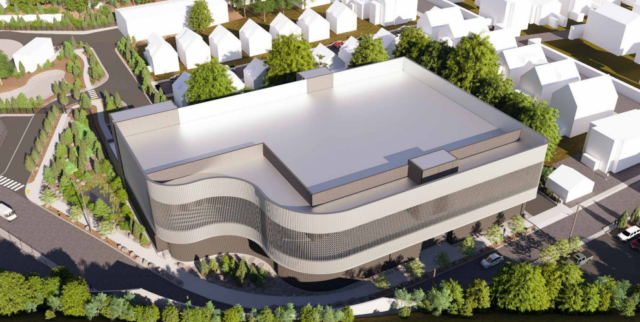
Public comments against Flatiron Energy’s Project Lite Brite in Brighton included risks of fire from lithium-ion battery storage and proximity to nearby homes. Image courtesy of RODE Architects
Tewksbury, Everett, Duxbury Projects Advance
Large-scale battery storage facilities like Project Lite Brite have become a flashpoint for public opposition in many communities where they’ve been proposed.
In June, the EFSB approved Hillman Energy Center’s battery storage facility on a 4.3-acre site at 73 Hillman St. in Tewksbury, along with a 1,200-foot transmission line connecting to a National Grid substation. The project will store electricity for connection to the electric grid during peak demand times.
And in February, the board approved Massachusetts’ largest battery storage facility to-date: Jupiter Power’s 700-megawatt project at the former Exxon Mobil tank farm in Everett.
Stand-alone solar projects also are easier to permit following a 2025 Massachusetts Land Court ruling.
The court ruled that such projects are protected from unreasonable zoning restrictions under the Dover amendment, a state law that limits communities’ zoning powers over certain types of projects.
The lawsuit was brought by New Leaf Energy after the Duxbury Zoning Board of Appeals rejected its proposed 5-megawatt battery storage facility behind a residential neighborhood.

Steve Adams
A 12-Month Shot Clock for Small Projects
Enacted in 2024, “An Act Promoting a Clean Energy Grid” set up a two-tiered system for reviewing clean energy projects in Massachusetts. The law is designed to support the state’s climate policy shifting away from greenhouse gas-emitting fossil fuel sources.
It gives cities and towns an Oct. 1 deadline to adopt zoning for small clean energy facilities, which applies to projects that fall below certain size thresholds. Developers of small solar, wind, short transmission lines and battery storage now have an optional fast-track path to local approval. They can request approval under a consolidated permit, giving a city or town 12 months to approve or deny a project.
“It’s intended as an option for the more complex projects where the applications get stuck in a little bit of purgatory,” said Jeremy Koo, assistant director of clean energy at Metropolitan Area Planning Council.
State regulations set baseline standards for safety, public health and environmental protections, although communities can set more stringent standards, Koo said.
The Boston Planning & Development Agency board approved the city’s new small clean energy zoning at its Aug. 13 meeting. It allows accessory battery storage systems under 400 square feet as an allowed use in all zoning districts. Previously, Boston zoning didn’t have a specific use category for battery storage.
Such equipment is similar to ground-source heat pumps and is likely to comprise the bulk of activity in Boston, planners told the BPDA board.
Many smaller communities have yet to adopt the small clean energy zoning, Koo said, leaving them vulnerable if regulations aren’t in place by Oct. 1.
Sullivan & Worcester’s Sampson said the consolidated permit option will be attractive to developers.
“If you know you are facing significant opposition, you may want to go that route because you know there is a little more certainty with the appeals process,” he said. “It’s obviously untested at this point, but the presumption is if you check all the right boxes and have the right type of site, you expect a pathway to approval under this process.”