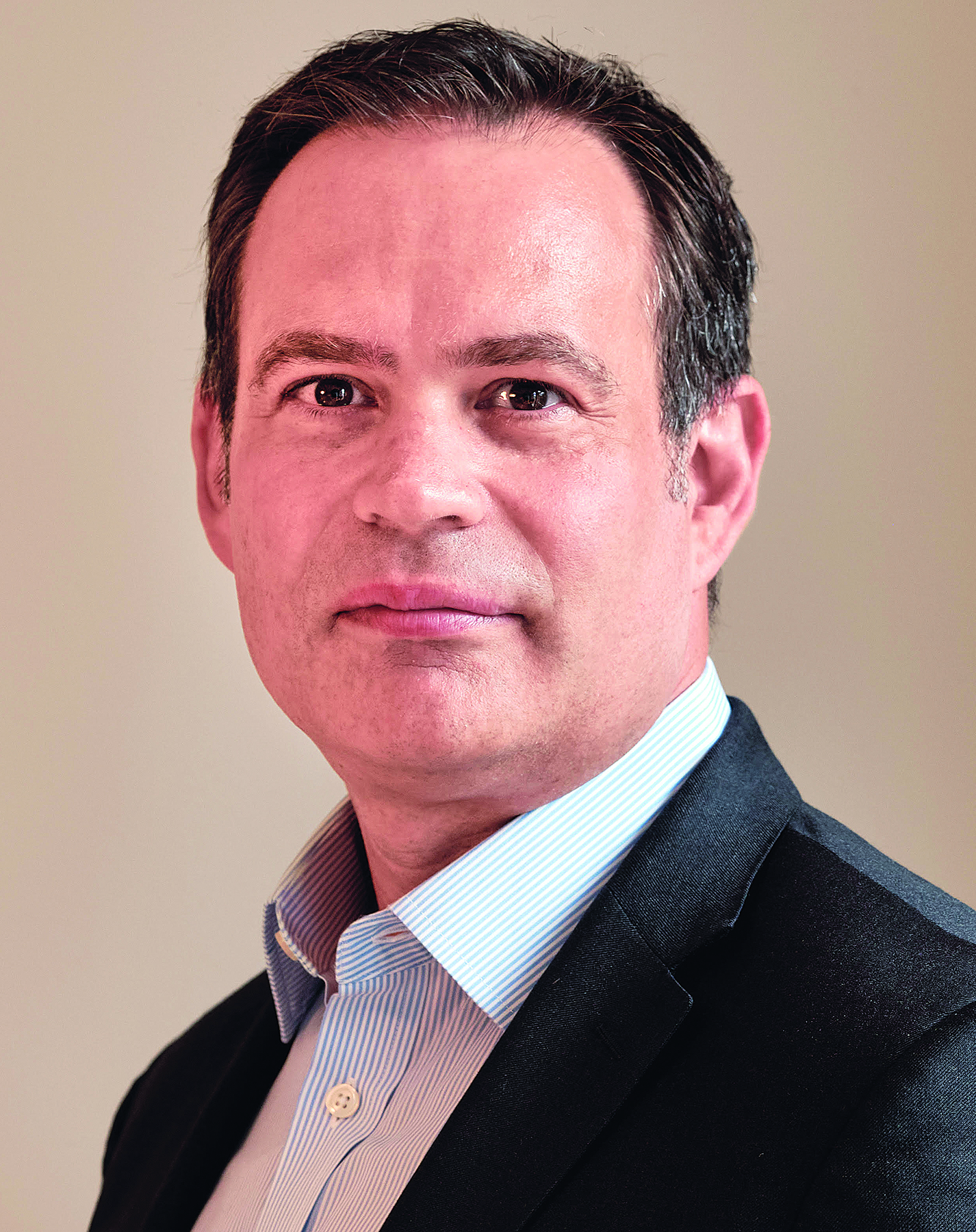
Photo courtesy of LabShares
Philip Borden
CEO, LabShares
Age: 51
Industry experience: 26 years
In a prolonged biotech industry and real estate slump, one lab space provider is bucking the trend and expanding its Greater Boston portfolio. LabShares is scheduled to open its third location this week at 66 Galen St. in Watertown. Philip Borden, a venture capital and private equity industry veteran, and investor Pacific Lake Partners, acquired a majority stake in LabShares in 2023, with Borden assuming the CEO role. The Newton-based company was founded in 2018 and opened locations at 55 Chapel St. and 90 Bridge St., before signing on last fall as a major tenant at The Davis Companies’ new life science development in Watertown.
Q: You must have your hands full with the new location set to open this month. What’s the schedule for the phased buildout?
A: It’s an incredibly busy time for us right now. We signed the lease at our new location in November for 58,000 square feet, and the first phase opens in April. That’s about 10,000 square feet, and phase two will open in November. We’re working with [property owner] The Davis Companies on the buildout of the space. Phase one is going to be done much more quickly, because it was already a spec suite on the second floor where we’re doing some minor conversions. And then we have the entire first floor of the building for phase two. We’re responsible for all of the equipment that’s going into the facility.
We don’t provide just space to our members, but we’re providing them a fully equipped lab that’s in many ways turnkey for them. We take care of the permitting and regulatory. That’s one of the real value propositions is you can get your lab up and running literally in a couple of days. That makes it much more time-efficient and capital-efficient for companies. Space is less than half of the value of what we’re delivering. The two other pieces are the equipment that we provide on a shared basis: millions worth of advanced lab equipment that we monitor and maintain. We have the OEM contracts. And the third piece is the back-end lab services: permitting and regulatory, safety, on-site management.
Q: Given that you had existing locations in Newton, how wide a search did you make before settling on 66 Galen St. near Newton Corner?
A: We did a very broad search when we were evaluating opportunities. As I probably don’t need to tell your readers, there’s no shortage of lab space that’s available. We visited 23 buildings, but we really concentrated in Watertown, Somerville, Allston and Brighton. We didn’t focus that much in Kendall Square, nor did we focus on the Seaport. And the reason for that is our fundamental belief is that the locus of innovation is shifting from Kendall Square to places like Watertown in particular. Kendall Square is always going to be a big deal. We don’t see any changing, but it’s increasingly the home for large biotech and large pharma. Innovative smaller companies are increasingly moving to Watertown and other areas that we call the Goldilocks Zone of Boston biotech. They’re close enough to get into Kendall Square, to get to the airport, to have board meetings. But they’re far enough out that they’re a little bit less expensive. They have things like free parking, which we offer at all of our facilities and you don’t have to fight the traffic. We have a ton of public transportation options at our new location too. That was a big advantage for us.
Q: What is LabShares’ typical member profile?
A: LabShares is different than what you might be more familiar with, traditional incubators. We don’t consider ourselves an incubator. We do have some of the earliest stage companies here, but we also have publicly traded companies and everything in between. So for us, a typical profile might be a series A or series B company, but it could be a publicly traded company. Companies that have between two and 30 scientists are the right profile for us. At that level and below, a shared laboratory is highly compelling, versus going out and building out your own lab, taking on your own lease or sublease. We’ve done math on this to show the savings in the total cost of ownership. Lots of people just think about it in terms of dollars per square foot, but companies are increasingly thinking, “What’s my total cost of operating my lab?” We have an all-inclusive model that we think compares very, very favorably to even really cheap leases and subleases, because we offer all of these other extras around it.
Q: How many suites and availabilities do you have in phase one at 66 Galen?
A: We’ve got five private suites available, and we are in contract negotiations with our first couple. We’ve had significant interest and our pipeline is as deep and rich as we’ve ever had. Phase two will have 23 private suites, and we do already have people who are expressing interest.
Q: Which applications could AI potentially replace in terms of traditional lab space physical activities?
A: AI is good at some elements of chemistry, for instance, they’re good at helping to narrow down the wide range of things that you might attack into a smaller subset. AI is not replacing the wet lab though. Some people think, you just don’t need a wet lab anymore, and you can do it all “in silico.” That’s absolutely not true. We think AI is a tool that allows you to narrow down your list of targets to a much more manageable list or identify which targets are the most attractive. But it doesn’t fundamentally change the need for wet labs.
Q: As a former venture capital executive, what trends are you seeing in private investment markets for biotech in 2026?
A: It is hard to predict, but we are seeing the start of an uptick across the board in biotech. So, what are the leading indicators of biotech? I think of three. What’s the public market performance? Stocks are up 100 percent [from April 2025 through February 2026]. M&A activity has been going strong recently. Pharma’s got more money than they know what to do with, so they need to replenish their pipelines. And then three IPOs. You’re seeing all of those three things pointing way up right now. That doesn’t immediately lead to venture capitalists spending more money, but we’re confident that’s going to happen.
I think Boston has been, and will continue to be, the home for the most innovative companies and opportunities, and that’s why we’re expanding here. We could have gone to many other locations, and we decided that Boston was the right place for us to locate. Some of the lower value-added elements of the biotech industry are increasingly being outsourced. You will see chemistry work being outsourced, or low-end bioanalytical work. But in terms of the newest science, there’s a critical mass that we’ve built here of universities and venture capitalists, that is incredibly hard to replicate. We believe that Boston is not going to lose its leadership position. It’s just going to look a little different than it has. We think that plays well into what we’re providing to our customers. Smaller labs are the future for Boston and other U.S.-based biotech hubs.
Borden’s Five Favorite Places in Massachusetts
- Harvard Book Store, Cambridge
- The outdoor patio at Oleana, Cambridge
- Mass MoCA, North Adams
- Lou’s, Harvard Square
- Wingaersheek Beach, Gloucester