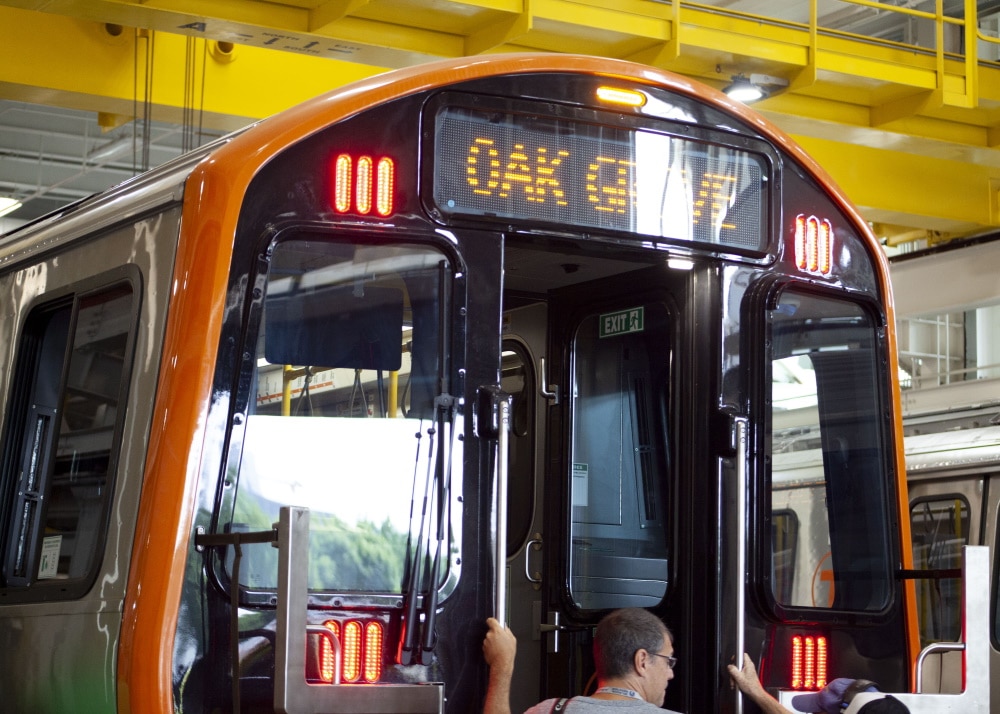
Members of the media tour a then-new Orange Line train at the MBTA's Wellington maintenance facility in August 2019. State House News Service photo / File
The financial and policy analysts at the Massachusetts Taxpayers Foundation have mapped out how “the path to a safe and reliable transit system just got a lot longer” thanks to a ballooning price tag for bringing the MBTA’s infrastructure into a state of good repair.
The MBTA updated its state of good repair measurement last month – using a slightly different calculation than resulted in the 2019 estimate of about $10 billion, as MTF explains in the brief it published Wednesday – to show that it would now cost $24.5 billion to fix all MBTA assets that are not in a state of good repair, which is almost two-thirds of them.
And that figure includes only the cost of addressing current problems, not “needed investments in modernization, electrifications, accessibility, climate resiliency or expanded services” including those that the T included in a 2021 framework unconstrained by available funding, MTF said.
In order to make those investments and eliminate the new repair backlog estimate, MTF said that the MBTA would need to increase annual capital spending above the 2019 target of $1.4 billion by “approximately $2 billion per year as a starting point.” That’s what MTF called “the scary part,” noting that the T already didn’t have the resources necessary to address the older estimate.
“Given that the MBTA lacks sufficient resources to even manage the previous $10 billion [state of good repair] Index, let alone the projects in the unconstrained 10-year spending framework, an additional $2 billion in capital needs puts the capital gap at near unsurmountable levels … climbing to an average of $3 billion annually for [fiscal year] 2025 through [fiscal year] 2031,” the foundation wrote.
The implications of the repair backlog and how it affects public transit service through and around the largest city in New England are gigantic.
“If the MBTA cannot return to safe and reliable service, the Boston economy cannot recover,” MTF wrote. The brief also declared that the consequences of continuing with a majority of MBTA assets out of repair “would be catastrophic to the regional economy and the impacts would fall on transit-dependent communities and those who have few affordable transportation alternatives.”
Gov. Maura Healey said two weeks ago that she has been talking with state lawmakers and unnamed “stakeholders” about what kinds of taxes and fees are necessary to address the massive list of infrastructure needs at the MBTA. She told WBUR that “it’s going to take a lot of thinking about how to get there in terms of the kind of revenue that we need for that.”
Shortly after the report was released, Greater Boston Chamber of Commerce President and CEO Jim Rooney urged lawmakers to find a solution.
“This report highlights that the Commonwealth urgently needs to meet these challenges with financial strategies and solutions, including aligning the long-term funding requirements and pricing of mobility. In addition to the MBTA needs that are well documented in the MTF paper, the financing plan needs to consider the critical repairs of roads and bridges throughout the state. Transportation impacts commerce, the quality of life and future of every person, and the Commonwealth’s ability to attract and retain talent. Not only will efficient and safe transportation move people forward, but strong transportation systems will also help address the housing crisis, climate goals, downtown vitality, as well as economic access and equity,” he said in a statement.