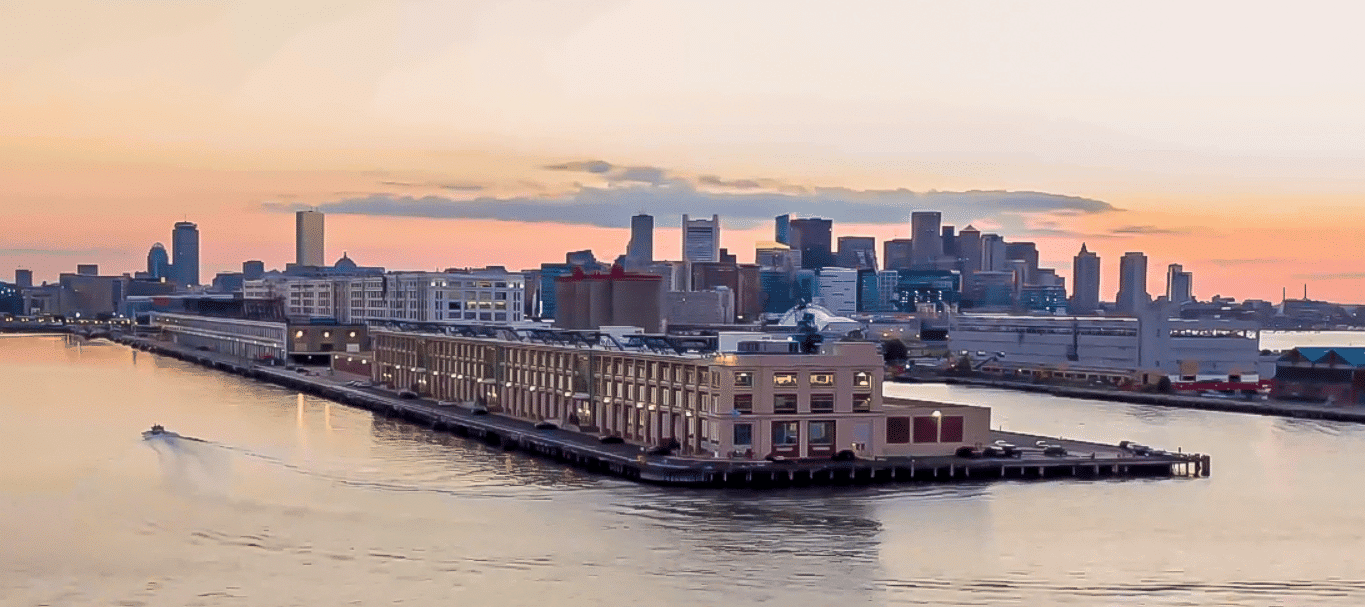
Pier 10 in the Raymond L. Flynn Marine Park. Photo courtesy The Davis Cos.
Neither the North-South Rail Link nor the MBTA’s proposed Route 7 bus on Congress Street yet exist to connect commuters from north of Boston to a growing area of the Seaport District.
But commuters just got an option to add a little more fluidity to their commute. And Seaport landlords just got a new amenity to promote to potential tenants.
The quasi-public Massachusetts Convention Center Authority and the Seaport Transportation Management Association – a private entity funded and run by Seaport employers and landowners – have launched a new ferry linking the MBTA’s North Station and the Raymond L. Flynn Marine Park. The two entities already operate a ferry service between East Boston and Fan Pier, and between North Station and Fan Pier; the latter route is being extended to add a connection to Pier 10 on the north side of the Innovation and Design Building.
Construction on the new ferry dock finished in May and the extended route began operations in June. The ferry operates Monday through Friday year-round every 20 minutes during the morning and evening commutes for $5 per ticket. Employees and tenants of the funding companies can use the service for free.
The celebration Monday drew grandees like Boston Mayor Michelle Wu and statements of support from major Seaport District employers.
“Expanding water transportation will boost economic activity and also provide important commuter alternatives that can ease traffic,” Boston Mayor Michelle Wu said in a statement. “This new commuter ferry stop at Pier 10 in the Raymond L. Flynn Marine Park builds on our administration’s efforts to give residents more options to get around safely while making significant investments that better connect our communities. I’m grateful to all of our public and private partners for their leadership in stepping up to get this transformative project done.”
Construction on the new ferry stop at Pier 10 in the park was funded with a $2.5 million grant from the city of Boston and the first two years of service are being funded by a grant from the Massachusetts Department of Transportation. Once it’s established, major neighborhood landlords and employers like Innovation and Design Building owner Jamestown Properties, Related Beal, The Davis Companies, Beacon Capital Partners and Vertex Pharmaceuticals will provide ongoing funding, Wu’s office said.
“Davis and our tenants at 88 Black Falcon Pier are grateful to the leadership at the City of Boston and the Seaport Transportation Management Association for their ongoing support and management of the new dock at Pier 10,” Davis Companies Director of Leasing Duncan Gilkey said in a statement provided by Wu’s office. “The new ferry service at the end of Black Falcon and Drydock Avenues will greatly enhance neighborhood accessibility and give our tenants, their employees and visitors a fast and efficient way to travel to and from Lovejoy Wharf near North Station, the Seaport’s Fan Pier and the Eastern Seaport neighborhood.”
As the Seaport District filled up in the years before and during the COVID-19 pandemic, major developers began turning their attention towards under-used or vacant sites in the Flynn Marine Park around the Innovation and Design Building, with The Davis Companies proposing a large, multi-story addition to 88 Black Falcon at the very tip of Pier 10 itself.
Marcus Partners’ Foundry at Drydock – once slated to be the home of major life science firm Ginko Bioworks – the first half of MP Boston’s spec-built South Boston Innovation Campus and Related Beal’s Innovation Square campus, set to house 345,000 square feet of research space for Vertex Pharmaceuticals, rose before the post-pandemic collapse in funding for life science companies.
But with many companies, like Ginko Bioworks, either pulling back from planned expansions or sitting on their hands, the Greater Boston biotech market’s availability rate has hit 29.7 percent region-wide and 44 percent in the Seaport District, according to second-quarter figures from commercial brokerage Colliers. And both prominent economists and the main statwide biotech industry trade group predict challenges for the sector, at best, and shrinkage at worst as the Trump administration slashes funding for early-stage drug pipelines.