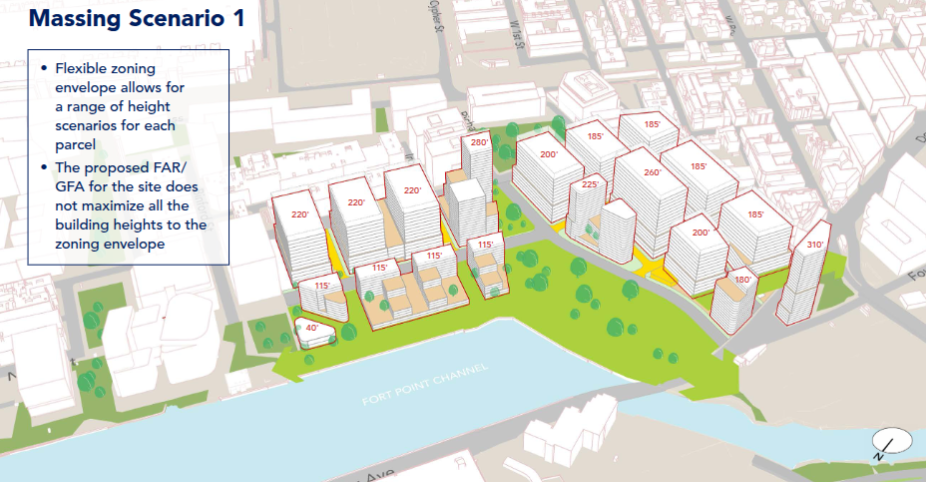
One of several massing scenarios presented for redevelopment of the Gillette campus in South Boston. Image courtesy of CBT Architects
Boston officials asked Gillette for a “healthy and balanced neighborhood” with more multifamily housing at the expense of commercial and life science space in its redevelopment of the 31-acre South Boston property.
The razor maker is seeking approval of a master plan for 5.7 million square feet of commercial and residential development. More than 20 buildings could rise on the site next to Fort Point Channel over the next two decades, according to submissions to the Boston Planning Department.
In a feedback letter from city departments, Gillette is asked to maintain a 33 percent housing component across the entire project, or approximately 1.9 million square feet.
“The city would like the proponent to revise the use mix for the project to one that is centered around creating a vibrant, mixed-use neighborhood as an alternative to the master plan filing, which heavily prioritizes commercial and life sciences development,” municipal departments wrote in the consolidated feedback report completed last week.
The project currently indicates residential uses would amount to 30 percent of the project’s overall floor area ratio.
Planners added that the city is “open to considering greater density as a trade-off” for meeting housing affordability and neighborhood goals.
Gillette is relocating its manufacturing operations to an existing campus on Burtt Road in Andover, freeing up the South Boston property for redevelopment.
In 2025, Gillette kicked off the formal permitting for the redevelopment, presenting plans for 3.5 million square feet of office and R&D space, a 250,000 square-foot hotel and 200,000 square feet of retail and restaurant space. The housing component was estimated at 1.7 million square feet.
But city officials indicate they would like to see Gillette devote an equal amount of square-footage to multifamily housing and commercial space, each comprising 33 percent of the overall buildout.
The remaining third could include residential uses, along with civic and cultural, retail, institutional and hotel uses, the report states.
Gillette spokesperson Kara Buckley said the company will “contemplate revisions” to the initial master plan filing in the coming months, reflecting the scoping document and upcoming community meetings.
“This robust scoping document will help guide us on what to prioritize to create a project that is feasible, offers positive benefits to the community and continues Gillette’s long legacy in South Boston,” Buckley said in a statement.
The report endorsed Gillette’s plans for a 6.5-acre waterfront park, adding that buildings should be designed with dawn-to-dusk shadow impacts in mind, and the parkland conveyed to the Parks and Recreation Department.
To meet the city’s Net Zero Carbon policy, developers are encouraged to consider microgrids or district energy systems for the site’s electric load.
The transportation analysis asks for construction of a new headhouse for the MBTA’s Broadway station on the Gillette property, and a reduction in the proposed 4,489 accessory parking spaces, most of which would be built below-grade.