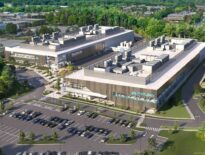
Competition among Boston office landlords is intensifying amid lingering vacancies, but buildings that complete significant capital improvement projects can stand out from the pack. Photo by James Sanna | Banker & Tradesman Staff
In-person work is rising. Boston office attendance climbed roughly 4 percent year over year in 2025, ahead of the national average of 3.2 percent. But tenants are not returning evenly across the market. Demand is concentrating in a smaller group of buildings that offer a distinctly better workplace experience.
JLL’s latest Boston Office Outlook report captured the divide. Downtown vacancy reached 23.6 percent following the delivery of South Station Tower and 10 World Trade Center, even as the number of full-floor tenants actively searching for space jumped 77 percent quarter over quarter. Companies including Schneider Electric and Hasbro have recently committed to major new office footprints in Boston.
The issue is not whether companies still value the office. It is what kind of office they are willing to invest in.
Increasingly, the market is separating commodity office space from buildings that function as destinations. The middle ground – buildings that offer neither a compelling experience nor a clear value proposition – is becoming harder to sustain.
Tenants are no longer evaluating buildings solely through the lens of efficiency. They are touring buildings with a different question in mind: Can I see my team wanting to be here?
The Gap Is Widening
For years, many owners approached repositioning through traditional refresh strategies: upgraded lobbies, amenity additions, cosmetic renovations and incremental tenant improvements. Those investments still matter, but their impact is becoming more uneven across the market.
Capital and tenant demand are increasingly concentrated in buildings that deliver a materially different workplace experience, including recently repositioned towers or assets with the scale to support hospitality-driven environments and stronger building identity.
Meanwhile, buildings relying primarily on piecemeal upgrades are finding those improvements no longer translate into meaningful leasing differentiation. Cosmetic enhancements alone often do not change how tenants evaluate a building. In some cases, owners are already revisiting amenity investments made just a few years ago as tenant expectations continue to evolve.
As a result, performance is diverging more sharply between buildings that can reimagine the workplace experience and those that remain within a traditional refresh cycle.
The Office Has New Competition
Today, office buildings are no longer competing primarily with one another.
They are competing against the convenience, personalization and flexibility people have become accustomed to elsewhere, including highly personalized home environments, hospitality-driven experiences and digital tools that increasingly handle routine desk work.
Buildings that cannot offer a meaningfully better experience than a well-equipped home office face growing competitive pressure.
That shift is changing what tenants value. Gensler’s 2026 Global Workplace Survey found employees currently spend about 54 percent of their workweek in the office, though they report an ideal closer to 61 percent. The gap points less to rejection of the office than to a mismatch between what workplaces deliver and what employees now expect.
The survey also found that two-thirds of office workers globally report “hacking” their workspaces to compensate for shortcomings in the environment. The challenge is no longer getting people back to the office. It is creating environments that meet their expectations once they arrive.
Hospitality as the New Baseline
The workplace now competes with hospitality, residential and cultural experiences, not just other office buildings.
The test is whether a tenant would feel confident bringing a recruit, a board member, or a major client through the front door. Concierge-style reception, welcoming gathering areas, hosting spaces and serious food programming, from cafés to communal kitchens, are becoming table stakes, not amenities.
For building owners, that shift is increasingly shaping repositioning strategies.

Patricia Nobre
The Chiofaro Company’s transformation of International Place combines a reimagined ground-floor experience, including new entrances, lobbies, and Winter Garden, with the introduction of the Aries Club, a 23,000-square-foot tenant amenity floor.
Together, these investments have helped attract close to 500,000 square feet of leasing activity over the past year.
Communal Space as Cultural Infrastructure
Communal spaces are where an organization’s identity becomes legible, or fails to register. They are not leftover square footage after the desks are placed – they are cultural infrastructure.
Gensler benchmarking shows amenity space allocations have increased from roughly 8 percent to 28 percent across industries. For class A landlords, this is a competitive lever. For class B owners weighing reinvestment, it is the central question: Does the building have the bones to support that infrastructure?

Todd Dundon
Boston’s office market is not running out of demand. It is redefining what demand looks like. The market is becoming increasingly unforgiving toward buildings that sit between commodity office space and experience-driven destinations.
That creates real challenges for aging office stock, but also a significant opportunity for owners willing to rethink the office as a destination and experience rather than simply a product.
The buildings that succeed over the next five years will not necessarily be the newest. They will be the ones that most effectively differentiate themselves in a market increasingly defined by experience.
Patricia Nobre is a principal and strategy leader at Gensler, and Todd Dundon is a Gensler principal and office buildings leader.