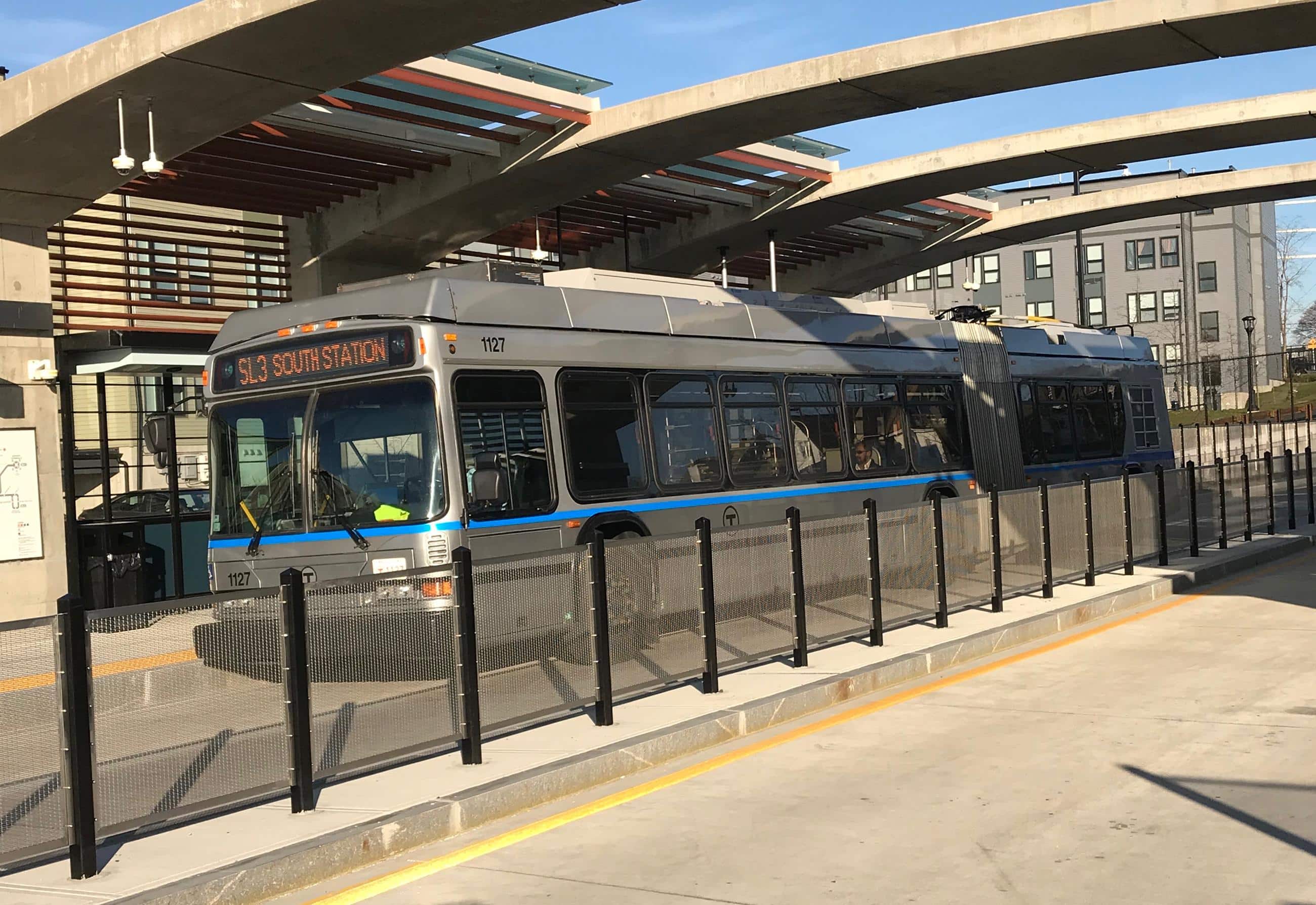
An SL3 bus waits for passengers at the MBTA's Box District station in Chelsea in this undated photo. Photo courtesy of the MBTA
Connecting Greater Boston’s “eds and meds” hubs with a rapid bus line would be explored under a budget amendment adopted by the House on Tuesday night.
The amendment requires a Department of Transportation study into creating a public transit corridor between Kendall Square in Cambridge into Allston and North Brighton, then south to Longwood Medical Center.
“It’s critically important for the life sciences and biotech, you’ve got that incubator in Kendall Square with MIT and Harvard Square has an extraordinary amount of life sciences going on, and a commuter rail stop coming into Allston at some point soon,” said Rep. Kevin Honan of Brighton, who put forward the language that was packed into a much larger amendment to the House’s annual state budget bill.
“With people coming in and out of the city going to the hospital and these life science hubs, in terms of economic development in Boston and the region, this is an important and dramatic step forward to connect these areas together,” Honan said.
Some parts of the route would map onto the old Grand Junction Rail corridor, a single-track freight line running from Allston through Cambridge to Somerville and North Station. That historic line has long been mooted as a right-of-way for new subway, commuter rail or light rail lines and is key to the infrastructure planning in this area, as is a promised commuter rail station located in the Beacon Park Yard area of Allston.
The Grand Junction tracks are currently used by the MBTA to move commuter rail trains to and from its main maintenance facility near North Station, a challenge that would have to be overcome by any attempt to reuse the right-of-way.
Designed to serve the Framingham/Worcester Line, the future West Station is intended to bridge the gap between nearby Brighton/Allston station Boston Landing and Landsdowne Station in the Fenway area. It’ll also better connect the area to bus routes and, from there, the MBTA Green Line’s B branch.
“We’re increasing [public transit] quite a bit in that area with the commuter rail, but going from Kendall Square to Longwood Medical, that will help the eds and meds – I can’t think of anything that would be more helpful to our economy than this. Education, health care, training. It’s all there,” Honan said.
He recognized that “it needs to be studied” as there are concerns about additional traffic on Commonwealth Ave. and Washington St. in Boston. Bus rapid transit has its own dedicated bus lane.
“It’s still mass transit, which is what we want to do. Less cars,” Honan said.
The MBTA currently operates bus rapid transit service to the Seaport, Roxbury and Chelsea via its Silver Line network, but BRT-like infrastructure has been used to upgrade local bus service in Roxbury, and has been proposed to improve transit access to Everett’s entertainment district and future soccer stadium.
The transit agency is in the opening stages of crafting its 25-year investment plan, called Focus 250, with a range of ideas being pushed by different groups, from a status quo-oriented vision focused on upgrading the commuter rail and local bus lines, to ambitious ideas that would expand higher-quality and higher-capacity transit service to more places.
Banker & Tradesman staff writer James Sanna contributed to this report.