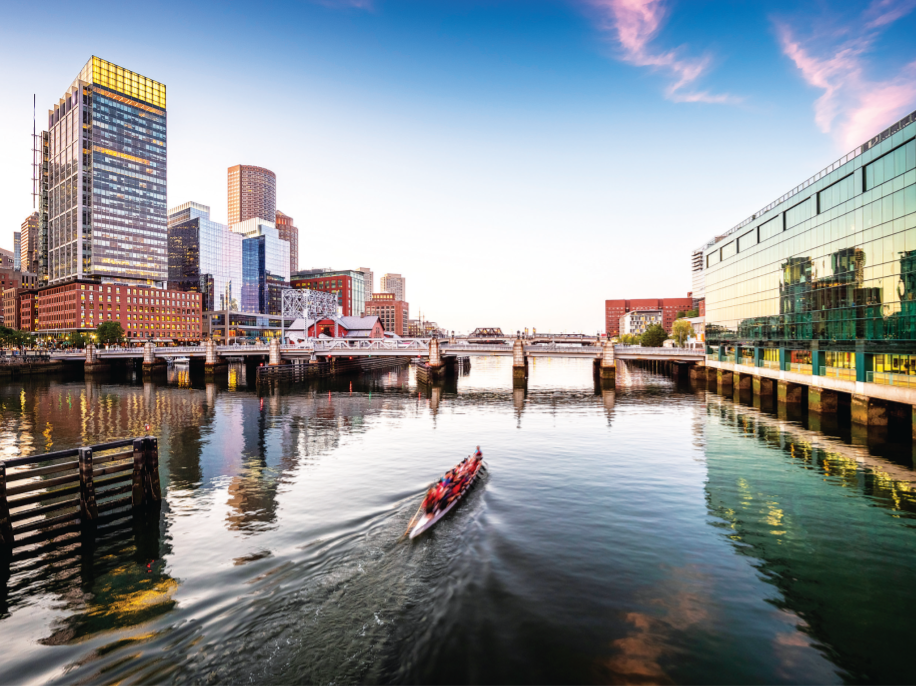
A new study is exploring how the city of Boston could harness the energy of Fort Point Channel and other waterways to help heat and cool large buildings in the state’s capital city.iStock photo
Greater Boston’s waterways have always been an integral part of the region’s commercial endeavors, from textile mills built along area rivers to Clipper trading ships sailing in and out of Boston Harbor.
Now a new study is exploring how the city of Boston could harness the energy of Boston Harbor, Fort Point Channel, and the Charles and Mystic rivers to help heat and cool large buildings in the state’s capital city.
City and state officials recently launched the so-called BosTEN (Boston-Area Thermal Energy Network) project to study how thermal energy might play a role in the city’s ongoing decarbonization efforts to combat climate change.
The year-long feasibility study, conducted by the Salas O’Brien engineering and consulting firm with its five subcontractors, is expected to review a wide range of issues tied to the potential creation of new “thermal energy networks” that could provide heating and cooling services to various commercial districts across Boston.
The source of those potential heating and cooling services: the natural clean energy contained in waterways, whether it’s hot or cool energy, and using that energy to ultimately heat and cool large buildings connected via a vast network of energy transfer stations, heat pumps and underground pipes.
Other Cities Put Idea into Practice
It’s not as fantastic and futurist as it sounds.
The cities of Toronto and Esbjerg, Denmark have already established their own thermal energy networks, tapping into Lake Ontario and the North Sea, respectively, for their power.
Locally, the University of Massachusetts-Boston has long relied upon clean thermal energy to help cool buildings on its Columbia Point campus, tapping into energy from cold seawater drawn from Boston Harbor.
Meanwhile, Smith College in Northampton is in the process of transitioning from an old-style steam-generated energy system to a ground-based thermal energy network.
Nearby Amherst and Mount Holyoke colleges are eyeing similar thermal-energy projects on their campuses as well.
“This is something that can really work,” said Lindsey Butler, executive director of the Boston Green Ribbon Commission, an independent group charged with administering the BosTEN project. “Geothermal energy is definitely having its moment right now.”
“It’s not fantasy,” said Jim Stanislaski, managing director of accelerating decarbonization at the Massachusetts Clean Energy Center (MCEC), which provided a $500,000 grant to conduct the BosTEN study.
The thermal-energy networks in Toronto and Denmark are “proof thermal-energy [projects] can be done at a utility-scale level,” said Stanislaski.
Building Sector Has a Stake in Success
Closely monitoring the BosTEN project are those who would be impacted most by any new thermal energy venture in Boston: large property owners.
Commercial landlords have been particularly anxious of late about Boston Mayor Michelle Wu’s aggressive push to meet the zero carbon emissions goals outlined in the city’s Building Emissions Reduction and Disclosure Ordinance (BERDO).
And now along comes BosTEN.
A spokesperson for the Commercial Real Estate Development Association (CREDA, formerly NAIOP) could not be reached for comment.
But Samantha Cahill, vice president of communications and public affairs at Longwood Collective, the nonprofit organization representing members of the Longwood Medical and Academic Area, made clear her group is interested in hearing what the Salas O’Brien study has to say.
“Longwood Collective has been actively engaged in discussions around BERDO and other energy-related policy issues given their potential implications for our member institutions,” Cahill said in a statement. “Because the BosTEN initiative is still in the feasibility exploration phase, there are a number of practical and implementation considerations that will be important to understand as the work develops, including how a potential system could work in different settings.”

Owners of commercial buildings could find it easier to comply with Boston’s greenhouse gas emissions regulations if systems generating heat and cooling from seawater come to fruition. iStock photo
Harbor Pipes Would Work Like Geothermal
Thermal energy, often known as geothermal energy, is usually associated with ground-based projects, in which deep-bore drilling is used to tap into naturally consistent heat found in the Earth’s interior.
Today, ground-based geothermal energy is increasingly being used to provide heating and cooling to new residential subdivisions and various commercial and nonprofit developments around the country.
Colin Schless, national director of energy transition at Turner Construction Company and a member of the Boston Green Ribbon Commission, estimates his firm has drilled as many as 4,000 bore holes over the years for ground-based thermal energy projects across the region.
Among others, Turner has overseen thermal-energy projects at Yale and Princeton universities and at some U.S. defense contractors, Schless said.
Water-based geothermal energy works in the same fundamental way as ground-based thermal energy – except it taps into the naturally consistent heat found at certain levels of oceans, lakes and other waterways.
Basically, water-based geothermal energy works by drawing water from various sources, then sending it through a heat exchanger before the water is pumped into the network of individual buildings to heat or cool facilities.
Schless said thermal energy works roughly the same way as traditional air conditioning: transforming hot air into cold air and ultimately vice versa.
But What About the Costs?
Geothermal energy is definitely not cheap. Every project is different, so prices can vary widely.
But it generally requires a major upfront investment in an entirely new heating-and-cooling infrastructure. That usually includes underground pipelines, pumps and heat exchangers, among other equipment – and that’s just for the network’s building-to-building interconnections.
Individual facilities might need major heating-and-cooling retrofits in order to handle geothermal systems.
Robert McKenna, a principal and director of energy planning at Salas O’Brien, said it generally takes 10 to 15 years before users see the financial benefits of transitioning to geothermal systems.
“It can be expensive,” McKenna said. “There are many flavors of geothermal energy. But if it’s done right, it’s less expensive in the long run than gas or air-sourced systems. It could also be a cheaper source of energy than drilling so many holes in the ground like you do for [ground-based geothermal].”
Turner Construction’s Schless agrees, noting that U.S. tax credits for thermal-energy projects can drive down overall costs to the point where it’s literally cheaper to construct than conventional energy systems.
“You can actually end up with net savings with geothermal,” he said.
Who Would Own It?
But who would own a thermal energy network once it’s built out? Who would maintain the system?
That’s one of the many questions that the Salas O’Brien study is expected to address – or at least review.
Generally, it comes down to three options: a user-owned system, a municipal-owned system or a for-profit utility-owned system.
No matter what, the Boston Green Ribbon Commission’s Butler said geothermal energy has proven over the years that it’s a viable clean-energy option for Boston.
“It’s exciting,” she said. “We’re discovering there’s a huge demand for it today.”