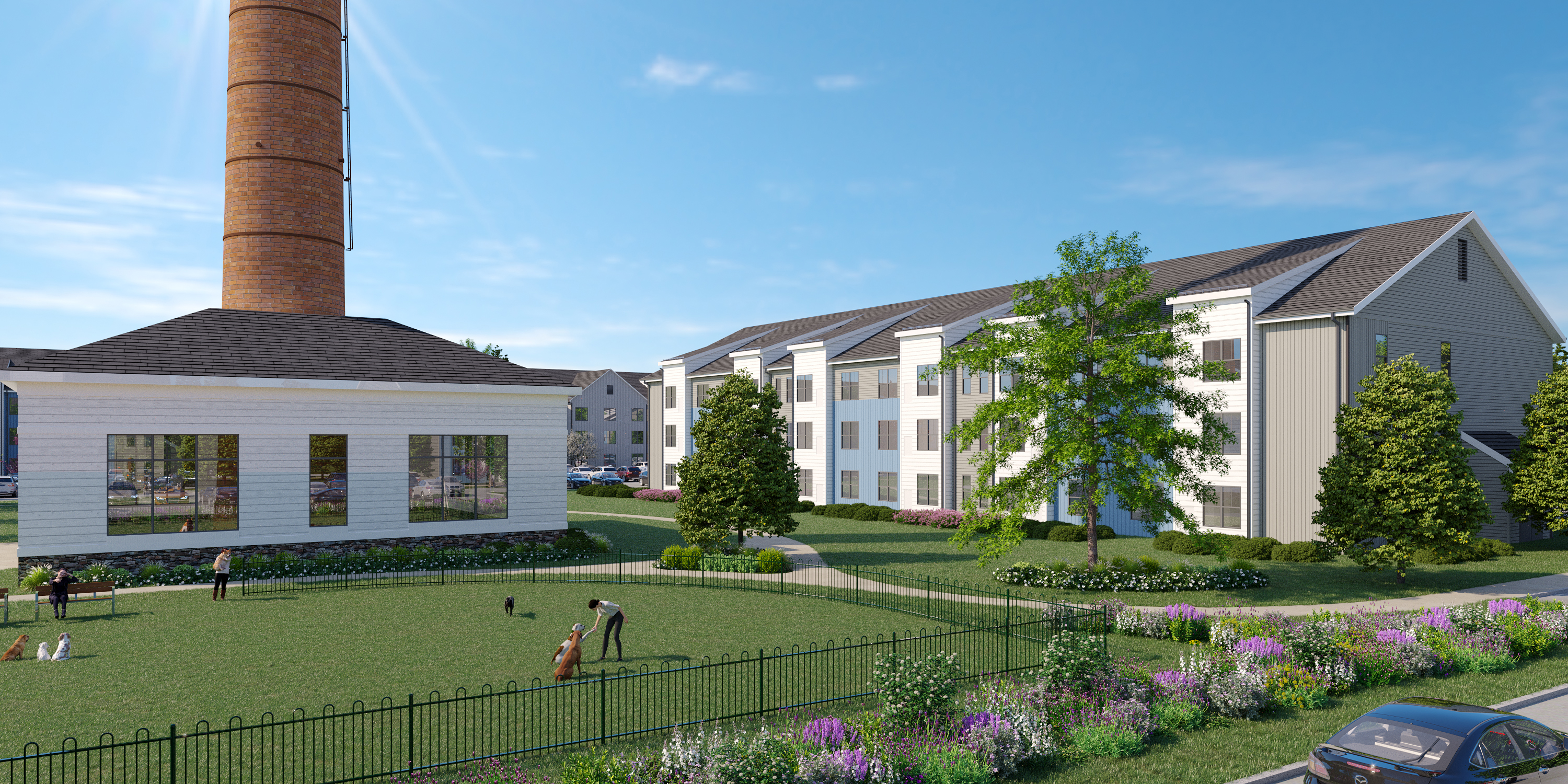
Assembly of Massachusetts’ largest factory-built housing project will begin this year at a 42-acre former mill property in Taunton. Greystar is developing the 390-unit Whittenton Mills complex using prefabricated modules shipped from its Modern Living Solutions subsidiary in Knox, Pennsylvania. Image courtesy of Greystar
After decades of optimistic talk that modular construction will be a piece of the puzzle addressing the housing crisis, tangible examples of off-site assembly are fitting together in Massachusetts.
The most prominent example is in Taunton, where the nation’s largest multifamily landlord is set to begin construction of 390 apartments that will be shipped in 990 pieces from a modular housing factory in Pennsylvania.
But a sticking point is tied to the financial equation for homebuilders: Whether the state’s prevailing wage laws apply to modular homes built in Massachusetts factories.
“We often have challenges in Massachusetts,” said Tom Hardiman, executive director of the Charlottesville, Virginia-based Modular Building Institute. “One that will absolutely kill our industry is trying to apply traditional on-site prevailing wages in our factories. A lot of politicians want to ensure organized labor is getting a fair shot and make them pay prevailing wages in their factory. That kills the whole business model.”
Without a large-scale local factory to build modular housing, the industry’s potential to grow remains limited, Hardiman said.
Pennsylvania Factory Produces Taunton Apartments
In Knox, Pennsylvania, crews are assembling housing modules that will be shipped to a 42-acre former mill property in Taunton for Massachusetts’ largest factory-built housing project to date.
Greystar, the nation’s biggest apartment owner, has made modular construction an important piece of its development pipeline. In 2023, the South Carolina-based operator launched its Modern Living Solutions division and opened the 256,000-square-foot factory, which will assemble modular units for shipping to Greystar construction sites throughout the Northeast.
The Pennsylvania facility is capable of assembling three or four similarly-sized projects each year across its Northeastern U.S. footprint, Greystar Managing Director of Development Ryan Souls said. The goal is to build at least one of those projects each year in Massachusetts, he said.
In Pennsylvania, workers will assemble approximately a dozen 12-by-30-foot modules daily, eventually shipping 990 modules to the 437 Whittenton St. site in Taunton over several months. Workers will stack the modules up to three stories high on concrete pads, and complete assembly including utility connections.
“This is a site that a number of developers have looked at. We had looked at it a few times and couldn’t figure it out,” Souls said. “Then in 2024, we came to the city of Taunton and said, ‘We think we can do something with our modular execution. Can you work with us to make it happen?’”
Saving Time Means Saving Money
For Greystar and other modular developers, off-site construction means significant savings in time and cost.
Greystar predicts resident move-ins will begin next spring, and the entire complex will be complete in the fall. By contrast, a similar site-built apartment project would take approximately two years to complete.
“It’s a pretty quick process,” Souls said.
The $139 million project received $80 million in construction financing from Bank of America in December.
Public subsidies, including a MassWorks infrastructure grant and a local tax increment exemption, helped Greystar make the numbers work, and offset up to $10 million in environmental abatement and demolition costs. And the city of Taunton does not require a minimum percentage of income-restricted units in new developments, a significant calculation in developers’ pro formas. Souls estimated rents will range from $2,200 to $3,600.
The Knox plant has manufactured 1,734 modular units to date. Other large multifamily operators are likely to follow Greystar’s strategy, the Modular Building Institute’s Hardiman said. Traditional building contractors also are creating separate modular divisions and stand-alone companies.
“There is not one correct business model, but what we are seeing with these developers is they want more control over the process. That is what Greystar is doing,” Hardiman said.
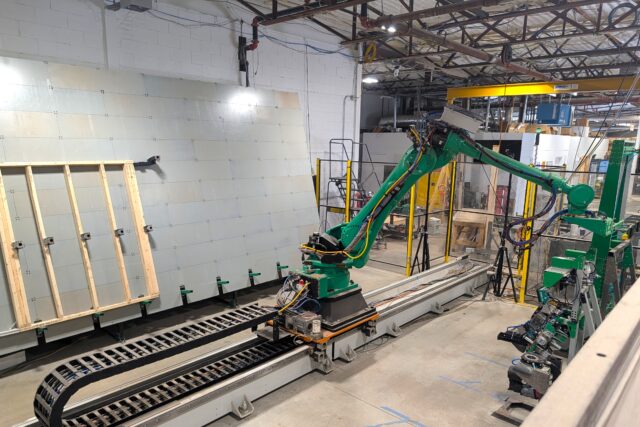
Andover startup Reframe Systems uses a robotic arm to build wall panels while human workers tackle higher-skilled work. The company claims its methods can build housing between 25 percent and 50 percent faster than traditional practices. Photo by James Sanna | Banker & Tradesman Staff
Somerville Project Prompts Challenge
In a cautionary example, a Boston nonprofit affordable housing developer’s attempts to use modular construction on a Somerville project prompted the Massachusetts Attorney General’s office to intervene in 2025.
Preservation of Affordable Housing and the Somerville Housing Authority partnered on the redevelopment of the Clarendon Hill public housing complex, including a 168-unit first phase.
The general contractor, Dellbrook | JKS, used a pair of modular subcontractors on the project: Lab 9 Modular LLC and Lab 12 Corp., which manufactured housing modules off-site in Littleton.
Although a Home Rule petition exempted the project from the public bidding process, workers at the Littleton factory were eligible to be paid prevailing wages, according to an April 15, 2025 advisory letter from Lauren Moran, the fair labor division chief at the attorney general’s office.
In October 2025, the Department of Labor Standards ruled that off-site modular factories in Massachusetts are subject to the prevailing wage law.
A spokesman for the North Atlantic States Regional Council of Carpenters did not respond to requests for comment.
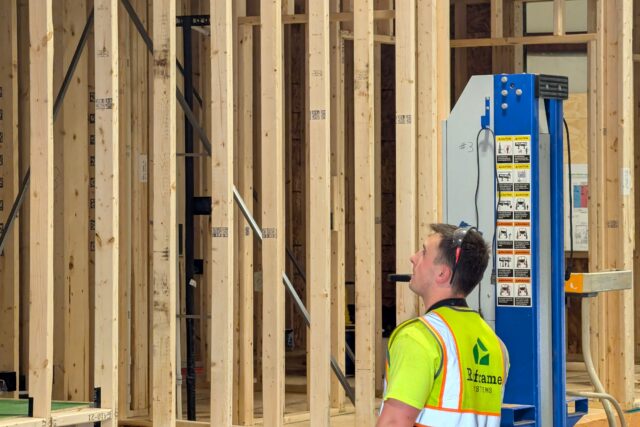
Humans still do significant finishing work on modules at Reframe Systems’ Andover “micro-factory,” like drywalling and plumbing, before the blocks are shipped to a site. Its robots scan QR codes Reframe prints on building materials to identify how parts fit into digital plans. Photo by James Sanna | Banker & Tradesman Staff
Using Robotics for Factory Assembly
An Andover startup may have found a workaround for high union labor costs: extensive uses of robotics in modular home assembly.
Founded by three former Amazon Robotics employees, Reframe Systems is targeting the in-fill housing market with several modular housing prototypes, ranging from backyard cottages to small apartment buildings.
The company has capacity to build approximately 50 projects a year at its existing 16,800 square-foot facility. Robots perform most of the heavy lifting at the Andover facility, enabling higher-skill trades to complete the modules.
The company raised $20 million in series A venture capital funding last fall. Reframe is in final negotiations to lease over 100,000 square feet in a nearby town for a new headquarters and assembly plant, business development staffer Chris Eggert said during a recent tour of the factory.
The new facility will be able to grow its weekly output five-fold immediately, and between seven-fold and eight-fold if unspecified “process improvements” can be made down the line.

Steve Adams
Healey Panel Urges ‘Collaboration’
The Healey administration’s “Unlocking Housing Production” report, issued by a blue-ribbon study commission in early 2025, recommended a series of reforms intended to make modular construction more easy to build and finance.
It did not address the issue of prevailing wages, although the report noted a “need for the modular industry to find a path for collaboration with organized labor groups.”
The Board of Building Regulations and Standards has been approving approximately 35 manufactured building plans a month, according to a spokesperson for the Executive Office of Housing and Livable Communities.
And in 2024, the Biden administration awarded a $3 million grant to Metropolitan Area Planning Council to study ways to create a modular housing factory in Greater Boston.
In an email, MAPC Executive Director Lizzi Weyant said several working groups are studying regulatory barriers, development pipeline, workforce development opportunities and facility siting. A request for proposals will be released by early next year with a focus on creating a new manufacturing plant, a network of smaller facilities and a training center.