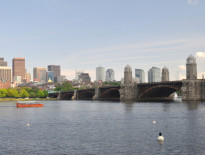
Economic stagnation was the bane of Boston when the last citywide master plan was completed in 1965. Jobs and residents were migrating to the suburbs, and most development was driven by urban renewal schemes that bulldozed entire neighborhoods.
As the city finally takes another top-down look at its future, the population is rebounding. A $7-billion building boom is overwhelmingly driven by private investment, but new challenges have emerged in growing inequality, vulnerability to extreme weather and a fraying transportation network.
Eight experienced architecture and urban planning firms responded to the Boston Redevelopment Authority’s request for proposals for Imagine Boston 2030, the city’s term for the upcoming master plan. BRA officials interviewed five finalists last week and are expected to select a firm to lead the $2.8-million, two-year process on Thursday.
The field contains a mix of locally-based and national firms that listed their qualifications, potential partners and experience in city-shaping from Brooklyn to Belgium. While the final plan will reflect an extensive public outreach process, many of the firms are already mentioning strategies to address growing inequality as a top priority.
“We now know that cities can be fabulous places to live and work,” said Frederick Kramer, a principal with Boston-based ADD Inc./Stantec. “That’s going to continue. What you’d like to see is a broader participation in that success, so it’s not the haves and have-nots.”
The prospect for a city-wide framework to shape development would be a departure from recent decades in which city regulators have typically looked at projects on a case-by-case basis, and hired consultants to conduct master plans only of individual neighborhoods.
Here are some of the key issues that are likely to be addressed by consultants and the public debate as the new master plan is assembled:
Density And Transit-Oriented Development
Density will be a central topic as the city reshapes its zoning to encourage more housing, primarily along existing public transit corridors. Mayor Martin Walsh has set a goal of generating 53,000 new housing units by 2030, and the BRA has already selected two pilot corridors for potential high-density zoning: between Broadway and Andrew Square on the MBTA’s Red Line and between Egleston Square and Forest Hills on the Orange Line. But other growth zones are likely to emerge. ADD/Stantec cited the Dorchester Avenue and South Bay Center areas as possible clusters for mixed-use development, and Melnea Cass Boulevard as a new research and innovation growth zone leveraging its proximity to Boston Medical Center.
Urban Infill Projects
The city’s recently abandoned bid to host the 2024 Summer Olympic Games turned a spotlight on Widett Circle, an 83-acre industrial area on the outskirts of South Boston, as the proposed site of the Olympic stadium and a post-Olympics mixed-use redevelopment. Much of the future development potential lies in redeveloping sites such as Widett Circle, Beacon Yards in Allston, the Marine Industrial Park in South Boston and sites along the Mystic River in Charlestown, Watertown-based Sasaki Assoc. stated in its submission.
But planning for smaller, neighborhood-scale projects also should be a major component of the study, said Martin Zogran, a project manager for Sasaki.
“If we look at the housing challenge, a majority of that will actually be in very sensitive infill locations with clustering around the city. The growth towards 2030 won’t be only these large footprint developments,” Zogran said.
Environment And Sustainability
Recent studies have warned that Boston should brace for a median sea level rise of up to two feet by 2050, putting large portions of the waterfront, downtown and even Back Bay at risk of catastrophic flooding in a major storm. The plan should include a framework to update Boston’s zoning and building codes to protect new and existing structures from flood damage, HR&A Advisors of New York said in its proposal.
Minority Outreach
Engaging minority and low-income residents in the public process is a goal to ensure the plan reflects all segments of the population. Several of the firms said they would partner with Watertown-based MORE Advertising, a minority-owned company that has taken part in projects in cities with large minority and low-income populations. “We know that to engage minority and low-income members of the community we need to go to their communities and seek them out in order to ensure that the participation program is inclusive,” ADD/Stantec wrote. The campaign would include telephone interviews, outreach in shopping areas and transit locations, fliers and materials for non-English speakers.
Public Health
Boston-based NBBJ sees an opportunity to address neighborhood disparities in life expectancy tied to unequal access to health care and fitness facilities, with Roxbury having the city’s lowest life expectancy at under 59 years and Back Bay the highest at 91. “Health equity should be considered throughout all plan themes and products,” with an examination of how development, transportation and housing influence rates of low birth rate deliveries and chronic diseases, NBBJ stated. “The built environment can have a profound impact on the health of residents and our experience has taught us that health disparities can vary substantially in the community, even from block to block.”
Next Steps
BRA officials and representatives from city departments interviewed five finalists last week. The BRA board of directors is expected to select a firm at its meeting Thursday.
“Our selection committee ultimately hopes to pick a team with well-rounded experience and proven ability to deliver on a project as ambitious as Imagine Boston. We’re eager for public engagement around the citywide plan to begin in earnest in the fall, and the consultant selection process is a key step to get there,” BRA spokesman Nicholas Martin said. n
Email: sadams@thewarrengroup.com