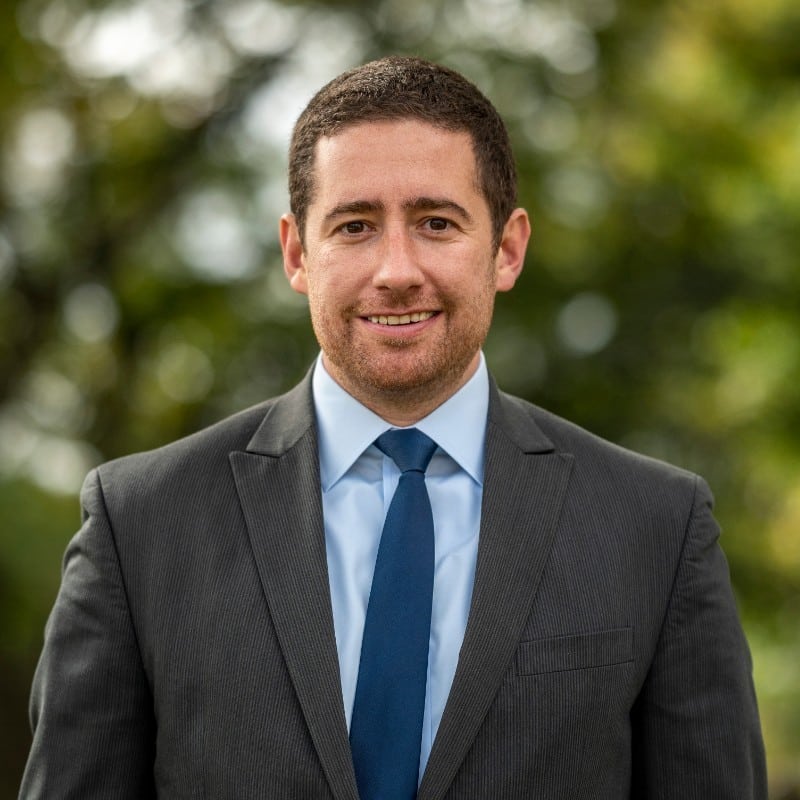
John Sullivan
Executive vice president, Cabot, Cabot & Forbes
Age: 39
Industry experience: 20 years
Decades before “compact living” became a buzzword, an order of priests lived in tiny cells at Brighton’s St. Gabriel’s Monastery. When Boston developer Cabot, Cabot and Forbes acquired the property, it devised plans to combine the living spaces into larger apartments for a modern demographic. Along with new construction, the project will include 555 apartments and over 100 condos on a nearly 12-acre site. John Sullivan is an executive vice president at CC&F, where he oversees development projects including The Overlook at St. Gabriel’s and a recently approved 250-unit apartment complex on New Boston Street in Woburn.
Q: The St. Gabriel’s Church and Monastery project is one of Boston’s most unusual housing projects in recent years. What’s the history of Cabot, Cabot & Forbes’ involvement in that property?
A: Like a lot of our deals, it was pretty much off-market. We had heard from a broker that Steward Health Care, which owns and operates St. Elizabeth’s Medical Center, had some excess land, and we asked to look at the possibilities and that’s how we caught wind of it. We tried to jar it loose for a year, and they kind of went dark on us. Then in the summer of 2015, they called us and said we needed to close on the property by the end of 2015.
They didn’t want to entertain a contingent deal. We weren’t comfortable with that, so they went with another developer who had it under agreement. Eventually, that deal fell apart and they called us on Halloween of 2015 and said, “The deal is yours if you want it, but you have to close by the end of the year.” We did a sale-leaseback and they leased it back from us during the entitlement process and used it for parking. For the past 10 to 15 years, it was a 400-space parking lot for the employees and the hospital. It took us two years for the rezoning and the Article 80 process [with the Boston Planning & Development Agency].
Q: Was the development plan always for a multifamily project?
A: We always looked at it as multifamily. At the time, multifamily was clearly the highest and best use of that site. There’s a lot of graduate students and the Millennial demographic. There’s a monastery which is a Boston landmark, which means you can’t take it down, and there’s a church on the site which wasn’t protected. So, we went the first six or eight months operating on the assumption the church was going to come down. It had been vacant for 10 years. At our first public hearing in 2016, Secretary of State [William] Galvin, who lives in Brighton, came and said, “I think you should keep the church.”
Q: What were the conditions of the two buildings?
A: It was a horror show: water damage, vandalism, partial roof collapses.
Q: What did your architects advise?
A: It was pretty obvious the monastery was residential when it was built: almost like a dorm building. The priests who lived there each had their own 10-by-10-foot room and shared bathrooms. And then on the second floor, there’s a big chapel and library and food hall. It was basically like a college. The geometry made sense, obviously, for a residential building. You take each of the 10-by-10-foot cells and turn them into a bedroom and a bathroom and another bedroom. We got historic tax credits from the state for both of these buildings, and you have to maintain the volume of these spaces inside. The church was a community building for hundreds of people, and you can’t really put residences in a church. There certainly are examples, but it wasn’t worth it. We needed a clubhouse and amenity space for the project, and it made sense as a community space. It was a huge plaster job, which is almost a lost trade, and was a huge money suck.
Q: How did you adjust the marketing plan leasing up during the first wave of COVID?
A: We have four residential buildings delivering in phases and each had a different timeline and strategy. We opened the first two buildings in the spring of 2020, which couldn’t have been worse timing. We did what the market was doing in terms of giving away two months free rent and doing what we could to fill the building. We were scheduled to deliver building two in December 2020, but six weeks before opening, some kids broke in and flooded half the building, so we didn’t deliver until May 2021. The last building delivered in July and by then, the rental market had significantly rebounded. We signed 80 leases the first week of June, and now we’re 96 percent leased.
Q: What’s the timeline for the condominium portion?
A: The neighborhood, probably more than any neighborhood in Boston, wanted home ownership to be a significant piece of the project. AvalonBay has a project next door where they were required to build condos. We set out to do 550 apartments, and turned over a portion of the site to a condo deal and ended up capitalizing that differently under separate ownership, and that’s under construction now. We’re just topping off and we’ll be done by Labor Day. That 100-unit size is kind of a sweet spot for condo developments.
Q: What submarkets are becoming challenging for housing because of the life science boom?
A: Alewife is the case study of how multifamily was the highest and best use, and overnight life science doubted it. Life science used to be concentrated in clusters like Kendall Square, then the Seaport and Watertown and Lexington and Waltham, and now it seems like anyplace in metro Boston is OK. You’ll still see housing on a smaller scale. The bigger sites, where possible, are converting to life science like IQHQ at 155 North Beacon St. If you have an acre or smaller or just scattered throughout the neighborhood, that’s probably still going to be a residential site. Cambridge says they want life science, and the suburbs favor that over any residential development. So, it’s what is preferred politically.
Q: What’s the next step for the former Boston Cab site on Kilmarnock Street in the Fenway?
A: We are on-site and just finished knocking the three existing buildings down in December and starting to dig the hole in January. That delivers in 2024, and we’re proceeding with 365 rentals and 75 condos across the street.
Sullivan’s Five Favorite New England Patriots’ Plays
- Malcolm Butler’s interception – Super Bowl XLIX
- Julian Edelman’s impossible catch – Super Bowl LI
- Adam Vinatieri’s 45-yard snow bowl kick in 2001
- Dont’a Hightower sack/fumble – Super Bowl LI
- Rob Gronkowski’s catch – Super Bowl LIII