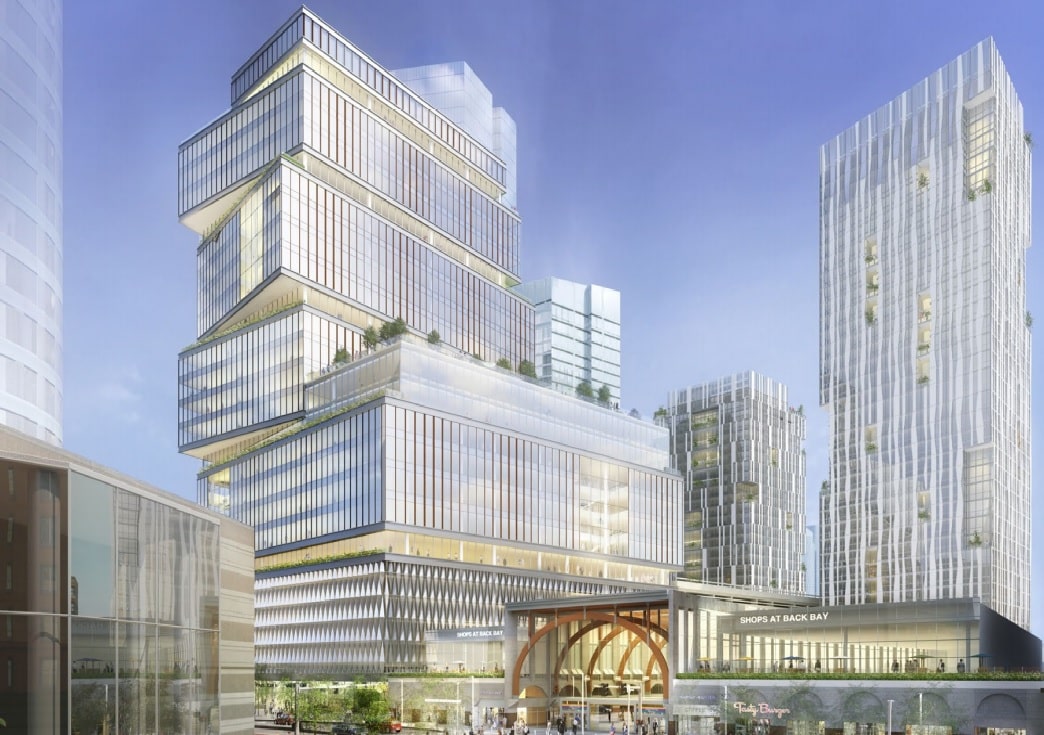
Image courtesy of Pelli Clarke Pelli Architects
Greater Boston construction costs are now so high, not even a brand-new, state-of-the-art office tower can pencil out, Boston Properties executives said in a quarterly earnings call this week.
And that means the REIT’s 606,000-square-foot “stack of books” office tower next to Boston’s Back Bay Station is “not part of the calculus in 2025,” BXP President Douglas Linde told investment analysts.
The tower received approval from the Boston Planning and Development Agency Board in 2017, but the REIT returned to the board in 2022 to get approval for a revised design featuring around 80,000 square feet less commercial space. BXP signed a 90-year ground lease with the MBTA, which owns the station’s parking garage site for the tower, in April.
With construction costs running between $1,400 and $1,600 per square foot for an office tower, Linde said, that would drive rents to a point where they are “materially higher than the rents that are achievable in existing both under construction and recently delivered new buildings in the financial district and the level of rents that we can currently command in the Back Bay.”
Linde said BXP would only reconsider reviving the tower project if there were dramatic changes in the cost of debt and construction costs.
The SOFR benchmark interest rate would have to fall from 5.5 percent to 3 percent and if the premium lenders charged on that rate dropped from between 350 and 400 basis points to 150 basis points, he said. In addition, construction materials and other building costs would have to come down, he added.
BXP executives did not comment on the other components of the 1.3 million-square-foot Back Bay Station project: two residential towers clocking in at 28 stories and 240 units, and 35 stories and 360 units, respectively.
Not Even Strong Rents Helped
BXP’s pessimism is despite the site’s location in what is perhaps the strongest office market in New England.
According to research by commercial brokerage Colliers, the 13.62 million-square-foot Back Bay office market had an availability rate of 18 percent at the end of the third quarter after just over 31,000 square feet of negative absorption. The submarket’s average asking rent sat at $68.49 per square foot, the highest in the Greater Boston region outside the biotech hub of Kendall Square and East Cambridge.
The latter market is bearing a nearly 30 percent office vacancy rate thanks in part to the recent delivery of 40 Thorndike St., Leggat McCall Properties and Oxford Properties Group’s mixed-use repositioning of the old Cambridge Courthouse tower.
And tenant demand for new space is strong, Linde noted, with “a number” of BXP office tenants in the Back Bay interested in space in the building. Much of the 647,000 square feet of new leases, lease renewals or lease expansions BXP signed across its portfolio were concentrated in Greater Boston, particularly among Back Bay financial firms, Linde said. Around half of that is attributable to Bain Capital’s decision to remain and expand at the iconic 200 Clarendon St. tower.
BXP’s decision leaves very little prospect of new class A office supply coming to Boston’s central business districts in the next two years. Hines’ South Station office-condominium tower expected to complete in 2025 without any anchor tenants named so far. And there is only other permitted tower in the area, Skanska USA’s 625,000-square-foot 380 Stuart St., and it has yet to announce any tenants or secure financing since its developer bought the site for $177 million in December 2020.