The Counting House Apartments in Lowell opened earlier this year and has rented 50 of its 52 units.
Boston-based WinnCompanies is gearing up for its next mill conversion project in Lowell after recently completing the $20-million repositioning of another old industrial property in the city into a modern apartment building.
Located in the 90,000-square-foot Hamilton Manufacturing complex in Lowell, WinnCompanies’ Counting House Lofts has already rented out 50 of 52 new apartments within the former accounting office (or “counting house”) for the original cotton- and wool-products manufacturer.
Through its development arm WinnDevelopment, the company finished construction at the site late last year and received its occupancy permit on Dec. 30.
With half the apartments designated as affordable units, the residences were quickly snapped up, company and town officials say.
“A lot of young professionals are moving into that area of Lowell,” said Liz Fish, vice president at WinnDevelopment. “It’s a great area. There’s definitely strong demand.”
Counting House Lofts is just the latest Lowell mill-conversion project by WinnCompanies, which has extensive expertise rehabbing old industrial properties into a mix of new uses. Previously, WinnCompanies converted old mill buildings in Lowell into the 27 Loft and Apartments at Boott Mills, totaling more than 300 units and costing more than $60 million combined, according to the Lowell Historic Board.
Now WinnCompanies is eying the conversion of the old Adden Building, also part of the Hamilton Manufacturing complex, into 75 residential units. About one-fifth of the units would be affordable. The company, which typically lines up historic and low-income tax credits to help finance development, is hoping to start that multimillion project early next year, Fish said.
Stephen Stowell, administrator at the Lowell Historic Board, praised WinnCompanies for the quality of its work and attention to historic detail.
“All their projects turn out fantastic,” said Stowell, adding the firm is “very respectful” of the historic nature of former mills. “They’ve really bought into these conversion projects.”
Half-Billion-Dollar Repositioning
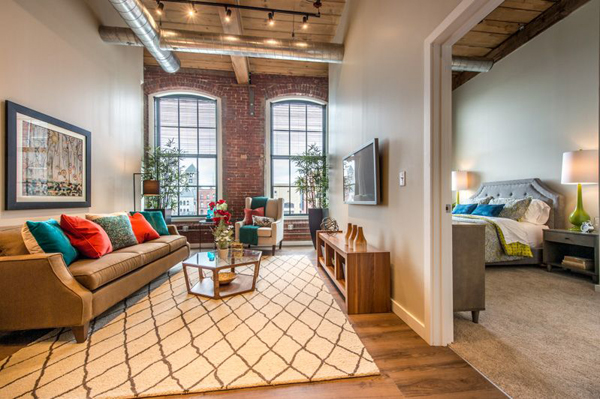
Interior views of one of the Counting House apartments.
Coupled with projects by other developers, Lowell has now seen about 94 percent of its 5.4 million square feet of former mills converted into other uses. Over the years, the total cost of those conversions, a few of which are still under construction, have amounted to about $580 million, Stowell said.
Haril Pandya, a principal at CBT Architects, said there are still hundreds of old mills across the region waiting to be converted. Some are abandoned and would require a tremendous amount of work to rehab them. But the majority have been used over the years for purposes other than their original manufacturing design, such as for warehouses or light manufacturing, and those properties tend to be better condition.
There are also many former mills that were converted into offices in the 1990s and early last decade, but now require “conversions of conversions” to make them more modern and attractive to commercial tenants, he said.
“They’re going from offices to much better offices,” he said.
Pandya, whose firm is currently involved in three conversion projects in Charlestown, Wakefield and Watertown, said the biggest challenge facing mill and old factory rehabs is building codes and zoning issues. The structures have to be structurally assessed for safety and comply with the federal Americans with Disabilities Act, if their zoning is being switched to residential, he said.
Despite complications tied to rehabbing and repositioning older buildings, the end results are popular among potential commercial and residential tenants, he said.

Interior views of one of the Counting House apartments.
“There’s nostalgia and character to these buildings that Millennials really like,” Pandya said. “They’re hip and cool. When done, they move quickly.”
In the case of Counting House Lofts, Fish said WinnDevelopment faced a number of construction challenges. Chief among them was working on the canal side of the structure to do masonry and repointing repairs. Workers literally had to dangle from the building like skyscraper window washers, she said.
The Counting House Lofts structure also needed new heating systems, insulation, windows and other features, with all the changes having to respect the historic nature of the facility, she said.
In the end, though, it was worth it.
“The building came out beautifully,” Fish said.