Image courtesy of Stantec
The next building in the redevelopment of Boston’s Bunker Hill public housing complex has been financed, including a $50 million contribution from the city of Boston.
An affiliate of real estate private equity firm Cottonwood Group loaned $122.11 million to a corporation controlled by the Boston Housing Authority Thursday morning, according to a Suffolk County mortgage.
The BHA has partnered with a joint venture of Leggat McCall Properties and the Joseph J. Corcoran Company to rebuild the roughly 26-acre, 1,010-unit public housing complex in the shadow of the Tobin Bridge into a 2,699-unit, mixed-income neighborhood.
“The novel public-private approach we’re taking will not only benefit the future residents of this building, but will transform our Charlestown community and spur investment in future housing construction projects across the City of Boston,” BHA CEO Kenzie Bok said in a statement.
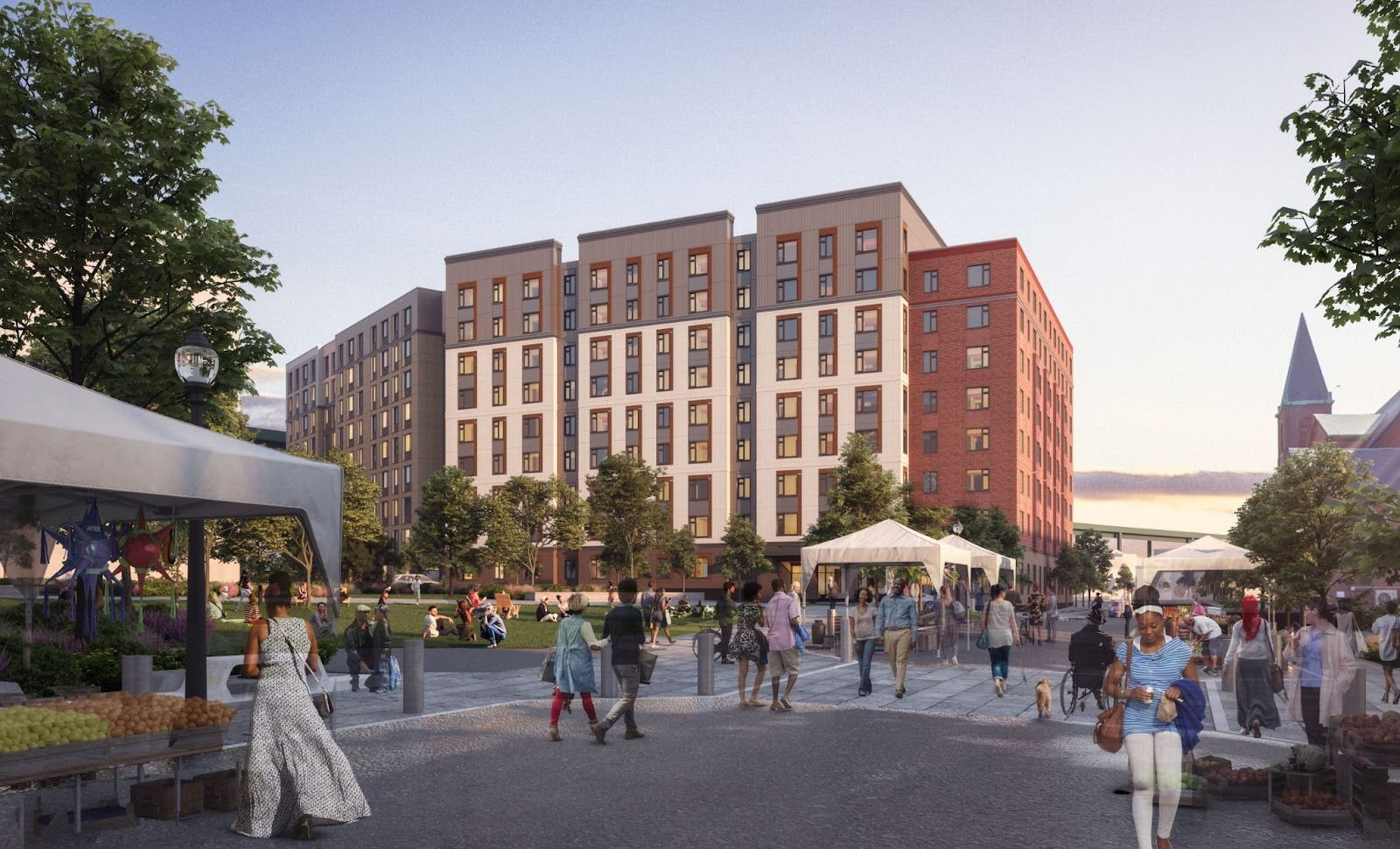
A joint announcement by the BHA and the two private developers Thursday said the $122 million loan would pay for the construction of building F, the second of what will eventually be 15 largely residential buildings to replace a warren of nearly 42, 3-story multi-unit buildings dating to 1940. Building F will rise 9 stories and hold 208 market-rate and 58 affordable units. Demolition of structures previously on the building F site was completed last year, followed by site prep work.
“This funding infusion catapults the construction start of our second building forward and allows for the continued momentum of delivering 2,699 critical, high quality, and sustainable market-rate and affordable apartment homes for a greater public good,” Leggat McCall Senior Vice President Adelaide Grady said in a statement. “Our endeavor to apply construction innovation and leading-edge carbon reduction strategies to building these healthy, vibrant communities in Boston’s most historic neighborhood is becoming a reality.”
Grady is leading the overall redevelopment project for the joint venture.

Image courtesy of Stantec
The city of Boston is also contributing roughly half its $110 million Housing Accelerator Fund to the project. Announced by Mayor Michelle Wu in September 2024 and meant to work in tandem with the state’s own $50 million equity-investing Momentum Fund, the revolving loan fund is intended to loan money to mixed-income developments around the city while seeking an unspecified lower rate of return than typical private equity capital, making it cheaper for developers now that construction and capital costs have risen sharply. Wu announced the city’s $50 million contribution to building F in November 2024.
“As we work to tackle the housing crisis and strengthen communities, this City-backed partnership to build a mixed-income housing development with majority public ownership will reshape what’s possible in Boston and beyond,” Wu said in a statement.
Cottonwood Group’s loan is part of a new pool of money it’s set aside to provide “lower-cost, impact-driven capital” for housing projects nationwide.
“We’re thrilled to provide $122 million in preferential financing to the City of Boston, Leggat McCall Properties, and Joseph J. Corcoran Company as part of the newly established Cottonwood Labor & Housing Initiative,” CEO Alexander Shing said in a statement. “This public-private partnership reflects Cottonwood’s strong conviction in Boston’s future and our commitment to supporting projects that deliver meaningful community impact, uphold strong labor standards—including 100 percent union labor and prevailing-wage practices—and create a foundation for continued collaboration across the City.”
Los Angeles-based Cottonwood Group’s biggest investment in the Boston area to date has been a $240 million refinancing of the financially troubled St. Regis luxury condominium tower in the Seaport District.
Like the first building in the redevelopment, originally called building M and now dubbed the “Stellata,” building F will use mass timber and cross-laminated timber for its framework, the joint venture said, plus pre-fabricated interior and exterior wall systems. Construction will cost $176.2 million, is expected to take 18 months and is expected to pursue Passive House certification when complete. Suffolk is the general contractor and Stantec is the project architect.