Image courtesy of ICON Architecture
Homeowner’s Rehab began its final permitting to transform a pair of former Lesley University properties into a 110,803 square-foot mixed-generation affordable housing complex using Cambridge’s affordable housing upzoning law.
The 95-unit project at 28-30 Wendell St. would include 40 units reserved for residents age 62 and older . All of the apartments would be reserved for households earning 80 percent or less of area median income, subject to availability of public subsidies.
“This site provides an opportunity to create a significant number of new affordable homes in a community that has historically not seen a large amount of new multifamily development,” developers stated in a submission to the Cambridge Planning Board.
The estimated project cost is $95 million. Major anticipated funding sources include $30 million in federal low-income tax credits, and $30 million from the city of Cambridge’s affordable housing trust.
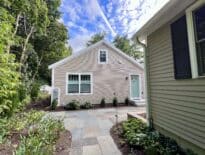
The Cambridge-based nonprofit affordable housing developer acquired the 30 Wendell St. parcel for $5.7 million in 2023 and the 28 Wendell St. property for $10.3 million in 2024, both from Lesley University. The properties include a tennis court and two 3-story apartment buildings.
Cambridge’s affordable housing overlay allows additional density for developers of 100 percent income-restricted housing projects. First approved in 2021 and updated in 2023, it allows all-affordable residential buildings up to 15 stories in main business districts, and 12 stories along major corridors.
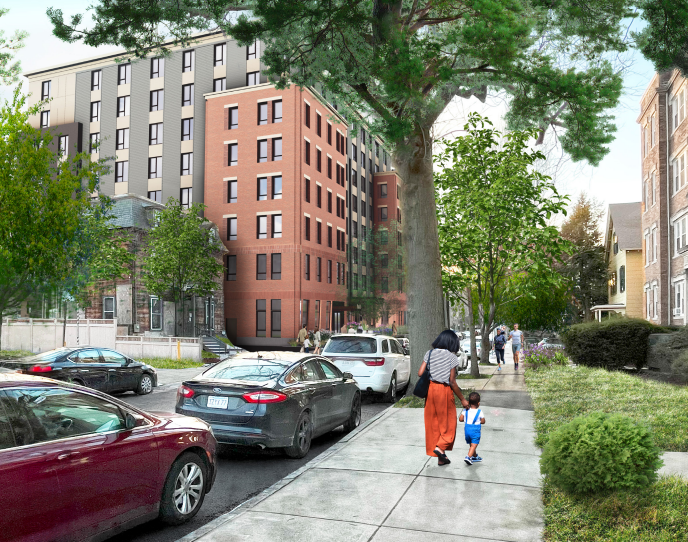
But developers still face opposition from neighborhood residents about height, shadows and density. Homeowners Rehab reduced the height of the Wendell Street project from 9 to 8 stories following community meetings, eliminating 15 units.
The maximum height in the neighborhood for such projects is 13 stories, according to the development team’s submission.
Developers also are required to submit designs to the Planning Board for an advisory review. Designed by ICON Architecture, the building would include a partial brick facade on two “bookends” and a 19-foot setback for the central building entry court, and a 15-foot setback at the rear of the building.
A 1,000 square-foot “Hub” on the ground floor would provide classroom and meeting space for community organizations and events.