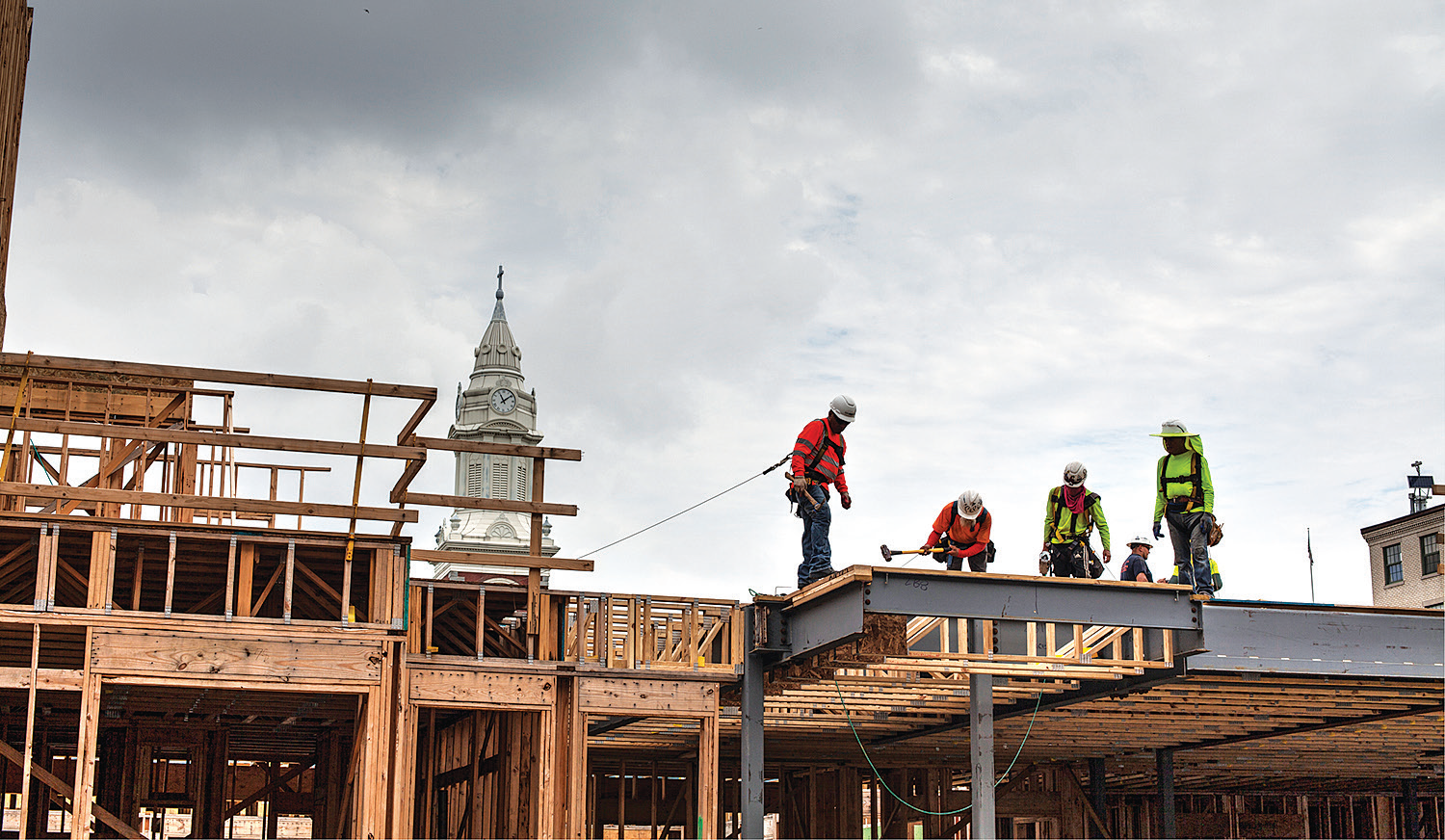
Construction workers on a Philadelphia building site in 2018. Additional cost savings may make projects feasible in an era of inflated material costs and elevated interest rates. iStock photo illustration
Construction costs have become the defining challenge for real estate developers in 2026.
Tariffs and other pressures have pushed material prices up an estimated 9 percent since 2024. Meanwhile, multifamily starts have fallen nearly 18 percent in the last year, and the development pipeline nationally sits more than 50 percent below its 2023 peak.
The margin between a project that pencils and one that stalls often comes down to how effectively an owner controls hard costs during preconstruction. But developers are often unaware how much savings might be hiding in plain sight.
Look Deeper than Scope Reductions
A recent project illustrates this. A multifamily developer of a 246-unit, 5-over-2 mixed-use project completed a thorough value engineering process with the full project team, identifying more than $4.4 million in cost reductions across the drawing set.
By every conventional measure, the exercise was thought to be successful.
Yet an independent review of the same construction documents – conducted in parallel, with no disruption to the project schedule – identified an additional $3.5 million in hard-cost savings across 52 distinct findings, an amount equal to approximately 3.9 percent of the construction budget.
Not a single independent review finding overlapped with the team’s existing VE list.
The reason for that zero overlap is worth understanding. Most VE exercises focus on material substitutions, scope reductions and specification downgrades – legitimate cost-reduction strategies that operate within the boundaries of design decisions already made.
The independent review, in contrast, examined the decisions themselves: whether the construction type classification was the most cost-effective path through the building code, whether structural approaches could be fundamentally simplified, whether specification requirements reflected the actual project conditions or had been carried over from prior work and no longer apply to the current plan.
Benefits of Early Design Analysis
This is not a judgment of competence, but rather a statement about perspective.
Architects reviewing their own drawings tend to optimize within the assumptions they have already made. A structural engineer will look for ways to lighten a beam, not question whether the construction type that dictated the structural system was the right starting point. A general contractor will sharpen subcontractor pricing, but is unlikely to flag that a specification carries redundant requirements inherited from a different project.
These are the natural consequences of reviewing work from the inside.
The example cited above is not an isolated result. Across reviews encompassing more than $1 billion in total project value, independent document analysis, which typically occurs early in the design process, after municipal permitting approvals are obtained, has consistently yielded average hard-cost savings of approximately 3.7 percent. Notably, those findings have less than 5 percent overlap with savings flagged by internal VE lists.
The pattern holds across project types, geographies and team compositions. It holds on garden-style developments and podium buildings, on 90-unit urban infill and 360-unit suburban communities.

Caleb Manchester
Why It Works
The takeaway is not that value engineering is broken. VE is a valuable and necessary part of preconstruction. But it addresses one layer of cost – the layer visible to the people closest to the work – and leaves another layer largely unexamined.
This second layer of savings is there because the structural conditions that make it possible – teams reviewing their own work, under time pressure, with deeply held assumptions about their own documents – are present on virtually every project.
In a market where interest rates have compressed deal economics and tariffs have inflated material costs, that gap is too significant to leave unchecked. That’s especially true considering the cost of the independent review can be structured to mitigate a client’s risk. At my company, for instance, we charge a base fee and incentive fees based on our identifying various savings thresholds. The base fee is refundable, dollar for dollar, if savings are not achieved.
Owners who are approaching GMP or finalizing construction documents should ask a simple question: Has anyone outside the project team examined these drawings with fresh eyes and no competing agenda?
If the answer is no, there is almost certainly money on the table – not in the obvious places, but in the assumptions that no one has thought to challenge. Engagement models that guarantee savings eliminate the financial risk of testing that premise.
For the project that barely pencils, this may be the difference between breaking ground and going back to the drawing board.
Caleb Manchester is co-founder and chief operating officer of Value Assurance, a Boston-based firm specializing in independent construction document review for real estate owners.