Framingham officials are proposing new zoning bylaws that would encourage the construction of mixed-use developments including housing units as part of an economic development strategy to revitalize the downtown.
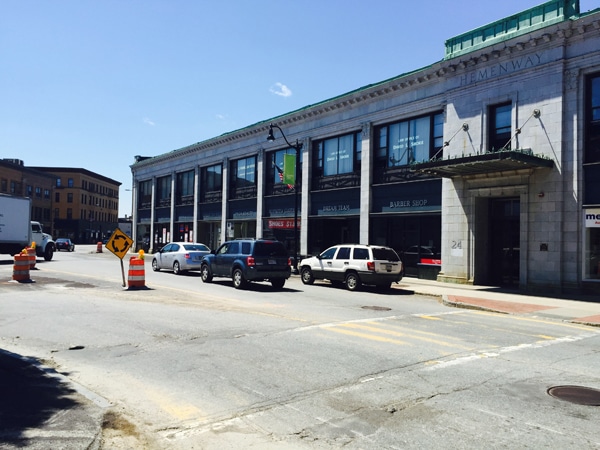
Downtown Framingham has the ingredients for the sort of transit-oriented development that is all the rage from downtown cores to suburban outposts.
But unlike in many Greater Boston communities, no developers are lining up with plans for mixed-use projects containing apartments for Millennials and empty-nesters or collaborative office space for startups. The town doesn’t allow it.
Officials are proposing a series of zoning changes that would allow multifamily projects in the downtown and other areas, and a broader variety of uses in aging single-use office parks.
Billed as smart-growth reforms, they would help Framingham attract new business and low-impact residential projects, economic development officials predict. They would also bolster the town’s prospects to keep the prized corporate employers that anchor its office parks, including Bose Corp., Staples and TJX Cos.
“Fundamentally we have a suburban zoning model that we’re applying to what is essentially an urban area,” said Arthur Robert, the town’s economic development director. “We have to find ways to change that.”
Framingham, which is Massachusetts’ largest town with a population of 68,000, can’t compete with surrounding towns with nimbler permitting processes, officials say. And zoning changes require town meeting approval.
While attempts to change to a city form of government have been made and failed in the past, another charter change movement is under way with plans for a referendum next year. In the meantime, zoning amendments will be put before the voters this fall to bolster the economic vitality of the downtown and the 140-acre 9/90 Corporate Center anchored by TJX Cos.’ headquarters.
Robert Halpin, Framingham’s town manager, said Framingham needs to change if it’s going to mentioned as a desirable landing spot for growth companies. One resource that’s being sorely underutilized: the town’s commuter rail station. Located in the heart of downtown, it’s the busiest stop on the MBTA’s Worcester line, Halpin noted.
“Knowledge workers are opting for more urban, more vibrant lifestyles,” Halpin said. “I truly believe we can leverage that transportation to create a residential aspect in downtown Framingham to serve our companies. It’s all about keeping the talent pool relevant and vital.”
The proposals are the culmination of a two-year study of why Framingham lags many similar-sized communities in new development. One of the key findings, Robert said: current zoning doesn’t allow the type of mixed-use projects that are generating buzz in places like Somerville and Boston.
“Framingham makes it difficult for that type of development to take place,” he said. “The consensus for a vision for a downtown was to create a diverse, walkable welcoming urban experience that can provide a housing platform for the next-generation workforce. We know they’re being priced out of Boston.”
The new zoning bylaws would give developers the flexibility to build various uses downtown based upon market conditions, while lowering the parking requirements from two spaces to one per residential unit.
A study by Metropolitan Area Planning Council (MAPC) focused on three blocks of properties in the downtown area that have the most potential to be redeveloped on a large scale: a block of 13 properties off Pearl Street, nine parcels on Howard Street and 18 parcels off Hollis Court.
The MAPC study questioned whether current rents in the area can support financing for such projects. It suggested Framingham offer tax-increment financing packages to reduce costs. Incorporating a town-owned parking garage and parking lot into development projects could make them more feasible for developers, Robert said.
New Look For Office Park?
While a more vibrant downtown is considered a plus for corporate employers, proposals to revitalize decades-old office parks also are part of the mix.
The planning board is reviewing zoning changes that would allow a wider mix of commercial uses and more density in the 9/90 Corporate Center. The office park has about 300,000 square feet of additional development that could be built under current zoning, including 250,000 square feet by Staples. Its current headquarters occupies 650,000 square feet.
The strategy would take a cue from office park redevelopments in suburbs such as Burlington where retail and residential space has replaced aging office buildings. National Development is repositioning the 13-building New England Executive Park as The District, with plans for collaborative office space, an Island Creek Oyster Bar, retail space and a Marriott Hotel. And Nordblom Cos. is continuing construction of retailers and restaurants at its 3rd Ave. development inside the Northwest Park complex.
“There’s a real need for workforce housing and I think Framingham sees these zoning changes as a way to address that and a way to bring the multi-uses to the parks that are strictly single uses,” said Jack O’Neil III, a managing partner at National Development. The Newton-based developer owns and manages another 450,000 square feet of office space in 9/90 Corporate Center.