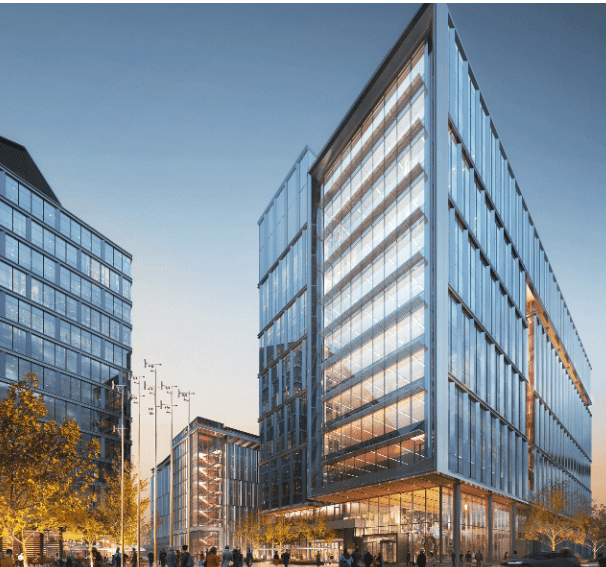
City officials in Somerville have offered medical device maker TransMedics a $17.7 million tax break to relocate and fill one of the city’s vacant spec-build lab towers: BioMed Realty’s 495,000-square-foot Assembly Innovation Park. Image courtesy of BioMed Realty
The Greater Boston life science sector continues to wrestle with headwinds that are weighing on real estate fundamentals, underscoring the outsized impact of muted demand and oversupply.
While leasing volumes improved during the third quarter of 2025, vacancy reached a new all-time high of 36.1 percent, and asking rents continued to decline.
Tenants remain firmly in control, commanding significant discounts and an abundance of high-quality options. Value preservation and occupancy retention are top of mind for landlords, with transactions taking considerably longer to finalize.
Yet, despite near-term challenges, green shoots are emerging and long-term optimism for the life science sector persists.
Despite Weakness, Cautious Optimism
Tenant demand remained subdued, closing the third quarter of 2025 at roughly 1.1 million square feet. Caution from venture-backed tenants, uncertainty around tariffs, and the potential for federal funding cuts are tempering momentum.
With recession risks rising, short-term pressure on the life science sector is likely to persist.
Still, there are encouraging signs: Venture capital funding nearly doubled from the second to the third quarter, and leasing activity experienced similar growth, particularly among new deals.
In one of the largest laboratory leases of 2025, AI-powered Lila Sciences signed a 200,000-square-foot lease at Healthpeak Properties’ Alewife Park development in West Cambridge.
CBSET relocated from Lexington, leasing 87,000 square feet at 153 Second Ave. in Waltham, and Eli Lilly expanded into 75,000 square feet at 645 Summer St. in the Seaport.
AI Proteins and Psivant also executed sizable laboratory leases in recent months.
With several additional major leases on the horizon, 2025 is on pace to surpass annual leasing volumes from 2023 and 2024.
Landlords are becoming increasingly aggressive to attract tenants, offering higher tenant improvement allowances, free rent and phased rent schedules to drive occupancy.
3M SF Under Construction
Historic levels of new supply have doubled Greater Boston’s laboratory inventory over the past five years, reaching 48.7 million square feet as of the third quarter.
This includes the newly renovated 149,800-square-foot 55 Summer St., an office-to-lab conversion in Boston’s Financial District, and 1 Riverside Road in Weston, totaling 121,085 square feet.
The groundbreaking of Biogen’s new 570,000-square-foot Kendall Square headquarters – being developed by MITIMCo and BioMed Realty – represents one of the few new projects to move forward in recent quarters.
Rentable building area under construction, including the conversion of 470 Atlantic Ave. in Boston, totaled more than 3 million square feet, or 6.9 percent of current inventory, by quarter’s end.
Most ongoing construction is limited to projects with major tenant commitments, such as the Takeda-anchored 585 Third Ave. (650,000 square feet) and the AstraZeneca-anchored 290 Binney St. (570,000 square feet), both in East Cambridge and set to deliver within the next 12 months.

Liz Berthelette
Projects Pivot Away from Labs
Looking ahead, supply risk has eased considerably as developers pivot away from laboratory construction toward traditional office, medical office and multifamily development.
In Needham, the former Muzi Ford site – originally approved for laboratory and office use three years ago – is now proposed to include hotel, senior housing, medical office and market-rate apartments.
National Development recently acquired the Watertown Mall, which was previously slated for 500,000 square feet of laboratory space, with plans to maintain its retail use.
The slowdown in new lab development and cancellation of speculative projects indicate moderating supply and a gradual rebalancing.
Life science fundamentals continued to cool across Greater Boston during the third quarter of 2025, with demand trailing new supply and asking rents declining further.
Although a full recovery remains distant, the resurgence of larger leases has sparked optimism in select assets and submarkets. The region’s deep biotech ecosystem continues to support long-term growth prospects for this global life science hub.
Liz Berthelette is head of Northeast research and head of national life science research at commercial brokerage Newmark.