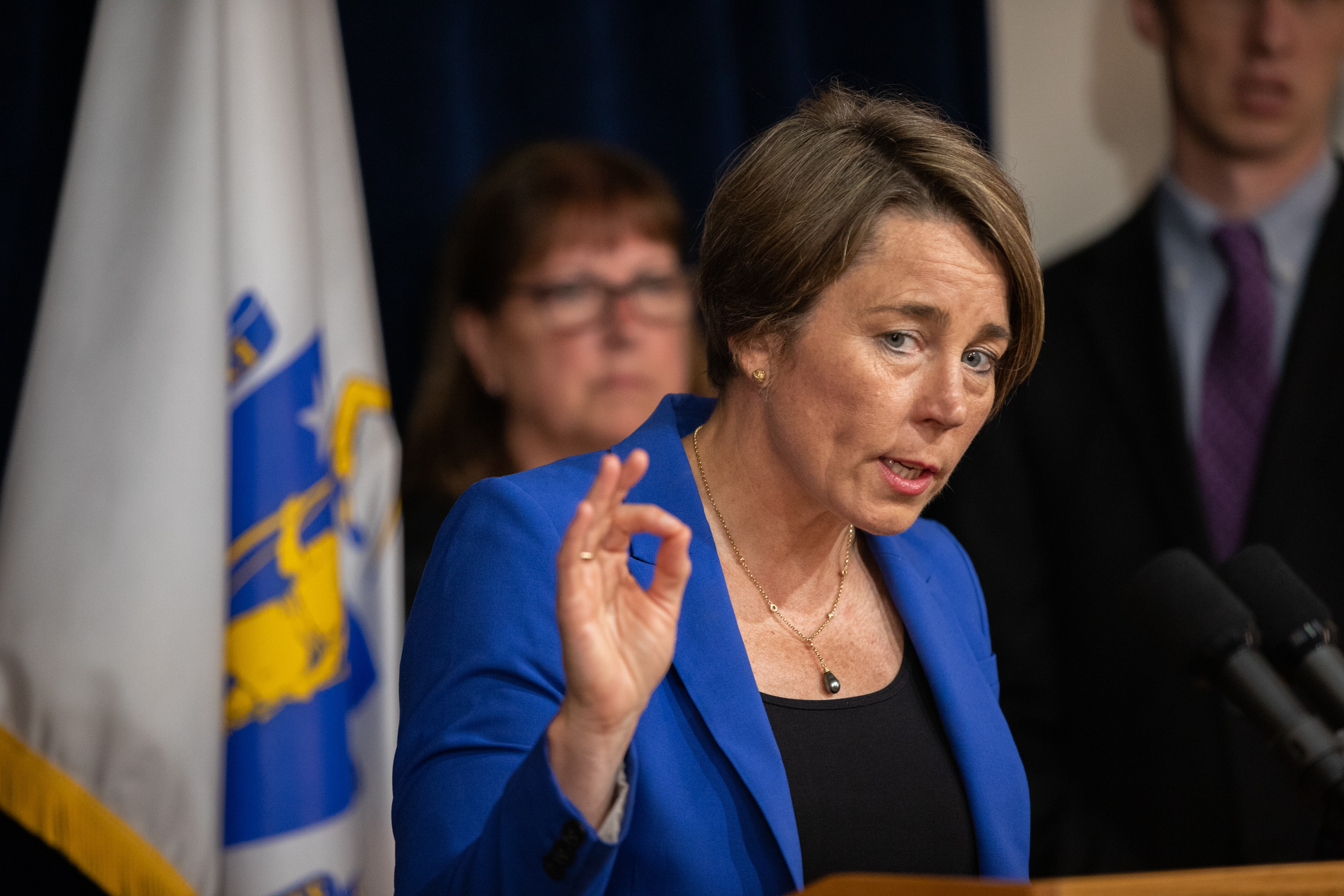
Attorney General Maura Healey speaks to reporters during a press conference on Aug. 7, 2021. State House News Service photo
Attorney General Maura Healey supports local-option rent control bills, her gubernatorial campaign spokesperson said, after Healey told GBH News’ “Boston Public Radio” program that she did not think rent control bills were a solution to the area’s high – and rising – rents.
In response to co-host Jim Braude’s question during Friday’s broadcast about whether or not she would sign a rent control bill if it made it to her desk, should she win the governorship this, fall, Healey immediately replied, “I don’t think that’s the solution.”
“I of course support and my office has supported – we have been fighting unlawful evictions, unlawful foreclosures. We have been advocating to make sure our rental assistance program is funded, particularly during this pandemic, so I support that. But also as a civil rights lawyer, I used to bring cases against landlords and property managers who didn’t want to take Section 8,” she continued, referencing Massachusetts’ ban on discriminating against prospective renters based on their source of income. “So, I’m a big believer in making sure those getting rental assistance to have support. But the way you get there [to lower rents], the overall picture, it’s not through rent stabilization. It’s through the production of more housing. We need more housing, we need more housing across income levels. And we need to look to create this statewide.”
Braude’s question was prompted by a listener asking how she would address the region’s high cost of living. In response, Healey said she was strongly focused on the housing and childcare costs, and said she supported “relaxing some of the zoning laws” to generate more housing construction statewide close to transit and close to workplaces.
However, when asked for clarification on her stance, which is in stark contrast to many progressives and Boston Mayor Michelle Wu, Healey’s campaign indicated Monday she would back local-option rent control bills like those proposed by Wu and her two predecessors.
“Maura supports the right of communities to implement their own policies on rent stabilization,” Karissa Hand said in a written statement. “She does not believe that a blanket statewide policy requiring rent control is the solution to our housing affordability crisis.”
The issue has real potential to surface in Healey’s first term if she, as current polling suggests she could, wins the State House’s corner office in November.
Wu and several other Boston-area municipal leaders have filed home-rule petitions on Beacon Hill asking for permission to institute local rent control or “rent stabilization” measures. Gov. Charlie Baker’s steadfast opposition to both bills and other factors mean these likely have little chance of becoming law this year, but could surface in the near future. Polling from earlier this year indicates the state electorate is closely divided on the issue.
Real estate trade groups have attacked the bills, warning that they would likely drive investors away from funding new multifamily buildings and drive down the value of commercial real estate in communities with these local-option measures. Many communities rely on taxes from commercial property to boost their budgets; around 70 percent of Boston’s budget is generated by property taxes. Opponents have also cited the problems they say were created by an earlier version of rent control used in Boston and Cambridge, which ended in 1994.
Rent control is increasingly seen by many housing advocates and progressives as an essential part of a broader strategy to rein in housing costs that include more housing construction.
In an appearance on “Boston Public Radio” Tuesday morning, Wu said she plans to file a home rule petition with the state legislature, pending City Council approval, next year containing “the best ideas Boston can put forward” based on the work of the city’s Rent Stabilization Advisory Commission. The commission, while weighted towards housing advocates, includes several prominent real estate leaders.
“This is something I ran on, that we have won a mandate to address the crushing levels of displacement Boston residents are experiencing,” Wu said, adding that rent control or stabilization plans will exist in tandem with efforts to build more housing.