iStock illustration
New polling data released this morning shows how housing affordability struggles don’t end in Massachusetts once someone manages to close on their house.
A survey of 850 Massachusetts homeowners by the MassINC Polling Group, sponsored by The Boston Foundation, found that 34 percent of respondents said that over the last 12 months, it has been very difficult to afford housing. And 29 percent of respondents had to skip other payments that they have to make to afford their mortgage.
Way Finders President and CEO Keith Ferry told a TBF virtual roundtable discussion of the report Wednesday morning that the data stresses the importance in investing in programs that help existing homeowners pay for repairs, and urged officials to do more in this regard.
“When we look at our gateway cities, in particular, we see a lot of homes with a lot of deferred maintenance,” he said. “It has a multiplier effect not only on the home itself. Many of these homes in our gateway cities, maybe two or three family homes, the homeowner may be on a fixed income. They can’t afford to fix up the repairs and rent out the rental units, so it can have a cascading effect if we don’t continue to invest in and grow programs like that and grow the awareness of these programs, so that people can access them.
But despite these challenges, the MassINC/TBF survey found 88 percent of respondents were satisfied with being homeowners.
Additionally, 47 percent of homeowners surveyed stated that owning a home has helped their financial stability. People who bought deed-restricted affordable homes and homeowners who utilized down-payment assistance programs reported higher levels of both satisfaction and financial stability.
The high-satisfaction levels were surprising to some roundtable guests, including CHAPA Programs Director David Gasser.
“I expected high satisfaction among these homeowners, [but] I think that the level of satisfaction was a little surprising,” he said. “I think it’s a good reminder that, despite some of the challenges and barriers that people face, homeownership still works for so many people. It’s meeting their expectations.”
Younger homebuyers highlighted the high cost of homes, with two-thirds of those aged 18 to 44 citing cost as a barrier to their purchase. Thirty-five percent of the homebuyers surveyed utilized down-payment assistance. And 28 percent of the homeowners in the survey were first-generation homebuyers.
The success of programs that help people purchase homes is important, said Jason Andrade, director of research at the Boston-based Partnership For Financial Equity. Not all families can tap into family members who can offer financial assistance and are current homeowners, he said. Down-payment and overall financial assistance programs make sure that all prospective homebuyers have access to funds rather than a select few.
“I think it’s really important when we’re thinking of certain communities that may not have families who own homes, who have equity who can leverage that, or have retirement funds, or other dollars available to support them,” he said. “So, I think it continues to be important in that kind of aspect of really addressing the racial wealth gap and making sure, especially first-time homebuyer programming and first-generation homebuyers, have that opportunity.”
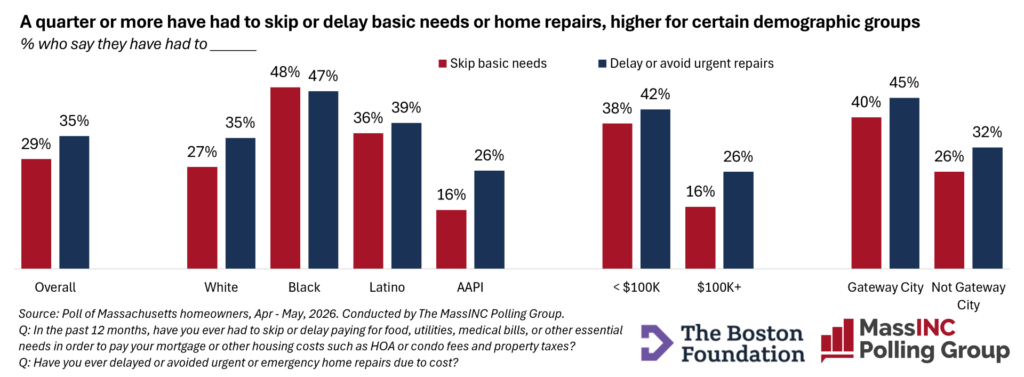
Image courtesy of The Boston Foundation
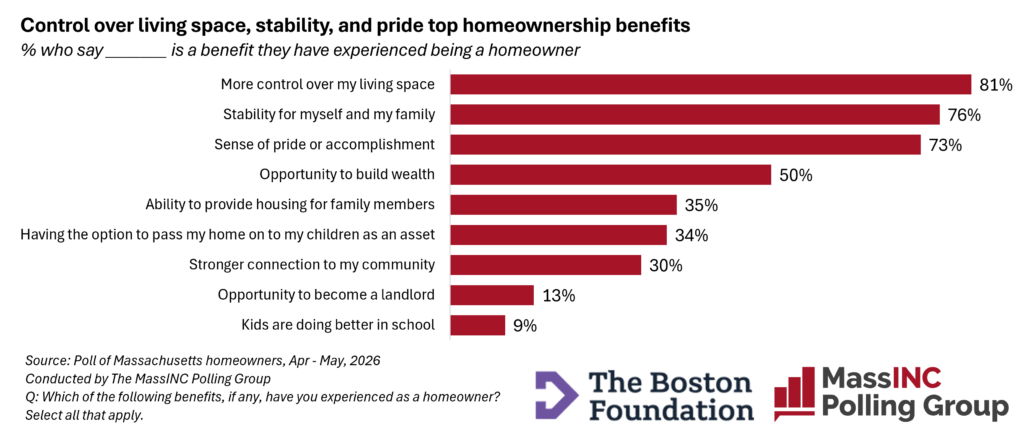
Image courtesy of The Boston Foundation