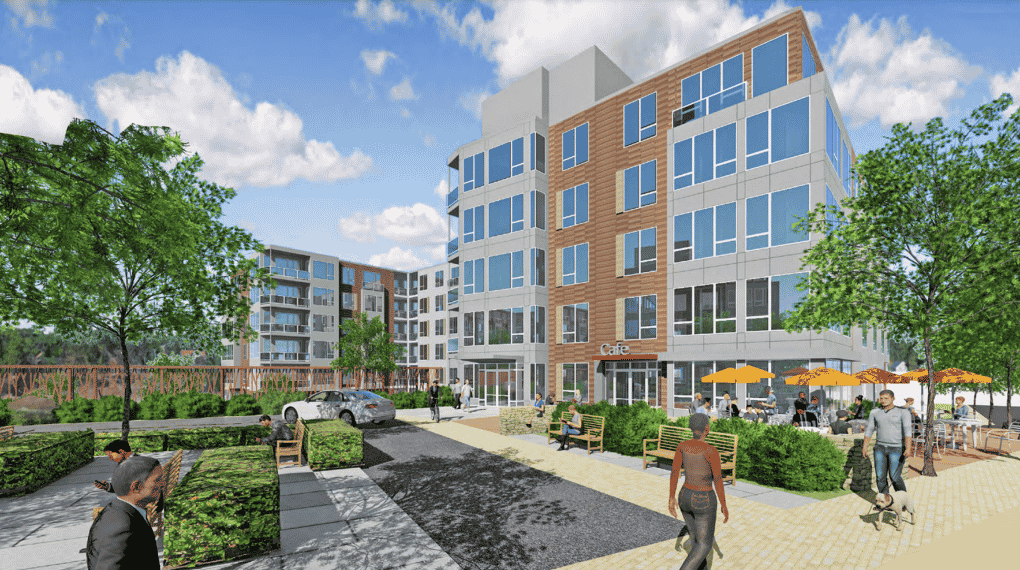
Image courtesy of Boston Planning and Development Agency and The Architectural Team
The one-two punch of rising interest rates and spiraling construction costs points to a slowdown in Greater Boston multifamily development, even as apartment rents and home prices shatter all-time records.
Apartment and condominium developers face shrinking profit margins, and some projects are having difficulty securing financing, in a sign of a pending decline in the construction pipeline.
Mount Vernon Co. Chairman and Founder Bruce Percelay said he’s shifting his multifamily development firm’s focus away from Boston as deals become harder to pencil out.
“That is the straw that breaks the camel’s back,” Percelay said, referring to rising interest rates that have sent rates on construction loans over 4 percent. “We as a company are starting to shift our focus to New Hampshire in a big way.”
Mount Vernon Co. has developed such recent multifamily properties as the 132-unit Radius and 83-unit Arthaus, both in Allston. It’s in permitting for a 99-unit apartment complex at 30 Leo Birmingham Parkway.
Boston Mayor Michelle Wu campaigned on a housing platform of raising the minimum allocation of affordable units in multifamily developments from 13 to at least 20 percent. At a city hall press conference earlier this month, Wu reiterated that she is still dissatisfied with “levels of affordability” in new developments. Wu suggested that rising housing prices are to blame for a recent U.S. Census Bureau report of a 3.3 percent decline in Suffolk County’s population between July 2020 and July 2021.
The administration is reviewing consultants’ proposals for a feasibility study on how to meet or exceed the 20-percent affordability target, before making any changes.
“There is a study out right now to really understand the market conditions and what the impact during the pandemic has been to change the economic outlook for Boston, and the best way to meet our goals to encourage growth and development and also having the resources to ensure affordability,” Wu said.
The proposed changes to the IDP and Wu’s promises of reforming the BPDA add another layer of uncertainty to developers’ expectations for multifamily projects in Boston, said Travis D’Amato, a managing director at brokerage Walker & Dunlop.
“It’s harder to pencil returns, and there’s a cloudier permitting process now,” he said. “How does it work to get a deal permitted in the city these days?”
Meanwhile, suburban apartment properties’ strong rent performance and occupancy rates throughout COVID-19 still offset construction cost increases, D’Amato said.
“Land is worth more in the suburbs than it was pre-COVID,” he said, mentioning communities with MBTA rapid transit service such as Somerville and Revere. “The majority of the pipeline is in the suburbs.”
“That is the straw that breaks the camel’s back. We as a company are starting to shift our focus to New Hampshire in a big way.” — Bruce Percelay, chairman and founder, Mount Vernon Co.
Land Costs Bid Up by Lab Rivals
Percelay said an increase in Boston’s affordable unit minimums would have the unintended consequence of reducing production of market-rate and affordable units alike by making it harder for projects to obtain financing.
Multifamily developers also continue to face hurdles acquiring development sites in the first place. Life science developers are winning bidding wars in an ever-expanding list of lab clusters in and around Boston. Some of the new lab clusters are located in areas that had been multifamily development hotspots in the past decade, such as Allston-Brighton, Watertown and Cambridge’s Alewife.
“Land costs are higher in the city, and what life science has done to the multifamily pipeline has made it that much more difficult to find land sites,” said Chris Sower, executive managing director for Cushman & Wakefield. “Lab has won that battle for the last 12 to 18 months.”
Even approved sites outside of Boston’s life science clusters face uncertain prospects. In Hyde Park, the developer of a 273-unit complex that was approved in late 2020 is looking to sell or find a financial partner.
Boston-based Ad Meloria LLC planned to build the two-building, 332,000-square-foot complex on a 2.7-acre site at 1717 Hyde Park Ave., next to the MBTA commuter rail’s Readville station. The developers now are seeking to sell or find a joint venture for the project, including 151 condos and 122 apartments, according to a Colliers listing. Ad Meloria did not respond to requests for comment.
Settling for Lower Returns, for Now
Construction industry research also indicates that Boston’s decade-old multifamily construction boom may be nearing an end.
At 9.9 percent, Boston had the largest increase in construction costs out of 12 major U.S. metros between January 2021 and January 2022, according to consultants Rider Levett Bucknall. The firm places Boston’s overall construction cycle in “mid-decline,” trailing only Seattle, Chicago and Las Vegas among 17 North American metros that are closest to the next market cycle trough.
The changing financial equations are forcing developers to accept lower returns, but not placing a significant dent in approved projects’ financial viability so far, Sower said. Multifamily developers looking to build in Boston now have to settle for projected returns on costs of 4 percent or lower, compared with the mid-5-percentage range a year ago.
“People are still bullish on Boston and are willing to adjust returns for the right project and the right return,” Sower said.
The changing economics make it harder for local developers to compete with larger national players such as merchant builders, REIT’s and insurance company-backed firms, Sower said.
Rents Surpass Pre-COVID Levels
The prospect of continued rent gains is enticing some multifamily developers to accept lower returns. Median Boston-area apartment rents have pushed past their pre-COVID levels to all-time highs, according to recent industry research.

Steve Adams
Zillow and CoStar reported that apartment rents in Greater Boston rose nearly 14 percent in 2021 to over $2,600 a month, as off-campus college renters returned to the city when in-person learning resumed.
“Rental pieces have continued to escalate, along with the other things, so that at least helps the other side of the pro forma,” said John Tocco, a partner at V10 Development, which is planning apartment projects in Everett and Worcester. “People still find Boston and Massachusetts a very attractive place to move and live, which contributes to demand.”
V10 Development is awaiting updated cost estimates for its 21-story SKY Everett tower, previously estimated at $215 million, as it prepares to seek a construction loan. The firm bought the industrial property near Revere Beach Parkway for $3.9 million in January.
Michael Procopio, CEO of Lynnfield-based multifamily developer Procopio Cos., said the region’s recent rent and condo price gains are keeping financing for new projects afloat.
“Typically as mortgage rates rise, you see prices decline. You’re not seeing that,” he said. “You’re seeing rates go up, and rents and sale prices go up, which points to our undersupply.”
Even so, Procopio is hedging his bets by diversifying the firm’s development pipeline into lower-cost markets. His firm has three out-of-state projects in its development pipeline and is seeking to acquire another half-dozen sites including locations in Florida, North Carolina and Texas.