BXP demolished a 59-year-old commercial building at 17 Hartwell Ave. in Lexington and is building a 312-unit apartment complex scheduled to open next year. The nation’s largest office REIT also is seeking to rezone three office parks in Waltham where it could develop approximately 1,500 housing units. Photo by Steve Adams | Banker & Tradesman Staff
Large-scale multifamily developments are injecting new investment and activity into the sleepy post-pandemic world of suburban Boston office parks.
Across Greater Boston, developers are pursuing plans for nearly 4,000 apartments and condominiums on sites currently occupied by office buildings, or at nearby shovel-ready development parcels previously designated for life science projects.
“When we first entered the work-from-home era, office owners were taking a wait-and-see approach and trying to understand if this is a fad,” said Levi Reilly, a partner and head of development at Boston-based Marcus Partners. “More transactions are happening as people are more comfortable with the long-term value, or lack of value, of their offices. The bid-ask gap is coming closer together, which is empowering more transactions.”
More than 15 million square feet of office space is vacant in the Route 128 submarket alone, according to a recent report by Boston-based Hunneman, representing more than a fifth of overall inventory. Close to 11 million square feet is vacant along the Interstate 495 belt.
Marcus Partners is preparing to seek approval for two multifamily developments at undisclosed locations in Boston suburban office parks, after scouting approximately 10 properties, Reilly said.
“It’s often in an area where it’s been fully developed in its prior life,” Reilly said. “It’s a flat site, often has access to highways and mass transit, and typically there is great infrastructure in place such as water and sewer.”
From a permitting standpoint, projects in commercial districts tend to generate less public opposition, he added.
Entitlement Risks, Fiscal Benefits
Vocal opposition to multifamily housing in some suburbs puts developers at risk, particularly in communities with town meetings that have the final say on zoning changes.
Brookline Town Meeting is expected to vote in May on City Realty Group’s proposal to redevelop its Chestnut Hill Office Park as a 893,000 square-foot mixed-use development, including 490,000 square feet designated for apartments and condominiums. The project has attracted opposition from some neighbors to proposed building heights ranging from 7 to 14 stories.
A handful of communities, including Andover, included office parks in their MBTA Communities districts, complying with the state requirement to add multifamily zoning districts in 177 cities and towns with transit service.
That presented an opportunity for apartment developer and landlord John M. Corcoran & Co.
In January, the Braintree-based firm and SV + Partners acquired 100 River Road in Andover for $20 million and submitted plans to replace the 1984 office-industrial building with a 5-story, 479,500 square-foot building containing 430 apartments.
The company is looking at similar development sites for acquisitions, John M. Corcoran & Co. Executive Vice President Peter Mahoney said.
“It’s very dependent upon the town you’re in,” Mahoney said. “This one was zoned for housing, so you start to feel more comfortable about where you end up for land values.”
Zom Living, a Dallas-based developer, received approval in November for 530 apartments at 37 Powers Road in Westford, another MBTA Communities-zoned site.
Homes Instead of Labs on Route 128
BXP, the nation’s biggest office REIT, has been divesting properties outside of its core markets and entering joint ventures for housing projects. Nationwide, BXP has three projects totaling 1,400 housing units under construction and another 11 projects totaling over 5,000 units in the pipeline, executives said in the company’s fourth-quarter earnings call.
One of the first broke ground last year on Hartwell Avenue in Lexington, in a joint venture with Northwestern Mutual. Another 480-unit project is planned at 133 Boston Post Road in Weston. And BXP is seeking to rezone three office parks in Waltham to build approximately 1,500 apartments.
Other developers are pivoting to housing proposals on vacant parcels previously envisioned for life science projects.
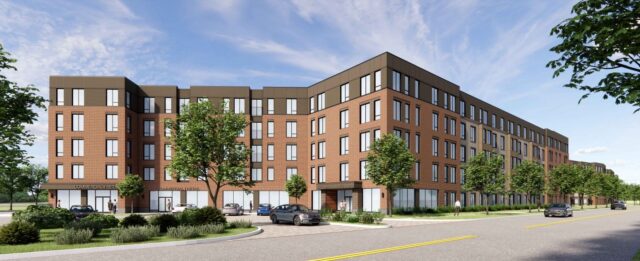
Braintree-based John M. Corcoran Co. acquired 100 River Road in Andover for $20 million last month. It proposes 430 apartments in a 5-story, 479,500 square-foot building, replacing a 1984 commercial building. Image courtesy of HDS Architecture
In Burlington, The Gutierrez Company has approval for a 235,000 square-foot life science building at 300 Summit Drive. Now, it’s seeking a zone change to build approximately 431 apartments and condominiums on the nearly 11-acre parcel, which is located near the junction of Routes 3 and 128.
Boston-based Leggat McCall Properties is pursuing a similar strategy in Woburn, where it envisioned a large life science component for The Vale, its redevelopment of the former Kraft Foods Atlantic Gelatin factory. It has agreed to sell 33 acres to Pulte Group, which is seeking to swap out a 1 million square-foot life science project in favor of 504 age-restricted condominiums.
The projects could help communities stave off a fiscal cliff, in a talking point used by several developers in presentations to local boards. Many communities are facing rising municipal costs tied to the inflationary climate, and declining tax revenues from lightly-occupied office and lab buildings.
Pulte Homes presented a fiscal analysis to Woburn officials estimating a $2.8 million annual net increase in tax revenues if rezoning is approved at The Vale.
At one of the sites in predevelopment by Marcus Partners, the project would increase property tax dollars by 60 percent from the current use, Reilly said.

Steve Adams
Seeking Frequent Transit Connections
Many of the projects are proposed at car-dependent locations, in contrast to MBTA Communities districts which were typically required to be located near transit stations.
The latest trend in suburban developments points to needed upgrades to the MBTA commuter rail system’s frequency, said Janet Cheung, program manager and regional rail lead at the advocacy group TransitMatters. Bus network upgrades also are needed to connect employment centers and housing to transit stations, Cheung said.
The group has called for the MBTA to increase trip frequency on the commuter rail network to every 30 minutes, and electrify the network to accelerate trip times.
“A lot of the commuter rail stations aren’t too well-located in relation to where development is,” Cheung said. “The big thing is ensuring more pairing with the regional transit authority buses.”