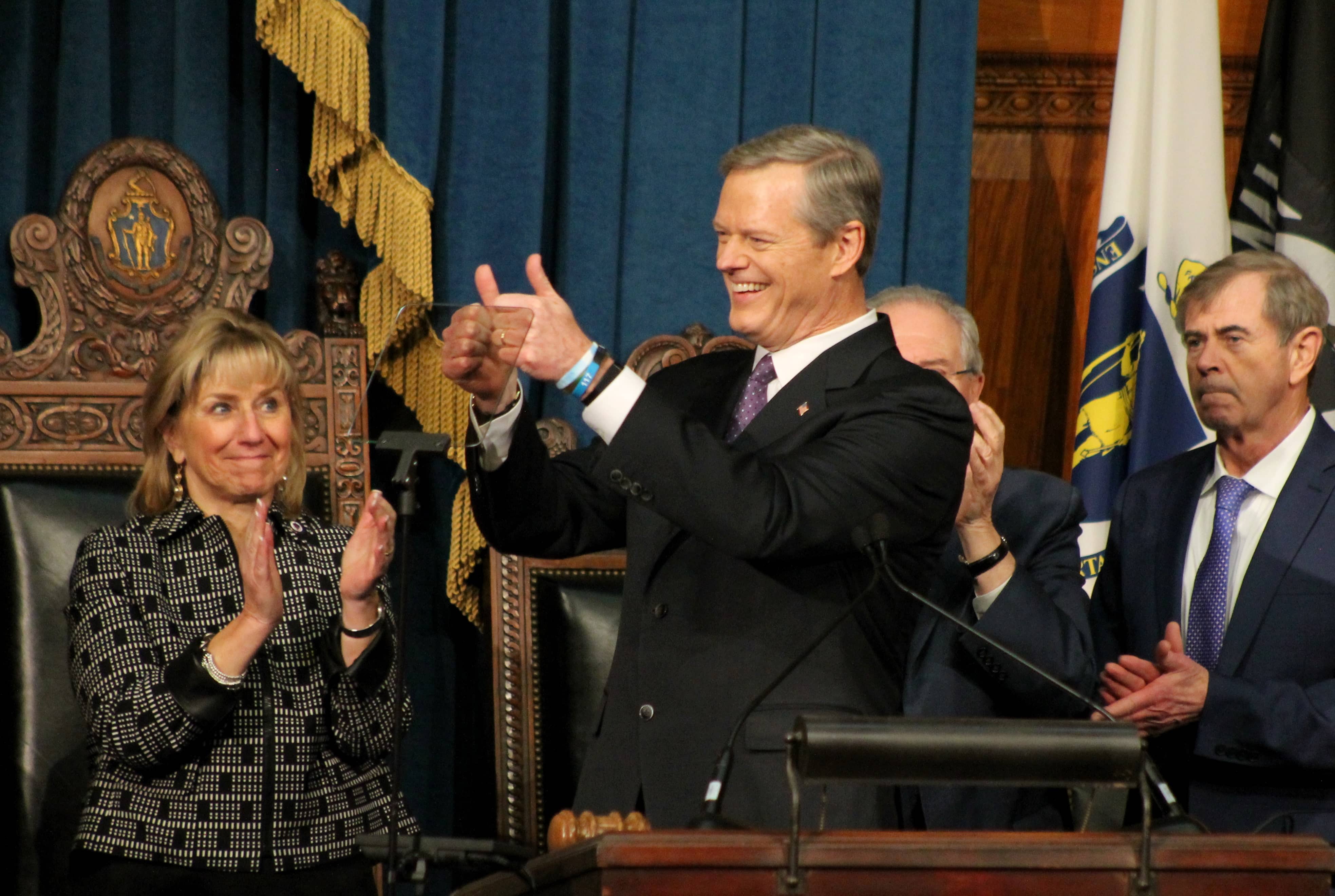
Gov. Charlie Baker gives a thumbs-up sign as he deliveres his second inaugural speech Jan. 3, 2019 in the House Chamber. (State House News Service Photo / Sam Doran)
Amid calls for health care reforms and more funding for the state’s public schools, Gov. Charlie Baker included a plea for legislative action on Massachusetts’ housing crisis in his inaugural address on Jan. 3.
“For over 20 years, we’ve produced less than half the new units of housing that we produced like clockwork in the previous 40 years,” he said. “As a result, we have limited inventory. And the inventory we have gets priced out of sight, forcing people to live farther and farther away from where they work.”
Eastern Massachusetts will need 435,000 new apartments, homes and condos by 2040 to keep up with this demand, according to the Metropolitan Area Planning Council.
Home prices in Massachusetts have climbed dramatically in recent years, more so in the Boston area. According to data from The Warren Group, publisher of Banker & Tradesman, the median sale price for a single-family home in Massachusetts in the first 11 months of 2018 was $385,000, up from $322,800 in 2013. In Suffolk County, that number was $550,000, up from $367,500. In Middlesex County, that number was $550,000, up from $425,000. The federal government recently raised the upper limit on Federal Housing Finance Agency conforming mortgages in 2019 to $688,850 for counties in the Greater Boston area.
To make a dent in the affordability crisis, Baker urged legislators to pass a limited zoning reform bill he introduced in the last legislative session, that would permit towns and cities to choose to lower their voting threshold for zoning changes from a two-thirds majority to a simple majority, among other measures.
“I believe that our housing bill was a strong step in the right direction to deal with this. It respected the need for communities to plan for themselves, but created incentives to tie development more closely to overarching strategies concerning transportation and land use generally. In the end, it failed because it was too much for some and not enough for others,” he said. “We shouldn’t let the perfect become the enemy of the good.”