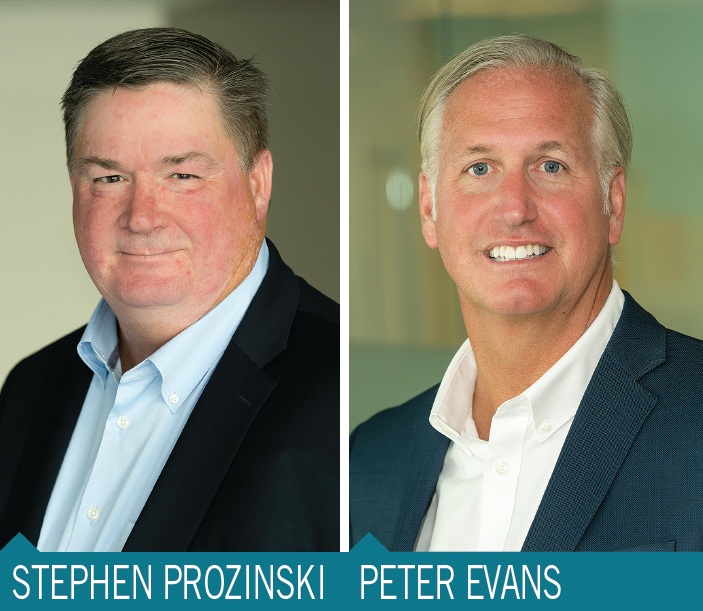
Stephen Prozinski
CEO and Chief Operating Officer, Hunneman
Age: 59
Industry experience: 37 years
Peter Evans
Executive Vice President and Managing Principal, Hunneman
Age: 60
Industry experience: 34 years
As it passes its 97th year in Boston real estate brokerage, Hunneman is ramping up its property management services to augment its leasing and investment sales business. The firm completed over $250 million in sales during 2025 and brokered over 1.9 million square feet of leases for landlords and tenants. CEO Steve Prozinski has expanded the property management business to a 16.6 million square-foot portfolio in New England. Managing Principal Peter Evans helped The Davis Companies buck the Kendall Square leasing slump by attracting a crop of seven new tenants to its 201 Broadway property in 2025. The pair has a combined 71 years’ experience in commercial brokerage, leading the largest independently owned CRE brokerage firm in Boston. Hunneman has 75 employees and 24 brokers, and emphasizes hands-on involvement by senior executives and a workplace characterized by independence and minimal corporate bureaucracy.
Q: Is property management growth a major focus of the business plan?
Prozinski: That’s not something new, but over the last 10 years or so, we’ve grown it from 3 million to 17 million square feet. It’s just a huge focus of mine, coming from the property management world, but also getting the new business and creating new clients, and putting out one of the best products possible in the industry. But that’s where we focused. I think all real estate companies are focused on them as well. It’s just a good backdrop to cover expenses. But we look at each deal to make money on management and it’s been fun. We have 35 people in our management company now, and we work for a lot of great clients.
Q: Have you expanded the geographic scope, or is most of your growth close to Boston?
Prozinski: It’s mostly the Boston area, but we are still doing more outside of our region. For groups such as Foxfield or Hilco, we do all of their accounting on their properties that are outside of Massachusetts. We’ve been pretty big on multifamily. [Executive Vice President] Carl Christie and his group have done a great job and they had a great 2025. New development is doing OK. The debt is the biggest problem right now. I think with existing assets, it’s extremely challenging based upon the uncertainty of rent control. We were out in the market with one particular property in Natick, and it just hit a roadblock. That uncertainty really drew back the prices quite a bit in various opportunities. The new stuff is different, because you can create the starting rent, but it’s so hard to get financing.
Q: What’s the outlook in 2026 for the industrial market in Greater Boston?
Evans: There’s a lot of space in the market right now that’s being repurposed, that was built out as robotics spaces. The industrial high-bay is still incredibly desirable in all markets: north, south and west. It’s just the velocity has slowed. A lot of those industrial buildings are seeking alternative uses. They have redundancies as a result of the way they were designed and built: an abundance of water and power, floor loads. They could still be used for regular, run-of-the-mill storage and distribution, but they have a lot of redundancies in the construction of the assets, because they were designed to be for robotics.
Q: Having represented The Davis Companies at 201 Broadway in Cambridge in adding seven new tenants last year, what was the key to securing those 72,000 square feet in leasing given the office and lab markets’ softness?
Evans: That was purely driven by The Davis Companies: their foresight to get it leased. For the first time in the history of real estate in Cambridge, particularly Kendall Square, you’ve got somewhere between 18 and 22 percent vacancy. We delivered spec suites, which are expensive for a landlord to build, but they were incredibly successful. We build one, lease one, we build two, we lease the other two. But we also did a full-floor user at 201 Broadway, a 17,000 square-foot tenant, and we’re having initial success at 2067 Massachusetts Ave. in Porter Square right now with Davis Companies, replicating what we did at 201 Broadway. It was a collective effort by Hunneman and Davis Companies to be as responsive as we could. 2067 Mass Ave. is about a 200,000 square foot building, and the building is probably about 30 percent occupied right now.
Q: What’s the tenant profile likely to lease a spec suite?
Prozinski: It’s a lot of companies. We did a lot of activity with companies that were on that next growth stage out of the [Cambridge Innovation Center], or they were in similar coworking situations. But we also have a national company that took a full floor [at 201 Broadway]. That has to remain confidential, but it was really the beginning. I think the first spec suite was 4,600 square feet, and then we built a 6,000 square-foot suite. Tenants don’t have a ton of vision. There’s so much space available in the market that they want to understand exactly what they’re getting, and don’t want to think about the buildout or construction or coming out of pocket with additional tenant improvements. So these are pure spec suites, some furnished, some not furnished, but they were pretty generic: three or four offices, a large conference room, kitchen, open area, bullpen. Very rarely did we have to add an extra office or make significant modifications to the spec suites.
Evans: I think if you want to be in Kendall Square, you’re focused on Kendall Square and access to the key educational infrastructure is critically important to these drug companies. I don’t think there’s ever been a more important time to have a broker engaged to represent your interests. When there’s no space, it’s easy.
Q: Is the coworking space competing against the more traditional lab space given the high vacancy rate?
Evans: Coworking space provides what we call the ultimate of flexibility. But you pay for that flexibility. It actually is more money to be in a coworking space than it is to be in a permanent space. But some companies just aren’t there yet. They can’t see beyond the next year. I think the shortest-term deal that we did was five years, but most of them are seven. Established companies that have got product, foresight, existing business. Coworking is still a place for exploring and developing and creating.
Q: How is Hunneman using AI to augment its services?
Prozinski: We had a broker meeting this morning, and we threw that out there for all of the brokers: “What are you using? How many people use it?” It was very interesting the conversation, because it’s needed in some cases, and it’s interesting how much people rely on it to help them in their business. But I think you still need to check everything that comes out of it, and that’s, that’s the one thing that needs to happen, is to make sure the information that they’re kicking it out works well, but we’ve been using it a little bit.
Evans: I also think it’s a generational thing. You know, Hunneman is approaching 100 years old, and we’ve got a lot of brokers that have been here for north of 25 years that aren’t utilizing it as much as our younger brokers. But as Steve mentioned, it’s a great tool, but still the application isn’t perfect, and it doesn’t matter which one you’re using. I use ChatGPT.
Prozinski’s Five Favorite Golf Courses
- Old Head
- The Country Club
- Tralee
- Eastward Ho!
- Framingham Country Club
Evans’ Five Favorite Golf Courses
- Eastward Ho!
- The Country Club
- The Kittansett Golf Club
- Sankaty Head Golf Club
- Framingham Country Club