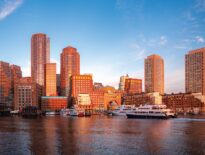
A Beacon Hill bill would create liquor licenses specifically for a select few Boston neighborhoods, to help boost local retail districts with more restaurants. iStock photo
A rising thread of criticism says some of the speed of development in the Seaport came at the expense of other neighborhoods – and specifically, local entrepreneurs’ access to profit-generating liquor licenses.
But it doesn’t have to be this way, retail experts say. An emerging middle ground proposal wouldn’t run the risk of devaluing existing liquor licenses by flooding the market with new licenses, either.
“The key here is restricted neighborhood-specific licenses,” said Adam Barnosky, a real estate attorney at Ruberto, Israel & Weiner and who co-chairs the firm’s hospitality practice group. “Restricted licenses are an incredibly important economic development tool, and they help to address the city’s license disparity.”
A vast majority of Boston’s more than 1,400 liquor licenses are transferable, which means a restaurant or bar owner can sell it to another restaurant or bar in any other part of the city. That’s garnered criticism in recent years, as bar and restaurant owners in rapidly developing parts of Boston obtained their licenses from businesses closing in other areas of the city.
That can put a headwind on economic revitalization in the areas where liquor licenses are dwindling and stimulus is needed the most, the argument goes.
“A vibrant neighborhood has bodies on the street morning, noon and night,” said Ann Ehrhart, founder and CEO of retail and restaurant brokerage Everstreet. “Having the alcohol component is a big piece of having people out and about on the street in the evening in the nighttime.”
Attempt to Stem Migration of Licenses
When Doyle’s Cafe in Jamaica Plain shuttered, its license sold to Davio’s Northern Italian Steakhouse on Fan Pier, the Boston Globe reported. The liquor license for the closed Canary Square in Jamaica Plain transferred to Alamo Drafthouse Cinema’s planned Seaport location, Universal Hub reported – the fourth time in four years a Jamaica Plain liquor license departed for the Seaport.
The state legislature has periodically issued neighborhood-restricted licenses – those that can’t be transferred out of a neighborhood. A 2014 rollout of new liquor licenses included 60 restricted licenses with the stipulation they can only be used in designated neighborhoods: Dorchester, East Boston, Hyde Park, Jamaica Plain, Mattapan, Mission Hill, Roxbury and Main Streets Districts designated by the Boston Planning & Development Agency (then known as the Boston Redevelopment Authority).
A home rule petition passed late last year permitted four new liquor licenses restricted to the Bolling Municipal Building in Roxbury’s Nubian Square. Another proposal before the legislature, set in motion by Boston City Councilors Bryan Worrell and Ruthzee Louijeune calls for a fresh wave of restricted licenses to come out for select areas in neighborhoods such as Dorchester, Hyde Park, Mattapan and Roxbury over a five-year period.
Backers say the geographic restriction is important: Unrestricted licenses means the potential for more of the same flow of liquor licenses to hot development districts like the Seaport. But it also means avoiding the wrath of existing liquor license holders, who could argue that a flood of new licenses devalues their own – sometimes purchased in the high six-digit range.
Ehrhart said the state’s liquor license structure is prohibitive for small and local new ventures, at the expense of equity.
“I understand the argument for keeping the system the way it is now,” Ehrhart said. “There are restaurant outfits where one of the biggest assets on their balance sheet is owning liquor licenses. You can’t say to them, ‘Well, this isn’t an equitable system, so we’re making liquor licenses free so those hundreds of thousands – if not millions – of dollars of liquor licenses on your balance sheet are now a goose egg.’”
“But there does need to be a way to make it easier for someone to be able to get a liquor license,” she added.
Leveling the Playing Field
Providing new, neighborhood-restricted licenses also enables smaller businesses without a hefty financial backer a shot at opening their bar or restaurant without the costly headache of finding a liquor license elsewhere in the city and having to fork over at least a half-million dollars to procure it.
“The idea is this helps bring people to the neighborhood,” said Todd Corbett Smith, founder and managing partner of Corbett Restaurant Group. “Adding $500,000 to the opening cost is not good for owners. You’ve got to get some of the barriers out of the way, so I think that’s probably the compromise.”
Lower barriers to entry in terms of opening a bar or restaurant are what helped fuel the thriving food scenes in other New England cities like Portland, Maine; Portsmouth, New Hampshire; and Providence, Rhode Island. Finding a way to lower the barrier in Boston will be crucial to driving interest in parts of Boston the city would like to see redeveloped.
While Ehrhart doesn’t see a perfect solution, she also points to other ideas beyond neighborhood-restricted licenses, such as licenses restricted to a building, that are issued not as assets to own but through certifications to pay a nominal fee to sell liquor for the time of one’s tenancy.
There might be a variety of potential solutions, but all interviewed for this story agreed on the importance of liquor licensing availability to fuel economic vitality of a neighborhood.
“Thinking about making a destination and bringing outside dollars into a neighborhood, well, entertainment is a huge way to do that,” Ehrhart said. “When you start adding these layers of all the ways to start getting people to come to a neighborhood or a square or a destination, being able to have some sort of alcohol component when they get there is really important.”
Email: camsperance@gmail.com