Carr Properties’ “signature scent” wafts through the lobbies of the Washington, D.C.-based developer’s eight-building office portfolio, including One Congress and 200 State St. in Boston. Photo courtesy of Carr Properties
Bracing notes of lemongrass and peppery spice greet visitors in the Lenox Hotel lobby, a sudden contrast to the diesel exhaust fumes on Back Bay streets.
Delivered in canisters every few weeks and hooked up to the hotel’s HVAC system, the Lenox’s signature scent has been an element of the hotel’s image for 18 years.
“A recognizable scent brings you back to the place you first smell it, and you associate whatever experience you had with that place,” said Dan Donahue, president of Saunders Hotel Group. “It conjures up how you felt when you were here. We are proud of how we take care of the guests, and create an experience that makes them want to come back again.”
In recent years, developers of luxury condominium buildings have sought to distinguish their properties and drive sales by optimizing professionally-devised aromas.
“It’s an exhaustive exercise to find the right fragrance, and one that we really like to get feedback on from our residents,” said Rich Baumert, a partner at Millennium Partners, developer of the Winthrop Center and Millennium Boston towers.
Office landlords have followed the lead of the hospitality industry and made fragrance part of their branding, seeking to tap into psychological connections between scent and location.
“When installing a scent, you have to be careful to not go to extremes. I’ve walked into a building where it’s just the first thing you notice,” said Linda Cogburn, senior vice president of operations for Carr Properties, an owner of the One Congress and 200 State St. office buildings.
Even Logan International Airport is planning to add its own “signature scent” as part of a $30 million renovation of 10 restrooms, Massport CEO Richard Davey told WBUR earlier this month.
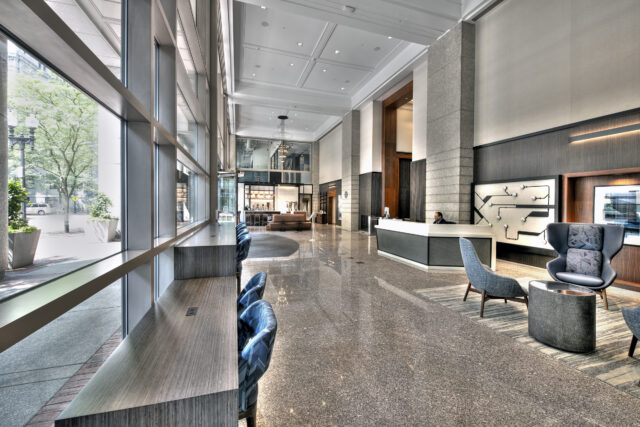
Recent lobby updates to 200 State St. in Boston were preceded by the introduction of Carr Properties’ “signature scent.” Photo courtesy of Carr Properties
Taking Hotel Scents To-Go
Unique scents are a cottage industry for some hotel and condo chains, which sell them online.
So popular is its fragrance that the Lenox Hotel now sells diffusers, candles and home fragrance sets with its signature scent, ranging from $40 to $110, on its website and in a lobby shop. More than 50 subscribers receive monthly shipments.
“It’s become a mini-business for us. It has become our calling card,” Donohue said.
Other hotel groups such as St. Regis promote scents on-site and online, with back stories designed to enhance their branding. St. Regis’ scent pays homage to Gilded Age society balls hosted by Caroline Astor, mother to the founder of the original New York hotel.
Raffles’ hotels proprietary scent – also available for purchase as perfume, diffusers or room spray – is designed to bring the aroma of the Plumeria obtusa flower outside its original Singapore location to guests and online shoppers.
And the Newbury Hotel hired New York-based “olfactory expert” Dawn Goldworm to create a custom scent, “Birch,” which wafts through the lobby and pre-function floors. Goldworm’s firm, named 12.29, previously worked with developers of a $29 million south Florida condominium project seeking to stimulate sales.
Donahue credits his wife’s purchase of scented candles at a Jersey Shore gift shop with the idea of adding a proprietary scent at the Lenox. The hotel originally used mini-diffusers that plugged into walls, before contracting with ScentAir, a Charlotte, North Carolina-based company that’s an industry leader in fragrance systems for the commercial real estate industry.
Typically, scent diffusers are not connected to guest room floors, or restaurant areas.
That has created another business opportunity for firms such as FreshAir Sensor, a Lebanon, New Hampshire-based company that sells guest room air monitoring systems to hotels. Hotels then can upsell rooms to guests that are certified to be free of offensive odors such as tobacco and marijuana smoke.
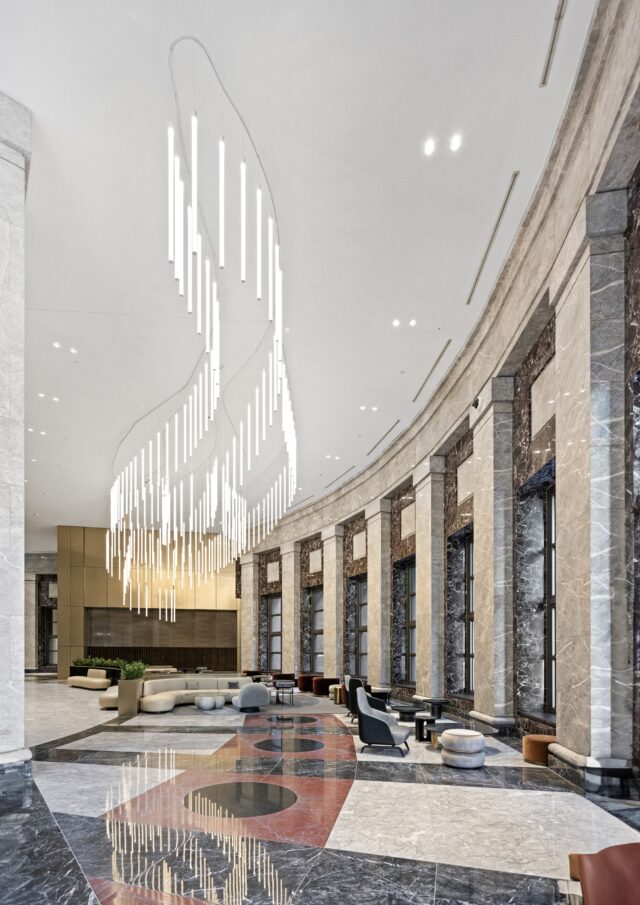
International Place in Boston infuses naturally-inspired scents through its lobbies to simulate elements of the environment. Photo courtesy of Columbia Construction
A Hospitality-Driven Approach to Office Lobbies
As office landlords have prioritized hospitality-like amenities in recent years, class A buildings in Boston have chosen signature scents for lobbies and common areas.
Carr Properties, owner of One Congress and 200 State St., introduced a proprietary fragrance just before the pandemic, Cogburn said.
“Hospitality is a big part of our experience,” Cogburn said. “Gone are the days where lobbies just have a couple of furnishings. Now it’s really an extension where people can interact and engage, and scent has actually been a phenomenal addition. People come in and they notice there’s something different.”
ScentAir canisters pump Carr’s fragrance into sections of the lobby, but not areas near restaurants or tenant spaces. Choosing a vendor that provided flexible and unobtrusive equipment was paramount, Cogburn said. If an event with food service is being held on a mezzanine level, scent levels can be dialed down temporarily.

Steve Adams
“You really have to be thoughtful about it and understand the [HVAC] zones, as well as how it could impact customers and the other spaces,” she said.
The Chiofaro Company also contracts with ScentAir at its International Place office complex, following a non-scientific review of potential scents.
“Everything at this company is by committee. We had a couple of different options, and people voted on their favorite, and then we went with what [founder Donald Chiofaro] chose,” quipped Donald Chiofaro Jr. during a recent tour of the updated office towers.
Marketing specialist Kait Shields said the fragrance has “green and fresh” notes that complements the sunlit atrium lobby and waterfall
“People seem to enjoy it, and it ties in all of our themes together, hopefully,” Shields said.