Photo courtesy of NADAAA
Nader Tehrani
Founding principal, NADAAA
Age: 62
Industry experience: 35 years
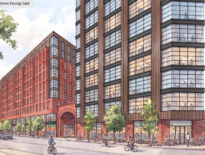
Boston Society for Architecture’s new home at 99 Chauncy St. is intended to raise the BSA’s visibility and build connections between the industry and general public. For a design that reflected those goals, it turned to NADAAA, a Boston-based firm founded by award-winning architect and professor Nader Tehrani in 2010.
In March, the organization announced that NADAAA won a design competition to create a new 8,700-square-foot downtown civic hub for exhibitions, collaboration and public programming scheduled to open in early 2027.
Raised in Pakistan and a former resident of South Africa and Iran, Tehrani taught at MIT School of Architecture and Planning, including as department head from 2010 to 2014, and is a former dean of The Irwin S. Chanin School of Architecture at The Cooper Union.
Q: What prompted you to enter the competition for the BSA space?
A: As the local chapter of the AIA, we just thought it’s important because it represents both the profession and the discipline. And from a local perspective, it’s an avenue to connect not only with architects but the public at large. So, it has both an educational function, which I think is important as a teacher, and it also has a communicative function to be able to allow others who are not in the field to enter into the space and widen their perspectives. [NADAAA has] done four schools of architecture, and many of the things that are related outside of buildings and houses for people, so buildings for institutions we feel are very important.
Q: What is the existing condition of the 99 Chauncy St. space?
A: It’s a raw space, currently, on the first and second floors, with the Theater District on one side, and Chinatown and downtown on the other, and a block and a half from the Common. It really is at the center of Boston.
Q: What are the key goals of the project?
A: The design is not set, but it’s in progress. It’s a very fast-paced project because of budgetary and schedule reasons. One of the challenges obviously is the streetfront presence, so people can see into the gallery, the lectures, the events that go on that.
Because it’s on two stories, it produced a challenge: how do you connect the first and the second floor? How do you not alienate the people who work there to the public activations that go on downstairs, and how do you encourage the people downstairs to come upstairs? A lot of the strategies that we have deployed are trying to reinforce the connections, to make the space more public.
There are several double-height spaces that connect the two spaces. That’s the beginning of creating a civic connection between the actual workings of the institution and the civic ambitions.
Q: What do you consider to be NADAAA’s niche in the industry?
A: What’s unique about our firm is that we have educational backgrounds in different disciplines: we are designers, we do architecture, we do interiors and we do fabrication. We have about 8,000 square feet of design-build exhibits. We don’t specialize, but it’s hard not to gain expertise in different arenas. We have done a vast array of houses, on the more expensive and economical side, and a good number of collective housing for institutions and developers. But maybe the most distinct thing in our portfolio is we have designed and built four schools of architecture.
We have a laboratory, and we have built a lot of material mock-ups. You can make models as a central part of your design process, but even better you can build mock-ups for the clients so you’re not relying on the industry to do that. You can be more proactive in means and methods. In some instances, we also have built out interior fitouts, and bespoke details for millwork and things like that. We have scaled up to do that, although I wouldn’t call us a fabrication shop. It gives us a direct conduit to the fabrication, innovation and invention of certain details.
Currently, we are doing a boutique in the [Prudential Center] for Aesop, a small project but highly specific. We are doing the renovation, extension and alteration of the Art of West Asia and Ancient Cyprus at the Metropolitan Museum of Art in New York City. Construction will be complete in two months, and the opening is a year from now.
Q: What is your approach to innovation in the use of building materials? Does brick still have a role in modern construction?
A: That is the cornerstone of a lot of our work, both early and recent. We like to think of ourselves as architects who are deeply invested in natural exploration and delving into the means and methods of how different trades work. It is a way of learning about how different craftspeople make certain things and by learning those, to replicate but radicalize what they do.
We have done explorations with brick and early on we did explorations with wood. We continue to design and build with it; even the small project for Aesop will include it. It’s very Bostonian. The load-bearing brick of yesterday that would have 2-foot-thick walls is not the thing of the present, but we still work with brick as a curtain wall. It stems from the idea that it’s an Earth material.
Tehrani’s Five Favorite Local Eats
- Lobster Roll, Kelly’s Roast Beef, Revere Beach
- Horiatiki, Kava Neo Taverna, South End
- Shrimp Scampi, The Daily Catch, North End
- Chelo Kabab Koobideh, Hafez, Watertown
- Milanese, Pammys, Cambridge