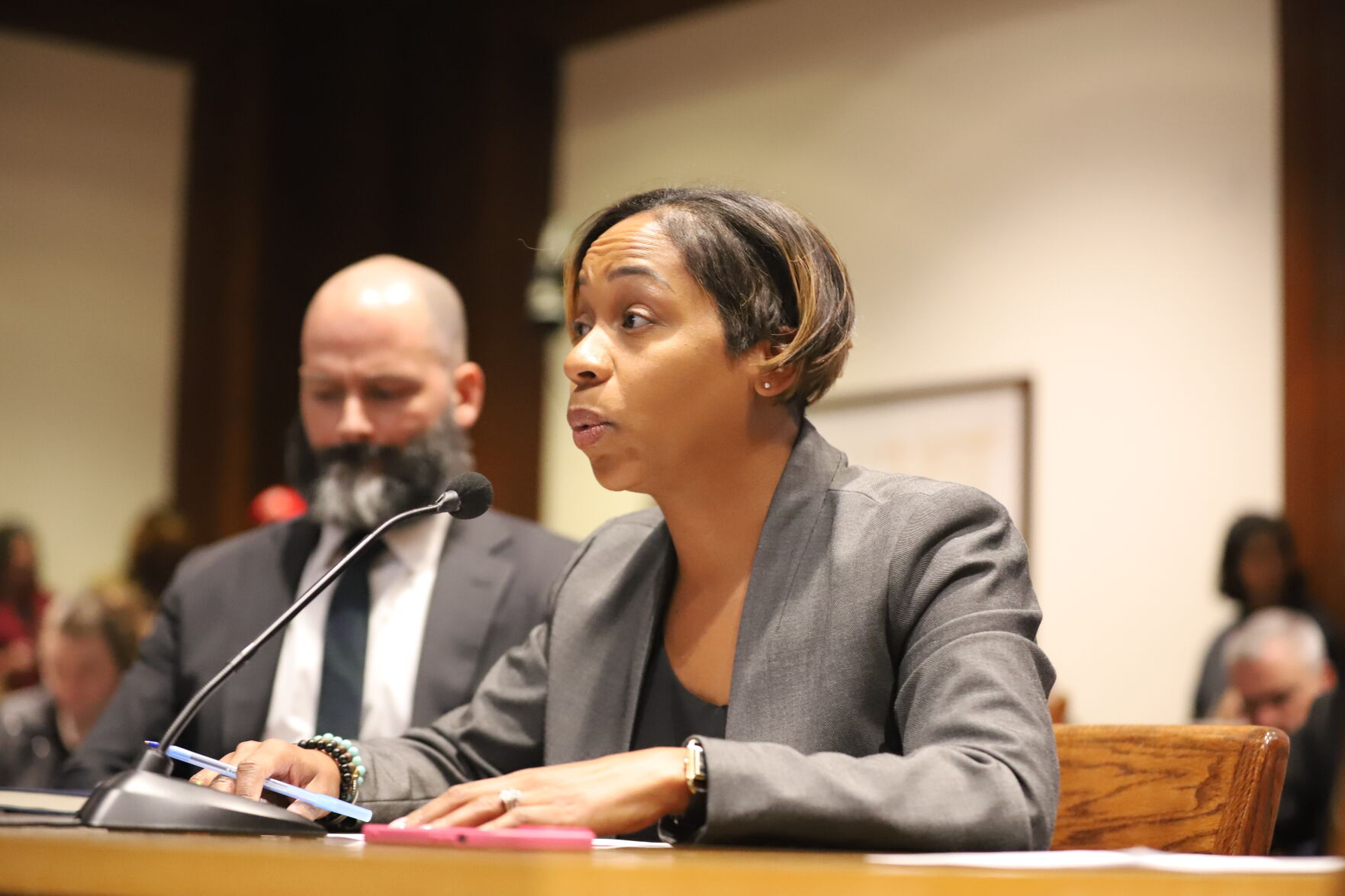
Attorney General Andrea Campbell testifies before the Judiciary Committee at the State House on Nov. 25, 2025. Photo by Ella Adams | State House News Service
Attorney General Andrea Campbell’s office filed a lawsuit Thursday morning against nine of the remaining 12 towns that still haven’t complied with the MBTA Communities zoning law.
The AG’s office named Dracut, East Bridgewater, Halifax, Holden, Marblehead, Middleton, Tewksbury, Wilmington and Winthrop in the suit, citing their “continued noncompliance” with the law.
The 2021 MBTA Communities law makes the 177 towns and cities directly served by or near MBTA stations allow multifamily housing in certain areas within their borders by right. However, municipalities must decide on their own how big and where these zoning districts are, how big the buildings can be and whether to allow more homes in these districts than each community’s state-mandated minimum. Existing multifamily buildings could count towards a district’s minimum number of units.
Most towns had until July 14, 2025 to pass MBTA Communities-compliant zoning
Of the towns being sued, only Dracut hasn’t even notified state officials of how they plan to comply with the law. All other towns have at least proposed potentially compliant zoning plans to their Town Meetings, but none have passed. In some cases, town officials tried multiple times, in other cases town meeting members didn’t even vote on the plan before referring it back to planning officials for another try.
“Massachusetts has a housing crisis, and our Commonwealth is unaffordable. The vast majority of MBTA Communities deeply understand that developing more multi-family housing will improve our ability to attract businesses, retain our families and residents, and ensure that Massachusetts remains the greatest state in the country to live, start a family, and work,” Campebell said in a statement. “While bringing a lawsuit is never my first choice, courts have consistently ruled that compliance with this law is mandatory, and the urgency of our housing shortage compels me to act to ensure that all MBTA Communities meet their legal responsibilities. My office remains ready to assist any town working to come into compliance with the law.”
Campbell’s lawsuit is asking for a court order forcing all nine towns to pass zoning that complies with the MBTA Communities law and submit their plans to the state for certification, but doesn’t ask for a specific deadline. The attorney general’s office said state officials “remain available to offer guidance and technical support to all communities as they move towards full compliance with the statute and regulations.”
Legal advocacy group Lawyers for Civil Rights sent letters to the 12 towns that still haven’t complied with the MBTA Communities Law – the nine named in Cambell’s suit plus Carver, Freetown and Rehoboth – warning that they were at risk of civil rights lawsuits from the group. LCR had earlier sued the town of Holden over its declared intent not to comply with the laws.
“All of the noncompliant towns are highly segregated, with white populations of 80% or more. The towns’ refusal to comply with the law perpetuates pervasive racial segregation and illegally prevents critical housing opportunities for Massachusetts residents of color,” Jillian Lenson, a senior attorney at LCR, said in a statement.
A spokesperson for Campbell’s office said it didn’t sue Carver and Rehoboth because both until Dec. 31, 2025 to comply with the law, and it wanted to give them more time to comply. Freetown was scheduled to vote on a potentially compliant multifamily district last week but had to postpone because of the snowstorm, with that vote rescheduled for Feb. 2.
A report published earlier this week by Boston Indicators, the think-tank affiliated with The Boston Foundation, found only around 7,000 new homes under construction or in the planning stages in MBTA Communities districts, compared to the more than 100,000 homes state officials had hoped for when the law was first introduced.