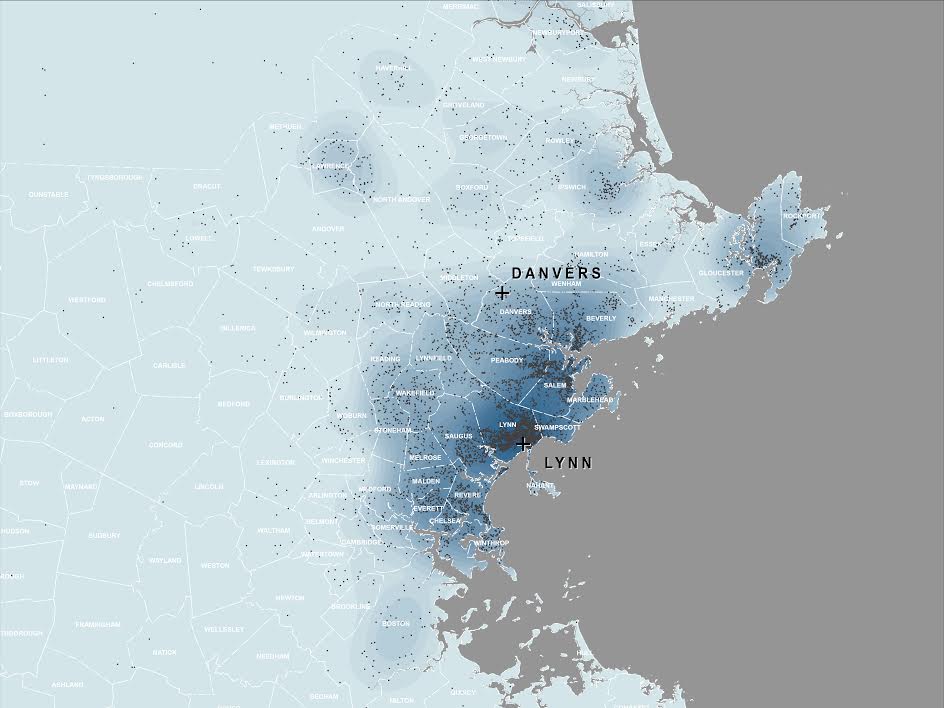
Demographic map of the North Shore region, demonstrating the cities and towns from which the Lynn and Danvers campuses draw students, faculty and staff.
Colleges and universities across the state are preparing for the start of another school year. So, too, are the cities and towns that host these schools. Though each pairing is unique, it is no secret that the traditional “town and gown” bond can be at turns tenuous, uneasy or downright tense. In the midst of this context, community colleges set a contrasting and forward-looking example.
Far from being polarizing entities, many community colleges maintain deep connections to the surrounding community, and are marked by rich student demographics, many of whom work full- or part-time jobs in the area while they advance their academic and professional careers. This fall, North Shore Community College – bolstered by a brand new master plan – will continue to celebrate the close bond it shares with its broader community and student population through innovative partnerships with local civic, institutional and corporate organizations.
Founded in 1965, North Shore Community College (NSCC) operates campuses in the cities of Lynn and Danvers. For five decades, NSCC has played an integral role in the economic and educational landscape of the state, offering its students degrees and certificates in some of the most crucial skillsets that our state and national economies need. In order to maximize the impact of NSCC’s programs, they contracted Sasaki Assoc. to collaborate with them on the completion of a master plan for its two campuses. Completed this summer, the master plan lays the path for future development on these physical campuses and illustrates avenues for embracing key partnerships that expand their value offer for their 16,000 students and host communities.

Tyler Patrick
Anchored by two-year workforce-driven degree programs and certificates, the country’s 1,100 community colleges play a crucial role in local and regional economic development. Establishing formal arrangements with their host communities amplify their impact. Industry partnerships offer students real-world job experience and feed qualified employees directly into the job market; arrangements with local school districts and universities expand access to educational opportunities for a broader cross-section of community members. As we kicked off the planning process, it became clear that NSCC’s dyed-in-the-wool approach to partnering with their community had already led to several synergistic opportunities. The plan focuses on cultivating these opportunities and developing them into formal relationships that afford benefits to both NSCC and the communities it serves.
Central to the completed master plan is leveraging the impact of CommUniverCity – an urban education-workforce development collaboration between NSCC, Salem State University and the city of Lynn. Established in 2015, CommUniverCity focuses on the education and workforce needs of Lynn, the largest urban center in Essex County. The program uses a “birth-to-career” model to create pathways to education. Outreach programs throughout Lynn Public Schools educate children and parents on college options, with a special focus on low-income families and potential first-in-family college graduates. High schoolers can partake in early and dual enrollment opportunities at NSCC, while NSCC students can transition into select baccalaureate programs at Salem State University. NSCC will increase its involvement over time through tying its programmatic offerings to workforce demands in fields such as manufacturing, healthcare, financial services, construction, life sciences and information technology. Many graduates find employment in the immediate area, completing the “birth-to-career” loop, and become direct contributors to the economic productivity of the region.
Smart Space Usage Limits Duplication
In addition to industry and academic partnerships, exploring synergies with other community organizations can realize significant programmatic and financial benefits for both schools and their communities. For NSCC’s Lynn campus, there are several opportunities that create further in-roads into the community while providing students expanded opportunities for recreation and experiential learning, such as a local youth recreation organization and a radio station. A link between a local museum and arts organization could represent another symbiosis; sharing use with existing visual and performance arts facilities in Lynn provides students access and opens up many options for co-hosted arts events for the betterment of the whole community. These smart spatial usages, such as with the arts organization, offer financial benefits to each party through limiting the duplication of expensive facilities. Reciprocally, NSCC offers space for community events on its campus, such as meeting rooms and outdoor recreational amenities. All of these opportunities to “see and be seen” continually blend the community’s goings-on with the education atmosphere.
Organizational partnerships such as these should also be complimented by spatial and design recommendations that encourage increased physical interaction between “town” and “gown.” For the NSCC master plan, we encouraged NSCC to celebrate the main seam between their Lynn campus and the community – Broad Street – by relocating the campus bookstore and the culinary arts and cosmetology program spaces to this prominent locale. Placing these service-based programs at the campus’ “front door” promotes community integration, access, and use, perpetuating a symbiotic ethos of community and pride.
The tradition of tension between “town and gown” traces its roots to a time when campuses isolated themselves from the community. North Shore Community College provides a powerful example of how partnering with the community opens up opportunities that neither NSCC nor the city of Lynn could achieve alone. These partnerships demonstrate how a school can advance its academic mission, expand access to educational opportunities, make more efficient use of resources and provide spaces for campus and community to come together.
Tyler Patrick is a planner and principal who works primarily in the campus studio at Sasaki Assoc. in Watertown.