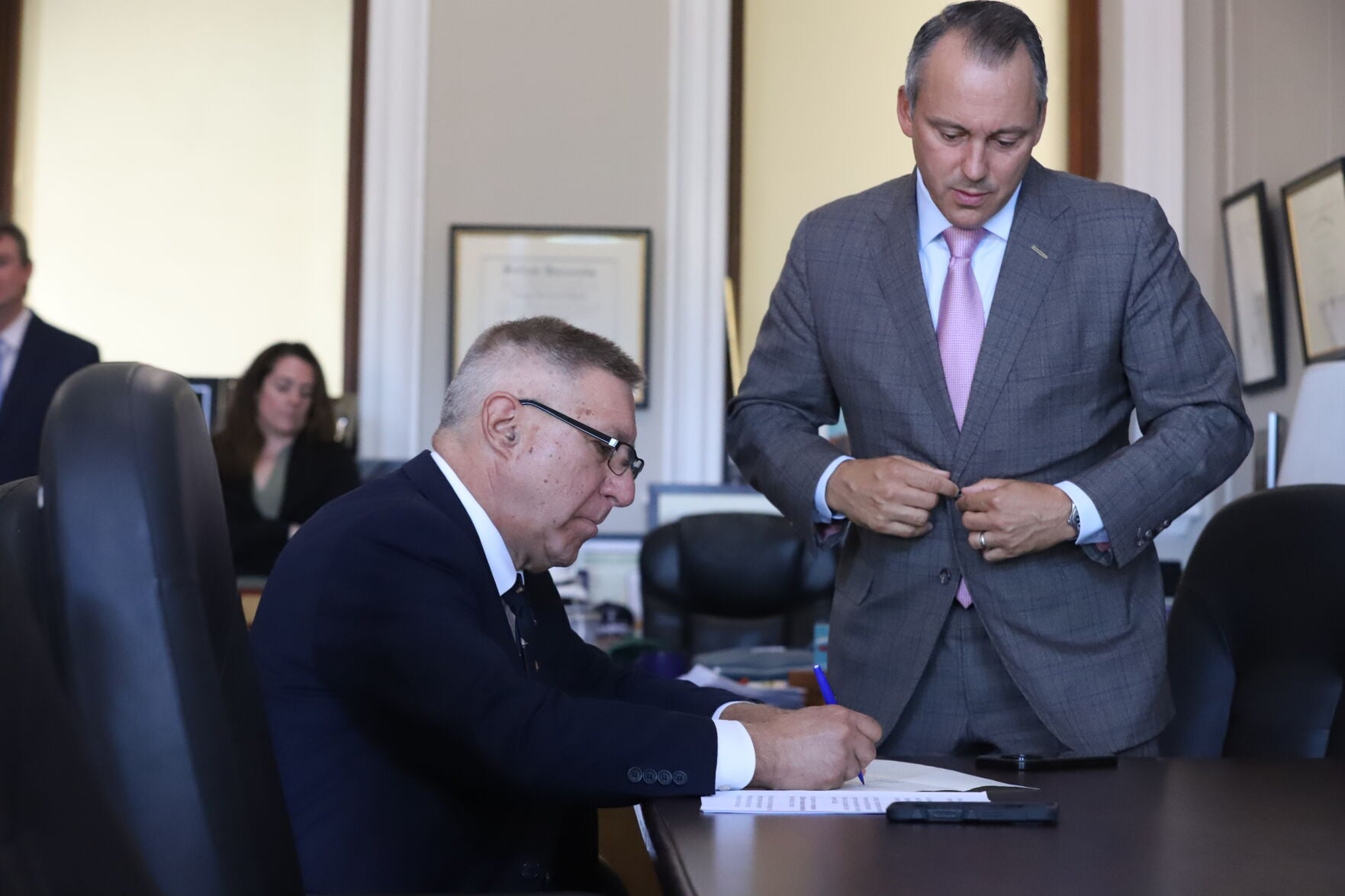
Senate Ways and Means Chair Michael Rodrigues signs a conference jacket for a negotiated surtax supplemental spending bill on June 2, 2026 in the House Ways and Means office at the State House. House Ways and Means Chair Aaron Michlewitz stands at the table. Photo by Ella Adams | State House News Service
House and Senate negotiators agreed Tuesday on a $1.56 billion spending package that strikes a middle ground on the distribution of income surtax funds for education and transportation, and adopts the House approach to mitigating the fiscal impacts of recent federal tax changes.
The conference committee report, which the branches could sent to Gov. Maura Healey this week, lands closer to the Senate’s push for a more balanced distribution of surtax dollars while preserving major transportation investments favored by the House.
Negotiators also resolved one of the biggest policy disputes between the branches by linking implementation of certain federal tax code changes to the outcome of a November ballot question that would reduce the state’s income tax rate from 5 percent to 4 percent.
Of the surtax-funded spending, $794 million would support transportation initiatives and $558 million would fund education programs, representing a roughly 59-41 split. The House-passed bill had directed $885 million to transportation and $417 million to education, while the Senate version proposed $753 million for transportation and $591 million for education.
The largest transportation investment remains state support for the MBTA, and negotiators settled on a figure between the amounts favored by each branch. The agreement provides $595 million for MBTA operations, infrastructure and workforce improvements, compared to $740 million in the House bill and $535 million in the Senate version.
The package includes $450 million for operating assistance, $60 million for capital improvements and commuter rail infrastructure upgrades, $50.4 million for workforce and safety improvements, $20 million for the low-income fare program and $15 million for water transportation infrastructure.
The compromise reflects a long-running debate between the branches over how heavily surtax revenues should be concentrated on the MBTA versus distributed more broadly in non-MBTA communities that have their own transportation needs and goals.
“In speaking to my Senate colleagues, they’re very much concerned about regional equity,” Senate Ways and Means Chairman Michael Rodrigues said when unveiling the Senate proposal in April. “And we focus on our RTAs, and wanted to make significant investments in our regional transportation improvements, and also in education.”
Regional transportation and municipal aid remained a major feature of the final deal.
The conference report provides $144 million for regional transportation investments, including $100 million for “municipal winter relief” after cities and towns were hit with high snow and ice removal costs. That figure matches the Senate proposal and doubles the $50 million included in the House bill. Of the total, $80 million would be distributed based on road mileage and $20 million would be targeted to communities most affected by recent winter storms.
Rodrigues had said senators were hearing concerns “about the budget constraints placed upon our local and municipal budgets” and wanted “to help them as much as possible.”
The agreement also provides $25 million for workforce recruitment and retention at regional transit authorities, $10 million for RTA capital improvements, $5 million for on-demand microtransit and last-mile grants, and $3.75 million for maintenance of unpaved roads.
On the education side, the package includes $152 million for special education costs and circuit breaker reimbursements, slightly above the House’s $150 million proposal but well below the Senate’s $232 million allocation. It also dedicates $150 million for early education and care initiatives, matching the amount both branches had proposed.