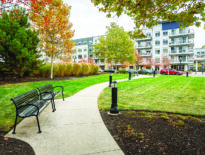
One of Backyard ADUs' recently completed projects. State housing officials say 550 ADUs were approved statewide in the first half of 2025. But builders and experts say the process of permitting and financing new units is hardly a housing vending machine. Photo courtesy of Backyard ADUs
Accessory dwelling units were legalized statewide almost nine months ago.
Rapid, modular construction techniques are finding a niche in the ADU sector.
And hundreds of homeowners are jumping at the opportunity.
But plenty of other hurdles remain – including financial ones – that keep some property owners from jumping into the market.
“Zoning is one of the 10 horsemen that approve your building in Massachusetts, and the other nine are still there,” said Chris Lee, head of design and development at Backyard ADUs.
Gov. Maura Healey’s Affordable Homes Act made ADUs under 900 square feet legal to build by-right in single-family zoning districts statewide outside Boston, which operates under a different part of state zoning law. Boston has its own, more limited ADU law.
How Long Does It Take?
According to Lee, whose Brunswick, Maine-based modular builder is active in Massachusetts, once a customer comes to him wanting to build a unit, getting a project to the permitting process alone takes two to five months.
“We do a full design-build process using modular construction,” he said. “That basically means that we help do initial feasibility of, can you get the utilities to the ADU affordably? Will the town allow it, given setbacks or conservation requirements? Then we do the design work, price out all the work as we go, and then get to a fixed-price construction contract.”
Once that is completed, then the permitting process can begin.
For Bob Berger, building commissioner for the town of Hudson, the process usually takes 30 days from start to finish once he receives an application for a project. Berger utilizes a checklist method to ensure that a project meets standards such as zoning and building code requirements.
Towns and cities are still allowed to write “reasonable” rules governing the design of an ADU and its placement on a property, despite the Affordable Homes Act’s sweeping legalization.
Once a project gets its permits, Lee said the construction process is rather quick. Utilizing modular construction allows for the construction of the ADU to typically take place in eight to 12 weeks.
“The key with modular is speed and predictability,” Lee said. “When used well, it can guarantee timelines, and it can make pricing and everything very predictable but it takes a lot of experience for a builder or designer to get to that point with modular. Modular just like any other construction method, can go wildly wrong in a hurry and go over budget and have issues, it just has the opportunity to be more predictable than typical.”

Regulations went into effect in February that allowed towns and cities to put “reasonable” restrictions on where ADUs can be built on a lot and what they look like. iStock photo
‘They’re Coming in Droves’
Since regulations implementing the 2024 ADU legalization rolled out in February, though, while some parts of the process has been sped up, other requirements still bog it down, Berger said.
“It’s fixed the zoning-related issues, which used to be a huge issue,” Lee said. “We used to have to go and do special permit hearings, which is 7 o’clock on a Wednesday night, to discuss with your neighbors about the ADU, and we don’t have to do that anymore. That’s enormous. It’s also made the rules more standard community to community. So that’s huge, but the permitting is also still very difficult.”
In many cases, local zoning and planning boards used to have 65 days to open a hearing on ADU projects, and 90 from opening to close it, said Judi Barrett, founder of Hingham-based Barrett Planning Group.
“The problem with the special permit process is that it is a public hearing, so people who are anxious about perhaps having another housing unit in their neighborhood might show up and complain that they don’t want another housing unit in their neighborhood, or they moved into a single family neighborhood, and this is going to change the character of the neighborhood,” she said. “Anybody in the role of the special permit-granting authority, you’re not governed by what the neighborhood says but you have to consider it.”
While there have been efforts to speed up the permitting process, municipal employees such as himself are also juggling oversight of other construction projects, Berger said.
Since the Affordable Homes Act passed the Legislature in mid-2024, 732 ADU have been approved or are otherwise “in the pipeline” across the state according to a Healey administration tally released in late August.
A September analysis from the state Executive Office of Housing and Livable Communities found 550 ADU projects were approved in the first half of 2025. The same office estimated that the Affordable Homes Act could generate around 8,000 ADUs by 2035.
While an insignificant total in a state that needs at least 220,000 new housing units by 2035, Berger said Hudson’s seen a notable uptick in applications for these projects.
“I saw very few, maybe one or two per year, because it needed a special permit,” he said. “Now that the governor took that red tape away and made it by, right? They’re coming in droves. It’s just not stopping.”

Sam Lattof
Cost a Major Concern
Barrett believes that it is important that ADUs are getting protections but hurdles in the process of constructing them remain.
“The protection of the use as categorically permitted is a big deal, and I don’t want to downplay that,” she said. “At the same token I don’t want people to get the impression that anybody can just run and get a building permit, because it’s a little more complicated than that.”
While relatively affordable compared to building a brand-new single-family home, building an ADU can still be costly. The average two bedroom unit Backyard ADUs builds costs $300,000, Lee said. The lower end of the spectrum can drop below $250,000 while the high-end units can eclipse $400,000.
Much of that cost is driven by today’s high interest rates and the escalation in construction costs over the last five years, Lee said.
“It isn’t like the average homeowner is going to be able to do this,” Barrett said. “You still have to deal with the reality of these are, for the most part, homeowners who may have a family need of some type that they want to address, and the ability to do a detached ADU is very inviting, but they still have to be able to finance that construction.”
Multiple local banks and credit unions have offered ADU financing options, but some require the property being built on to be the loan recipient’s main residence.
Additionally, a group of banks have teamed up with the city of Boston to launch a zero-interest loan product for a limited number of low-income homeowners looking to build an ADU in the city
While the cost might be high, Berger believes that the changes made by the Legislature have done a lot of good.
“Look, this is the best thing since sliced bread,” he said. “For years, it’s the elderly that were coming into my office and saying, ‘Look, I can’t afford the tax. I really want to put an apartment in the back so maybe I can live here and I can rent it to a student.’ For years I’d have to say you can’t do it.”