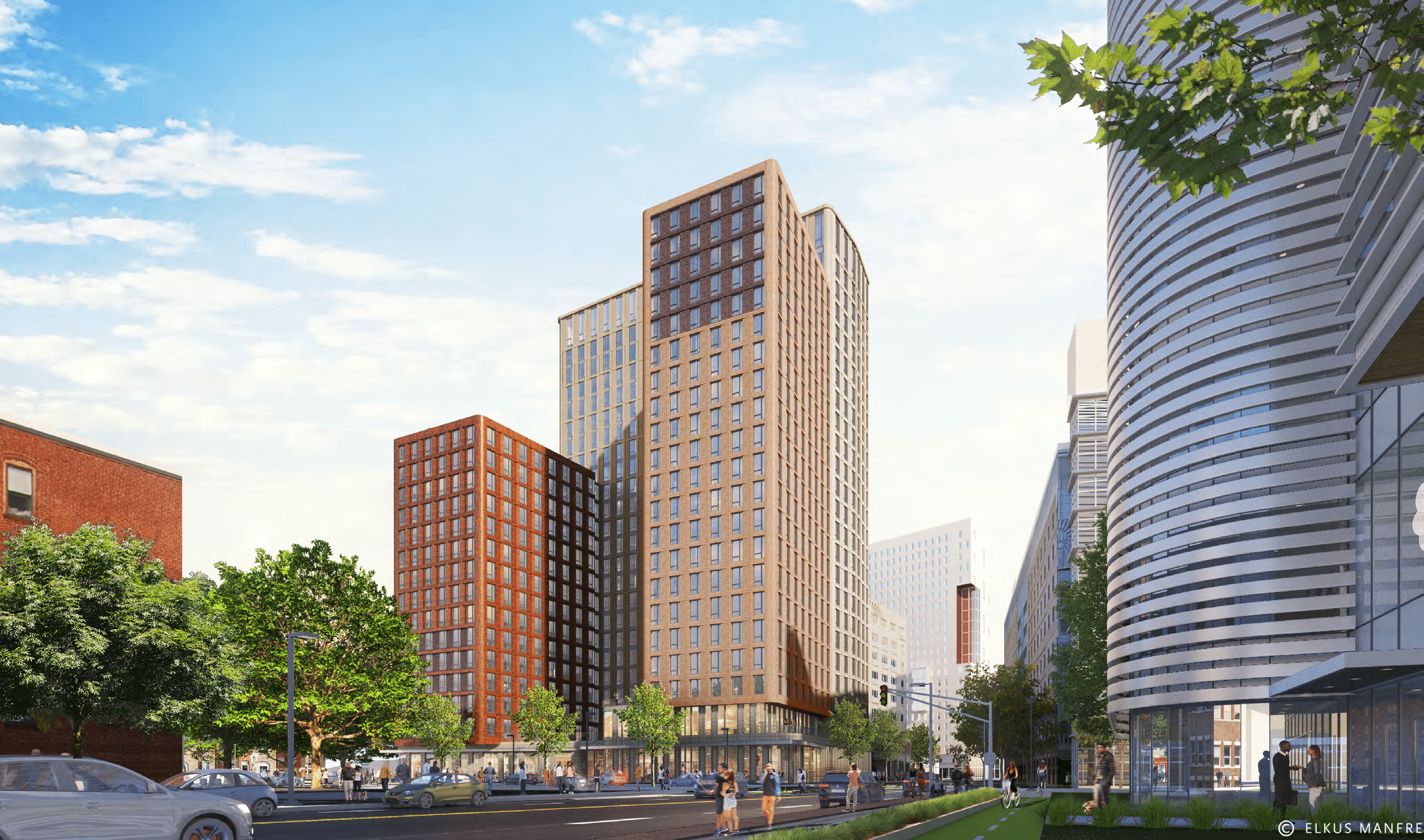
Northeastern’s second partnership with student housing developer American Campus Communities will add 1,240 student beds in a 23-story tower on Columbus Avenue. Image courtesy of Elkus Manfredi Architects
Private developers are eager to build student housing in Boston. And city officials continue to press local colleges to add more dorms and rein in the off-campus population estimated at more than 38,000 students citywide.
It might seem like a win-win proposition, except for the public opposition that frequently arises among residents wary of a dorm being built in their neighborhood. As Northeastern University and a private developer prepare to break ground on their second project in Roxbury in 2025, some observers see waning resistance to the private dorm model in Boston.
“What they don’t like to see is the private student housing unaffiliated with colleges or universities,” said Matthew Kiefer, a real estate lawyer at Goulston & Storrs. “They are afraid it’s going to be ‘Animal House’ and they won’t be adequately managed and supervised.”
Boston’s zoning code doesn’t allow private dorm-style housing that’s not affiliated with a local school, as was originally proposed by developer Scape at 1252 Boylston St. in the Fenway in 2019.
And private developers partnering with colleges have to thread the needle of complex zoning, financial and legal issues when considering partnerships on dorm projects.
But the model is playing out at Tufts University and Merrimack College, which are partnering with private developers on a pair of student housing projects that would create a combined 1,207 new student beds.
Off-Campus Renters Blamed for Rent Increases
Town-and-gown tensions are part of the landscape in Boston. Approximately 38,000 college students live off-campus, according to the 2023 student housing trends report issued by the Boston Planning Department. Nearly two-thirds of the off-campus population lives in the Allston-Brighton, Fenway and Mission Hill neighborhoods.
Concerns about off-campus renters overwhelming Boston’s housing stock have only increased amid the skyrocketing housing prices in recent years. Off-campus renters drive up average apartment rents by $200 in neighborhoods with the most off-campus renters, according to a survey by the Mayor’s Office of Housing from 2015 to 2021.
During the same time period, Boston has been gradually loosening its resistance to privately-owned student housing projects.
Capstone Communities developed University of Massachusetts-Boston’s 1,077-bed housing tower and dining commons which opened in 2018. American Campus Communities partnered on a 2019 private housing development at 744 Columbus Ave. in Roxbury, a dorm-style private housing tower known as LightView that contains 825 beds.
Following the initial experiments, city planners last March approved Northeastern’s second partnership with ACC: a 23-story, 1,240-bed housing tower at 840 Columbus Ave. expected to break ground in 2025.
NEU Experiment a ‘Success Story’
The project wasn’t without controversy, stretching more than four years and attracting opposition from Roxbury neighborhood representatives who warned of gentrification and displacement.
The public review process prompted the university to reduce the height and redesign the tower to eliminate academic space. Northeastern will lease the parcel to Austin, Texas-based ACC, which will operate the 21 residential floors.
LightView’s track record may give assurances to city officials and neighborhood groups about the acceptability of private dorms, Kiefer said.
“There was some concern when they initially filed, but it’s been occupied for years now and it’s well-managed. That’s a great success story for everybody,” he said.
Related:
Medford Mayor Objects to Tufts Dorm
In the first year of return to campus after COVID, Northeastern admitted an additional 1,000 first-year students compared to its recent history, bringing its current undergraduate population to 17,737 students, according to data submitted to the Boston Planning Department.
Three-quarters of the students live in Boston, including a 41 percent off-campus cohort that equates to nearly 5,550 undergraduates who live in private residences in surrounding neighborhoods.
Northeastern also has increased its residential footprint in Back Bay through a long-term lease of the Sheraton Boston Hotel’s South tower for 856 student beds, under a temporary arrangement in 2018 that was approved for a permanent dorm conversion this year.
Restrictions Remain for Independent Dorms
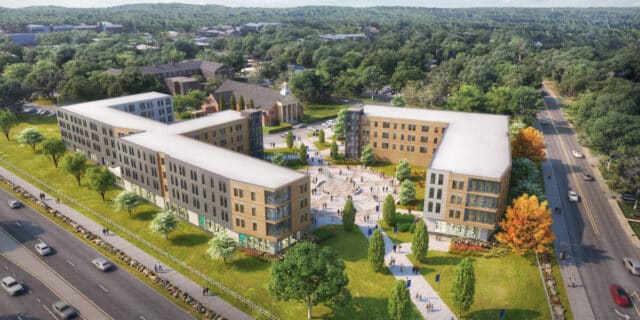
Developer Greystar broke ground in September on a two-building, 540-bed dorm project on Merrimack College’s campus in North Andover. Image courtesy of Cube3 Architects
But so far, city officials don’t seem keen to loosen the reins on private student housing developers who aren’t directly teaming up with a university.
Gary Kerr, senior managing director for Greystar Development Services, sees these zoning restrictions in Boston and elsewhere as a missed opportunity.
“More private student housing getting built would free up some of the housing stock,” Kerr said. “Students are looking for a premium product, and they are willing to pay for it.”
Greystar is expanding its Bay State student housing horizons after breaking ground in September on a two-building dorm project on Merrimack College’s campus in North Andover.

Steve Adams
The South Carolina firm manages nearly $18 billion in student housing properties near 82 universities totaling more than 110,000 beds. Developments typically are built under a 99-year master lease, giving colleges more oversight by retaining ownership.
“The strategic control remains with the university, which is incredibly important,” Kerr said.
Greystar was in planning and predevelopment with Merrimack College for more than four years before breaking ground. Designed by Cube 3 Architects, the project includes a traditional residence hall and an apartment-style building for first- and second-year students. Both buildings are scheduled for completion in 2026, adding 540 beds.
Payoffs for private student housing developers are lucrative, according to a recent report by brokerage Berkadia.
Dorm-style housing, with multiple bedrooms sharing kitchens and bathrooms, typically cost less to build than apartment buildings. Private student housing attracts average rents of $902 per bed as of June 30, up 4.6 percent in the previous 12 months. The Northeastern U.S. attracts the highest rents, averaging $1,065 per bed, the report stated citing RealPage data.