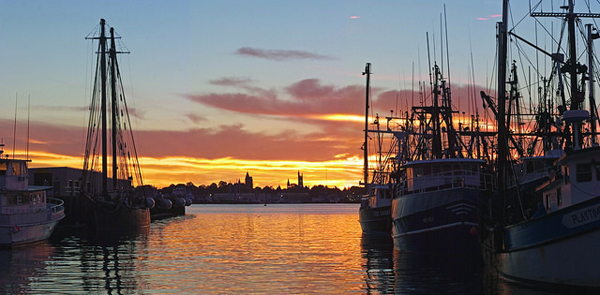
The working waterfront in New Bedford, which would become a major hub for wind power under utilities' plans. Photo courtesy of Destination New Bedford.
New Bedford’s future partly depends on issues that are out of its immediate control. There’s the fate of the South Coast rail extension, a developer’s bid to build a $650-million casino and hotel on its waterfront and its potential selection to host Olympic sailing events in 2024.
But in the meantime city officials are seizing an opportunity to shape future development along the harbor, where rows of seafood plants process the catch from what is still the nation’s most lucrative commercial fishing port.
“The city is coming to a point where it has some big decisions,” said Michael Goodman, executive director of the Public Policy Center at UMass Dartmouth. “One of those challenges is how you balance the traditional uses of the waterfront and the fishing industry with a tourism and arts-and-culture strategy for the downtown.”
Watertown-based Sasaki Assoc. is preparing a waterfront master planning study that will look at future zoning, and creation of up to two urban renewal zones.
This South Coast city of 95,000 residents is eager to continue the momentum of a downtown revival that has attracted more than 60 new restaurants, shops and art galleries to the narrow cobblestone streets of the business district in the last decade.
Those arrivals, officials say, are the result of an economic development strategy that leans not on massive catalytic projects but the unglamorous work of rebuilding the city one neighborhood at a time.
“There is no silver bullet, no one project that is going to make or break a community,” said Derek Santos, executive director of the New Bedford Economic Development Council (NBEDC). “Things are always in flux. We believe in a broad-based strategy that’s citywide.”
For the council, a nonprofit that is eligible to receive grants from foundations and other sources not available to municipalities, that means granting approximately 30 loans a year to new or growing businesses, most of them below $50,000.
The strategy, Santos said, accounts for the city’s healthy economic growth coming out of the recession, where other Massachusetts Gateway Cities have lagged. New Bedford has added more than 5,000 jobs in the last five years.
But the current unemployment rate of 9.6 percent is still twice the state average, and 23 percent of the population is below the poverty level in a city with a median household income of $38,364.
Acknowledging the need to attract better-paying jobs, officials have focused on attracting major new industrial and office users to the 1,000-acre New Bedford Business Park, which the council is responsible for marketing.
A milestone was reached last week when a seafood company, which Santos declined to name, signed a letter of intent to buy a 14-acre parcel for a build-to-suit distribution center. The purchase-and-sale agreement is expected to be reviewed this month by the directors of the Greater New Bedford Industrial Foundation, which owns the park.
A larger 45-acre parcel has capacity for 300,000 square feet of development, and several warehouse and distribution users have expressed interest, Santos said. Advanced manufacturing companies also are on the council’s wish list as a good fit, as five medical device companies in the park already employ 800 people.
Officials have signaled their willingness to offer aggressive incentives to convince companies to consider New Bedford. The council advertises prices of $75,000 per acre in the park, and the city routinely offers tax increment financing (TIF) agreements to developers in exchange for commitments for significant job creation.
TIFs remain the most popular incentive for developers when making siting decisions, said Gordon Carr, a Boston-based economic development consultant. Stable government and transparent permitting processes also play a major role in the perception of a community, said Carr, whose clients include the NBEDC.
The biggest factor holding the city back in the current economic cycle is location, Carr said.
“There’s a perception that it’s really far removed until you actually go there,” he said. “We’ve become very Boston-centric in Massachusetts, and that is one of the biggest challenges.”
A chance to host the 2024 Olympics’ sailing events would raise the city’s profile onto the international stage. Mayor Jon Mitchell and Boston 2024 organizers last week announced that New Bedford would host more than a dozen races, replacing Boston Harbor, if Boston gets the nod to host the games.
New Bedford’s 47-acre Fort Taber waterfront park would be restored to serve as viewing area for spectators and the location of the medal ceremonies, backers said. UMass-Dartmouth Chancellor Divana Grossman has offered the school’s dorms for athlete housing.
In the downtown, a four-by-five-block area is the latest focus of redevelopment efforts. MassDevelopment selected New Bedford in December to receive one of 10 Transformative Development Districts designations statewide. Recipients get staff assistance and state investment to reactivate underutilized parcels. City officials have set a goal of encouraging private developers to build 500 units of market-rate housing in the neighborhood now known as the Union and Purchase Innovation District, which includes two large vacant parcels.
“The overall focus is building a really vibrant and hip neighborhood right in the middle of the city,” Santos said.
Events such as AHA (Art History Architecture), a free arts event held on the second Thursday of every month, have enlivened the downtown district’s street scene. Travessia Urban Winery is relocating and expanding, one of dozens of new shops and restaurants that have given the downtown an artsy new flavor.
“Not having been down there in 15 years, I could kind of feel it’s coming,” said Jonathan Berk, a Boston real estate attorney, following a recent visit to the city to explore business opportunities. “It feels like sections of Boston and Salem in particular. It has that great old New England character and it’s not going to take much investment to turn the tide.”
But lingering perceptions about high crime rates and poor public schools continue to deter companies seeking a skilled workforce, said Goodman, the UMass-Dartmouth official.
Casino A Wild Card
While developer KG Urban tries to keep alive its on-and-off-again bid for the southeastern Massachusetts casino license, downtown revitalization plans are moving ahead. KG Urban wants to build a $650-million casino and hotel at a former NStar plant property on the waterfront.
The city hired Sasaki Assoc. to compile a $300,000 downtown land-use study expected to be completed in October. The report will include recommendations on whether some of the marine industry can be moved elsewhere in the city, opening up the waterfront to other types of development, Santos said. The urban renewal districts would give the city eminent domain powers, but Santos said that it’s unlikely that the power would be exercised.
“Like a lot of small cities, it’s a complicated place,” said Ben Forman, research director for Boston-based think tank Mass Inc. “It exemplifies the challenges that leaders in Gateway Cities have, with limited resources to bring to the table. It’s all about a sustained focus. You’re talking about a multi-decade endeavor to rebuild the communities.”
Email: sadams@thewarrengroup.com