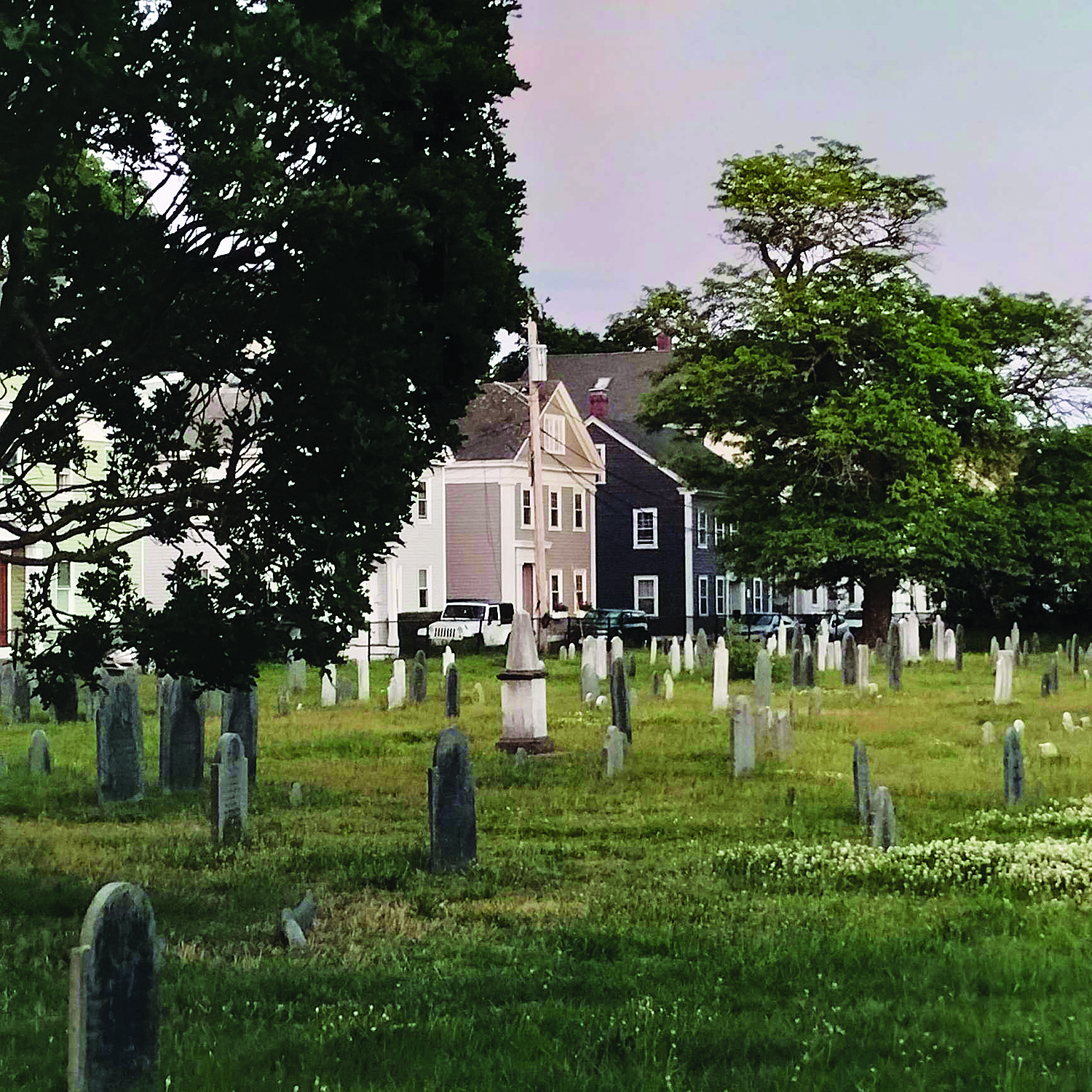
Houses around Salem’s Howard Street Cemetery in 2025. Price jumps following the COVID-19 pandemic and interest rate hikes since then have killed off the region’s status as an affordable haven for first-time homebuyers, area Realtors say. iStock photo
The North Shore of Massachusetts used to be an affordable option for Massachusetts homebuyers. But these days, even fixer-uppers can feel out of reach.
According to data from The Warren Group, the publisher of Banker & Tradesman, the median sales price of a single-family home in the North Shore was $860,000 through the first five months of 2026. This is a 5.1 percent increase compared to the first five months of 2025 and 100 percent growth since the first five months of 2016.
“There were many more homes that were would be listed for less than a million dollars, and that’s much more of an anomaly now,” said Paula Polo-Filias, a Realtor with J Barrett Realty. “Home values have increased significantly because of COVID, and because there’s been so much more demand to be on the North Shore.”
From Middle-Class to Hottest ZIP Code
Communities in the North Shore real estate market have been attracting national headlines for three years in a row.
Peabody was named Realtor.com’s hottest ZIP code in 2026 while Beverly was the hottest ZIP code in 2025. Salem also was the listing portal’s third-hottest ZIP code in 2024.
That’s a long way to come for the coastal strip marked by Lynn and Saugus on the south, Salisbury to the north and Lynnfield and Danvers to the west. In 2016, the median single-family house there sold for $432,500.
At the same time, Burlington, Billerica, Bedford and Lexington had a median sales price of $562,500 through the first five months of 2016, jumping 61 percent to $908,749 through the first five months of 2026 according to The Warren Group.
Other Route 128 suburbs like Framingham, Natick and Waltham had a median sales price of $505,000 during the same time period in 2016. The median sales price there increased by 66.3 percent over the course of the following 10 years.
The North Shore has seen even faster price growth than high-end communities like Needham, Newton and Wellesley. There, the median sales price of $1.1 million in the first five months of 2016 increased by 79.5 percent to $1.97 million in 2026.
Inventory Halved, Appeal Up
The existence of significantly more inventory was a crucial part of why were prices so low a decade ago, according to Shannon McInnis, owner and founder of North Shore Living Real Estate Group, affiliated with Lyv Realty.
There were 872 single-family homes for sale in the area in August 2016, according to the Massachusetts Association of Realtors. Last month, there were only 490 homes for sale: a 43.8 percent decline in single-family inventory.
“It was a buyer’s market,” she said. “Buyers just had their pick. Then, when COVID happened, things drastically changed. People started moving that really didn’t have it on their radar.”
The area has also gained a new crop of restaurants and buzzy downtowns in communities like Salem, Peabody and Beverly, thanks to investment ultimately driven by the MBTA commuter rail lines through the area that give rapid access to downtown Boston. It’s helped raise the region’s profile.
“Combination of the public transportation,” Polo-Filias said. “Beverly had a huge increase in apartment dwellings right in the downtown area with access to public transportation. Peabody has done similarly. More restaurants were brought to the area. The increase in residential places to live has also brought an increase in grocery stores, restaurants, shops, and entertainment.”
Beyond easy access to Boston, the region’s geography adds to the lifestyle appeal, McInnis said. The location also makes it simple for residents to travel north for outdoor adventures in New Hampshire and Maine.
“What we’re seeing on the North Shore is very different than what is being experienced over other parts of the state because we do have so much on the North Shore to offer, between highway access, ocean. You can be in the mountains, you can be in the city,” she said. “Everything is just so close to us within a 30-mile radius. You can experience all of that.”
First-Time Buyers’ Bitter Pill
Younger, first-time homebuyers and families have been attracted to the North Shore market, according to Realtors interviewed for this story. These buyers have typically lived closer to Boston and are now looking to purchase homes and also have more living space.
But the increased attention and the upward trajectory of prices has steadily priced them out.
“It’s becoming a little bit challenging, particularly for those who are just starting out,” Lamacchia Realty Realtor Amy Wallick said. “There’s certainly still a lot of opportunity, but our median sale price is a little on the higher end, comparatively speaking, when you look at it in comparison to the rest of the state.”
First-time buyers and young families now might be forced to make some concessions in order to find an affordable option on the North Shore, she said. This can include buying a house that may need some renovations.
“Here on the North Shore, most of the homes that are coming on in the $600,000 range are ones that most likely will need work,” she said. “And when it’s a first-time home buyer that is looking in that range, it can be challenging because they are usually using all of the money that they’ve been able to save to that point just to buy the house for the down payment. For your starter home, that’s $600,000 or $700,000. To also need things [renovated], it’s a really tough pill to swallow.”

Sam Lattof
Median Monthly Payment Hits $5.9K
North Shore buyers are taking more time to save for a down payment and home according to Wallick. Affordability calculations show the burden price increases and high mortgage interest rates have put on these buyers.
The monthly payment for the median-priced home in Essex County likely increased by 151 percent from 2016 to 2026 to $5,992 a month, according to a calculator provided by listings portal Realtor.com.
This calculation is based on the median sales price for Essex County for the first five months of 2026 and 2016, according to data from The Warren Group. This also assumes a 5 percent down payment – typical for first-time buyers – and typical interest rates in May of both years. The payment totals include taxes, insurance and private mortgage insurance.
“Home prices nearly doubled over this ten-year span, and mortgage rates rose nearly 3 percentage points, a double whammy for prospective buyers,” Realtor.com Senior Economist Hannah Jones said in an email. “This dramatic shift means more buyers, especially first-time buyers without existing home equity, simply can’t compete in this market. As home prices continue to outpace wage growth, especially in inventory-constrained markets like Essex County, more buyers are being priced out.”
For the North Shore, this has a particular impact on gateway cities such as Peabody, Lynn, and Salem.
“Add in interest rates north of 7 percent, that just shuts a certain portion of folks out of the market completely,” said Thomas Callahan, executive director of the affordability research nonprofit Partnership for Financial Equity. “It makes it more difficult for folks that still can be in the market, but they might struggle to be able to afford higher monthly payments. It also puts more strain on the public sector programs that exist out there.”
The days of being able to find an affordable North Shore home to buy are in the rearview mirror, according to J Barrett’s Polo-Filias, but she has hope for the future.
“The pandemic actually made the North Shore less affordable, and now we have all these escalated prices and [a] shortage of inventory,” Polo-Filias said. “In time, everything I believe will normalize again, but for now, if you want to compare pre-pandemic to post-pandemic, the pandemic caused the North Shore to be less affordable.”