Image courtesy of Boston Planning Department
Opponents of Boston’s downtown “Skyline” rezoning proposal are mounting a last-minute campaign as it heads to a vote of the Boston Planning & Development Agency board of directors Thursday.
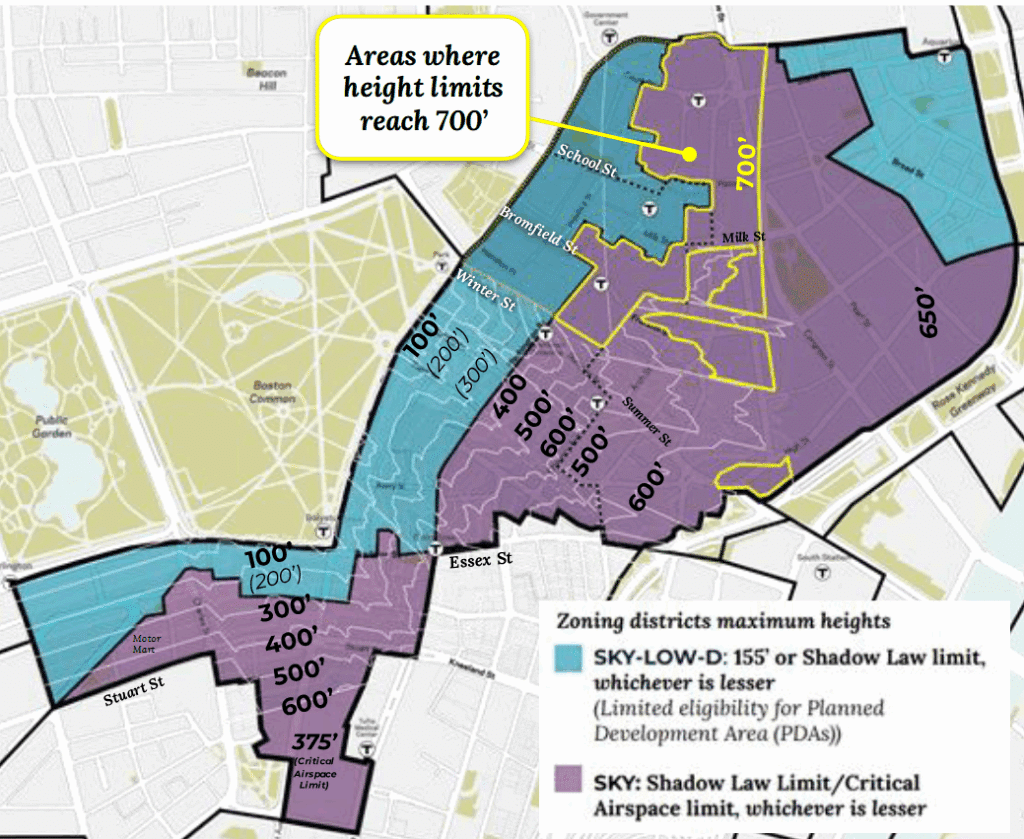
The Friends of the Public Garden and the Downtown Boston Neighborhood Association, a resident group, urged a “no” vote on the plan which could open up multiple development sites to towers up to 700 feet.
The neighborhood association contends the final version of the plan shortchanges goals for affordable housing creation and preservation of historic structures and small businesses.
“Your proposed plan reveals a striking lack of creativity, perspective, and vision and will not work,” the group wrote in a letter to Mayor Michelle Wu last week.
Wu offered an endorsement of the proposal in July, commenting that additional housing is critical to the future success of downtown.
The rezoning would increase base building heights under zoning in areas such as the Ladder Blocks, potentially adding more shadow on Boston Common.
“While we support the city’s efforts to revitalize and activate our downtown, favoring near-term development benefits with little understanding of the permanent impacts is shortsighted,” Friends of the Public Garden Board Chair Leslie Singleton Adam wrote in a letter to Boston Chief of Planning Kairos Shen on Monday.
Shen has defended the recent changes, arguing that the decline in office occupancy post-COVID demands bold action to reinvigorate investment in the downtown.
On social media, opponents are urging opponents to contact elected officials, who will be allowed to comment at the meeting.
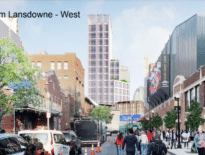
The proposal, last updated in May by Boston Planning Department officials, is designed to encourage high-density residential development and offset the decline in office occupancy. The new height and density guidelines could encourage developers to replace existing buildings, but requires a minimum 60 percent residential component.
A “Sky” zone allows skyscrapers from Washington Street in Downtown Crossing through the Financial District to the Rose Fitzgerald Kennedy Greenway.
Another zoning district, “Sky-Low-D,” allows maximum building heights from 100 to 300 feet. Sites that are at least 1 acre also could qualify for the maximum 700-foot heights.
In response to objections from historical preservation groups, planning officials last spring added a set of historic design guidelines, which is also scheduled for a vote Thursday. The guidelines add design recommendations for developments in the Downtown Crossing, Ladder Blocks, Theater District, Financial District and Wharf District.
The Downtown Boston Neighborhood Association contends that the final version of the plan ignores seven years of public comment while insufficiently studying the potential effects of development.
Sites including the Massachusetts Department of Transportation building in Park Plaza, The Druker Co.’s Corner Mall on Washington Street, Northland Investment Group’s 600 Washington St. and The Abbey Group’s Lafayette City Center would qualify for taller building heights under the final rezoning map.
“Chief Shen’s rush to implement an untested and unproven zoning scheme begins with a gerrymandered map in the aforementioned neighborhoods that radically departs from customary and critical uniform height and density controls. He cherry picks the sites of favored developers and offers excessive zoning relief to 500 feet in height,” the Downtown Boston Neighborhood Association wrote. “Some of these same sites have been left to decay, and coupled with unreasonable lease terms have led to many storefronts being vacant for years.”