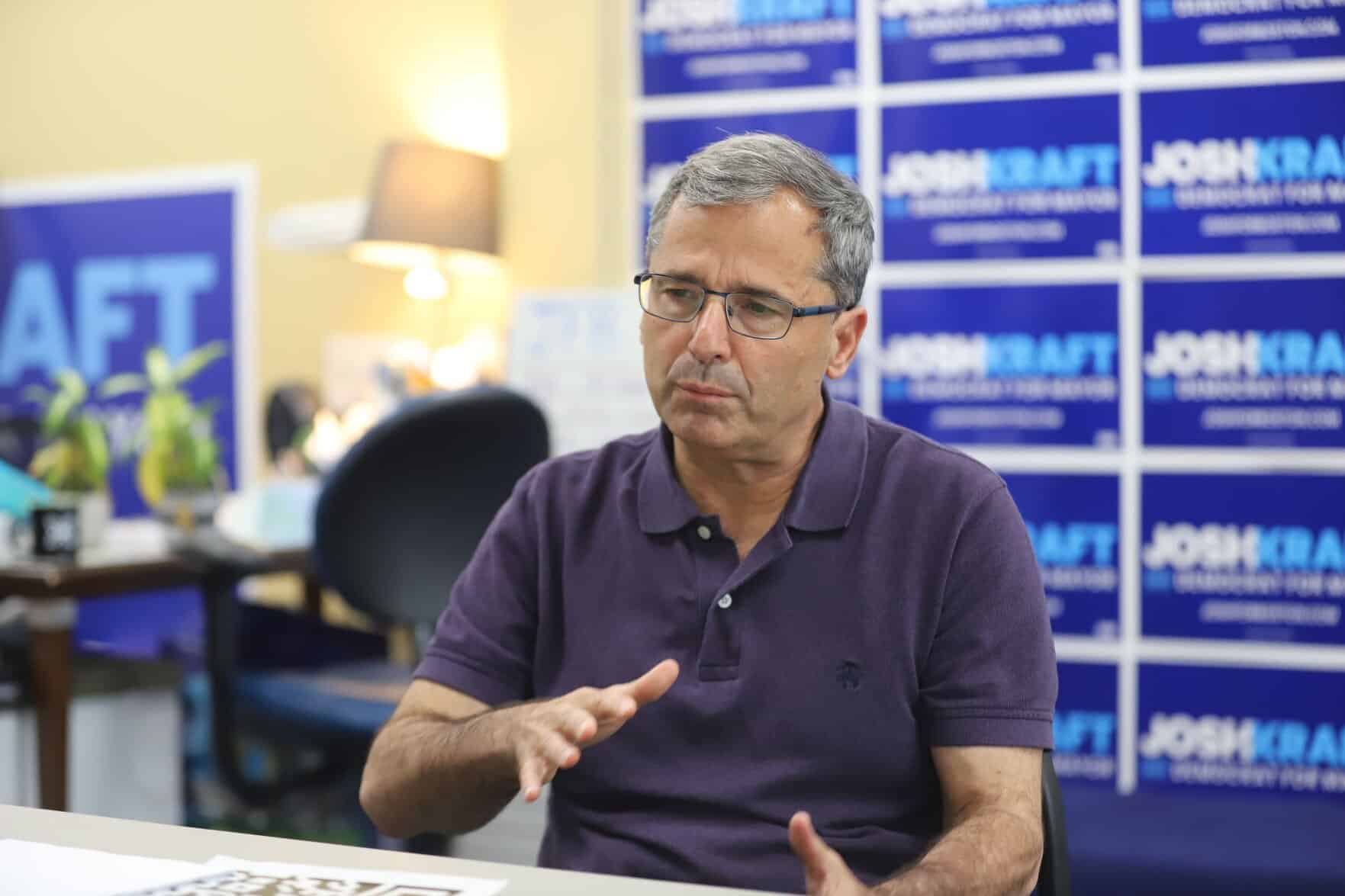
Josh Kraft speaks during an interview at his campaign headquarters in Nubian Square in July 2025. Photo by Ella Adams | State House News Service
Josh Kraft, a first-time candidate for political office, kicked off his campaign for mayor of Boston in February after months of intense speculation.
In the time since, Kraft has garnered headline after headline in the fiery race between him and incumbent Mayor Michelle Wu. Kraft, who is running as a Democrat in the nonpartisan mayoral race, has spent more than three decades of his working career in and around the neighborhoods of Boston.
Kraft grew up and spent most of his life as a resident of Chestnut Hill before moving to a North End property in the fall of 2023 and registering to vote as a Democrat in Boston that October. Kraft has voted as a city resident in recent years, but hasn’t voted for either Boston mayor or Boston City Council during his time living there.
An incumbent has not been ousted in a Boston mayoral race since 1949, and a spring poll of likely Boston voters showed Wu entering the campaign season with advantages in approval and favorability.
Kraft is centering his campaign around issues like housing, bike lanes and the reconstruction of White Stadium – all of which he calls “failed policies” of the Wu administration. And while often associated with his family – his father is Robert Kraft, patriarch of the New England Patriots and New England Revolution – the mayoral candidate has sought to distance himself, going so far as to say he is not politically aligned with his father, who historically has had a relationship with President Donald Trump.
This conversation has been edited and condensed for clarity and length. A significantly longer version is available at Statehousenews.com. The News Service has also reached out to the Wu campaign to give Mayor Wu the opportunity to sit down for a similar Q&A.
Q: Why politics? Why mayor and why now?
A: I’ve spent 35 years working in and around the neighborhoods of Boston and Chelsea doing community work. Most of it with Boys and Girls Club of Boston, some in the substance disorder world and the re-entry world. Two things have come out of that. The first is creating pathways for access to opportunity — especially for targeted or overlooked marginalized groups — is such a powerful thing, and I’ve seen how it can create a real sense of community, and it can help push individuals and communities forward. And secondly, in those 35 years, I’ve learned from so many great people. It taught me about people a lot different to me in so many ways. I love the city of Boston. [Those two things] inspired me to run for mayor, because the city is headed in the wrong direction. We have an administration that’s more focused on big picture and not getting things done for residents, not creating results for residents. My administration will be all about accountability, accessibility, transparency and competent fiscal and operational management.
Q: Let’s talk about your housing plan. It includes your version of “rent control,” which involves an optional program for landlords. Some housing experts and advocates have said that it would be helping landlords get tax breaks and not really helping renters. Why do you think that assessment is incorrect?
A: It’s incorrect because the landlords that get the tax break commit to keeping their rents at minimal increases over 10 years, so renters will have affordable rents [so] they can live in the city. These experts, I don’t know where they come from, but I know a landlord that owns over 500 units in the city ran the numbers and said, “This could work for us. It’s not going to be a boom for us, but we’ll be able to keep our rents at minimal increases so that people that need lower rents can afford to live in the city.” Legislative[ly-]mandated rent control will never happen here. So we got people around a table, landlords and housing advocates, housing experts, that deal with this every day – more than people that are at universities and other places – and said this could work.
Q: Why do you think that the legislatively-mandated rent control won’t happen in the city?
A: If you look at Minneapolis and St. Paul – do you know the study there? The Twin Cities – same everything, same environment. St. Paul approved rent control in the city, Minneapolis didn’t. St Paul, housing stopped being built, because people are like, “I can’t make money.” In Minneapolis, they had an increase in new housing being built for everyone. The more housing, the lower rents go. So it’s proven that [legislatively-mandated rent control] stunted housing growth in St. Paul, [and] because Minneapolis doesn’t have it, they’ve increased housing growth, housing starts, and the results have been rents have been naturally lowered because of the increased investment in housing.
Q: You’re focusing on housing affordability. You’ve said that there aren’t enough units being produced to meet the demand, and want to lower the threshold of the number of affordable units that developers are required to build to provide funding. Can you explain how that would help tenants specifically?
A: The way to get out of a housing emergency is to build more housing. Under the rules and regulations of this administration, housing can’t be built. For comparable-size cities across the country, we’re one of the lowest for new housing starts. This administration promised they would build 13,000 new units of housing. They built 7,700 and we’re closing in on the end of their term. Those are numbers through Inspectional Services, you can pull the permits. We know that there’s 26,000 [BPDA-approved] units of housing that can’t get built because it’s too expensive and too difficult to get them in the ground.
[Editor’s note: The Wu administration reports that there have been more than 17,000 housing units built or under construction during her term, a third of which are income-restricted. Wu has said that the 26,000 permitted units were “permitted under the old rules,” prior to October 2024 when her inclusionary zoning policy of 17-20 percent took effect. Wu’s policy requires 17 percent of units in new market-rate developments be set aside for affordable housing, with an additional 3 percent set aside for housing voucher holders.]
Going back to the rules and regulations of [former Mayor] Marty Walsh, his inclusionary [zoning] number was lower, it was 13 percent. Right now, it’s 20 percent. Twenty percent of nothing being built is zero. We need to get housing in the ground. With those 26,000 units will come $100 to $125 million of tax revenue, and we would create a first time home buyer fund that includes people in the working income bracket. Too many folks that want to live here and buy a house that work here, they don’t qualify for first-time home buyer programs. We would increase those eligible for the program so they can buy houses in the city that they want to live and work in.
Q: You would be inheriting a tight fiscal situation, especially considering the federal administration – Boston could lose a lot of funding based on what happens in D.C. How are you prepared to take that on, especially as you’re talking about finding funding for all these different initiatives you want to bring into the fold?
A: We’re coming into hard fiscal times, and all of us, city leadership, residents, businesses, we’re going to have to work hard and be disciplined to get through them, and we’ll come out of them stronger. One of the ways is we’re also going to be open for business. I’m going to show up at trade shows, I’m going to work with folks. I want to encourage investment into our city, into our downtown. I want to invite businesses in that might not have a presence here, and incentivize them to come here because that’s tax revenue, it’s jobs and it’s community, it’s philanthropy. That’s one of the ways we’re also going to be very fiscally responsible with the budget. Maybe it’s relooking at all outside vendors and finding cheaper – more cost effective alternatives and so on.