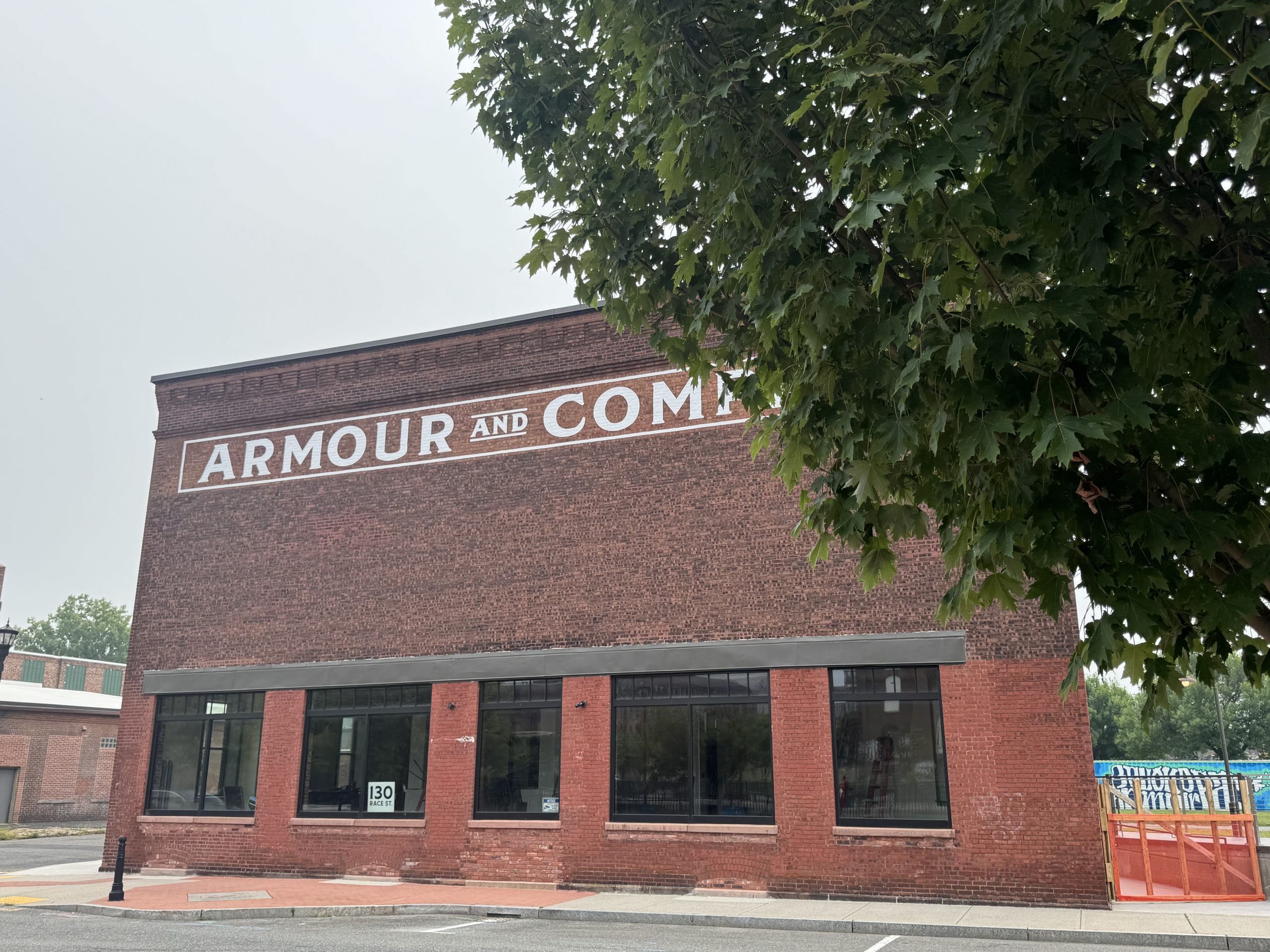
The Armour building sits on Race St. in downtown Holyoke. Marco and Denis Luzuriaga are working to restore the old meat-packing building. It will soon be a new restaurant and coworking office space. Photo by Hallie Claflin | CommonWealth Beacon
Marco and Denis Luzuriaga’s restoration of an old meat-packing building in Holyoke will soon bring a new restaurant and coworking office space downtown – something officials say is vital for the city’s efforts to grow and revitalize. But the Trump administration’s new 50 percent tariff on steel and aluminum imports – which went into effect in June after being raised from 25 percent – will undoubtedly add to their construction costs.
Because their project is small, the brothers are luckier than most.
“The little steel we still need to buy is going to be probably 50 percent more expensive, but we don’t need that much, so we’re talking an extra $5,000,” Marco Luzuriaga said. “If it was a huge building, it could completely stop the project.”
Housing and real estate developers both big and small are beginning to feel the effects of President Trump’s taxes on imports – a move the administration claims will boost American-made products, but market experts say will hike already-elevated real estate production costs. But because federal tariff policies continue to change, some say the biggest challenge has been figuring out how to factor uncertain material costs into their current project plans.
In Gateway Cities – where half of all renters spend more than 30 percent of their income on rent and housing production is already only half of what it needs to be to meet rising demand – increasing the cost of construction materials threatens an already tenuous housing market. High interest rates, land prices, and a shortage of construction workers have already strained developers’ budgets in recent years.
Marco Luzuriaga, a local Holyoke resident and small-scale real estate developer, said many developers are still reeling from the pandemic, when nearly all construction costs increased. Material prices are still 40 percent higher than they were before the start of the pandemic, according to the Producer Price Index, a US Bureau of Labor Statistics program that tracks the change in selling prices domestic producers receive for their goods.
Tariffs are taxes on foreign goods and shipments. They are paid by importers, but the cost usually gets passed to consumers as manufacturers and sellers raise their prices to offset the levies. Massachusetts imports goods and materials from Canada more than any other country. Last year, the state purchased $10.6 billion worth of goods from Canada. Steel and iron are two of Massachusetts’ top imports from Canada, at $270 million annually.
Canada is the largest importer of steel and aluminum to the US. Additionally, it supplies approximately 30 percent of the lumber used nationwide. Trump recently signed an executive order increasing the tariff on Canadian goods from 25 percent established in March to 35 percent – although the administration, for now, carved out an exception for most products under the new percentage, which went into effect this month.
The National Association of Home Builders estimated in their March 2025 Housing Market Index that tariffs on lumber and other construction materials could raise the average cost of a home by $9,200.
“How could this have gone up so much? And then I think, ‘oh, tariffs,’” Denis Luzuriaga said. “We’re noticing things going up by about 30 percent.”
Cassandra Witthaus, associate director of real estate at The Neighborhood Developers (TND), a nonprofit affordable housing developer in Chelsea, Revere, and Everett, said due to the uncertainty around tariffs, it has been difficult to plan budgets for current housing projects.
“We have had conversations about making sure that subcontractors are only including the known tariffs as of the date of our contract,” she said. “It has been challenging with the tariffs changing seemingly daily.”
The tariffs may also negate a change to the federal Low-Income Housing Tax Credit program, which helps organizations like TND finance their projects, enacted through Trump’s One Big Beautiful Bill Act. Before the bill was signed, the LIHTC program required that 50 percent of a developer’s land and building costs be financed by tax-exempt bonds. But the bill lowered that threshold to 25 percent.
Like others, Witthaus said she expected this to help clear the LIHTC backlog created by the rising costs – which often make it difficult for developers to meet the 50-percent test – of housing production. But ever-changing tariffs are simultaneously increasing project expenses and making it hard to predict potential cost overruns.
“They’ve had projects in the pipeline that they want to fund and they can’t, because the costs of the projects ahead of them have gone up so substantially that we have this backlog that’s created,” Witthaus said.
“That automatically frees up the queue and allows projects to get moving, but those projects have to then be able to have state funding,” Witthaus said. “I think that things will start to speed up, but the things that are working against that are construction costs due to tariffs going up.”
Other housing developers like Gordon Pulsifer – president of First Resource Development Company – are avoiding foreign imports, although American-made building materials are often more expensive.
“We’ve been very focused on sourcing products in the United States now – not Canada, and not overseas,” Pulsifer said. “With construction costs on the rise, obviously tariffs don’t help.”
This article first appeared on CommonWealth Beacon and is republished here under a Creative Commons Attribution-NoDerivatives 4.0 International License.