
Massachusetts home prices have largely returned to their pre-crash peaks, but nationwide concerns about another looming recession and signs of markets softening across the country have some concerned as the spring market heats up.
The Brookings Institute in January ranked Boston first in the nation for income inequality. In a February editorial, UMass’ Donahue Institute said the state economy is “emitting mixed signals.” Year-over-year, the median sale price of a single-family home in Massachusetts in February 2016 decreased 4.3 percent to $299,000, the lowest it’s been since February 2014, according to The Warren Group, publisher of Banker & Tradesman.
Could the rising cost of residential real estate be leveling off – or even starting to fall?
Shant Banosian, branch manager of Guaranteed Rate, says no – not yet.
“Conventional loan interest rates are close to three-year lows and jumbo rates have never been lower,” Banosian said. “The U.S. economy is the healthiest economy in the world, so everyone is parking their money in U.S. treasuries, and that keeps rates lower.”
Low interest rates are the key to making expensive homes affordable; Banosian is seeing fewer buyers maximize their debt-to-income ratio in the loans he’s writing, indicating buyers could afford even higher prices than they’re currently paying.
“I don’t even think if rates went up a half a point this year, it would change things dramatically,” Banosian said. “That happened in 2014 and the purchase market was still buzzing. At the end of the day it’s all about inventory, and I think we’re going to have an inventory problem for a very long time.”
David Kres, co-owner of Buyers Brokers Only, agreed, saying sale prices are primarily being driven up by low inventor, which has improved slightly. When interest rates eventually drift upward, prices might level off – at least, he hopes they will.
“It’s a frustrating time to be a buyer agent,” Kres said. “Sellers have more bargaining power and they know it. In a lot of transactions there are 10 to 20 offers. Some buyers are waiving their mortgage and home inspection contingencies. We never recommend that to clients, but because of that, you can have the highest offer and still miss out.”
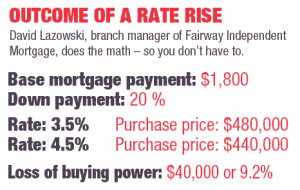 Major Challenges To Affordability
The Donohue Institute editorial cites the lack of affordable housing as one of the biggest challenges to the Massachusetts economy going forward.
“The most important challenges for the state involve long-term issues, which will require significant investments,” the editorial said. “A number of these issues represent genuine constraints on the future economic growth and prosperity of the commonwealth.”
Specifically, it said “housing availability and cost have long been issues. Increasing housing supply in areas of greatest need continues to be constrained by a myriad of archaic and highly restrictive state and local regulations.”
“A healthy job market in and around Boston is helping to maintain the current price points,” said Danny Dineen, Realtor with the Chase Realty Group in Brighton. “As more good jobs increase, people with money want to live close to their work, creating the price squeezes and lack of inventory in areas all over the city and just outside.”
If anything, higher prices are driving buyers to less-expensive suburbs, he said.
“It’s what took place in Somerville, as Cambridge became too pricey. Now people are getting priced out of Somerville, so they start to look in other areas like Arlington, Medford or Malden,” Dineen said. “Arlington has benefited from the price appreciation in Cambridge and Somerville and is not even that much of a cheaper option. Now Medford and Malden are starting to see price appreciation as people see them as affordable substitutes and still close to Boston with decent T access.”
Rising prices make homes in all price ranges less affordable, but they have an added effect on the middle and lower end.
“As prices get too high, it starts to affect the ability of homebuyers to use certain loan programs, such as Mass Housing,” Dineen said. “There is a maximum loan amount of around $418,000, so if prices start to get too far beyond that, less buyers are able to put down the additional cash to purchase homes in the $450,000 range and beyond. When you start losing those types of buyers in the market, the buying pool starts to decrease, and along with it, the buying pressure in the market.”
Kres, who works primarily in Northern Massachusetts and Southern New Hampshire, said rising prices make it increasingly difficult for many of his clients to find properties in their budget while keeping their commute reasonable.
“To a large extent, home appreciation keeps pushing north,” Kres said. “That’s an issue with a lot of buyers. The effects I’m seeing are buyers either have to compromise and buy a condominium or townhouse instead of a single-family home, or they just have a tough time in this market. They might have to make six or eight bids before they are successful, or they concede a longer commute.”