Agents have been telling sellers for years that while there are select home improvements that can net extra cash when it comes time to sell, they can’t expect to recoup every investment – and now there’s data to prove it.
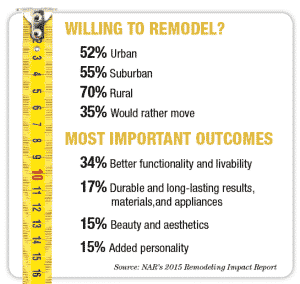
In October, the National Association of Realtors (NAR) surveyed random samples of its membership to find out more about remodeling projects. The survey asked why respondents did the project, how much they enjoyed it and how much value it added to the house. The results were compiled into the NAR 2015 Remodeling Impact Report.
Unsurprisingly, Realtors reported complete kitchen renovations, kitchen upgrades and bathroom remodels as the most like to increase the value of a property and the most likely to increase appeal to potential buyers. The full results of the survey are available on NAR’s website.
Most of the 4,211 respondents in the two surveys (one focused on interior projects, one on exterior projects) remodeled to upgrade something that was worn out, improve livability or just because it was time for a change.
The report assumes a 2,450-square-foot-house built after 1978 and in good condition with no hidden issues. The report also assumed that mostly builder-grade appliances and materials were used. No high-end projects were included in the data.
Banker & Tradesman asked several Massachusetts Realtors what remodeling projects make the most sense to increase value in the Bay State’s current frenzied market.
 Painting Pays
David Stead, a Worcester County Realtor since 1992, said there are some basic, short-term projects a homeowner can undertake to improve the appeal of the house to prospective buyers and perhaps tweak the value, but for the most part, he suggests the cost of larger projects like renovating a kitchen are unlikely to be recouped.
“A few years ago, I was asked to list a house with an insulated, unheated three-season room,” Stead said. “The owner installed electric baseboard heat in it and added 150 square feet of living area and increased his value.”
He recently listed a home in Worcester where the owner had $2,000 worth of insulation installed through a MassSave program that only cost the owner around $100. He said the owner recouped his investment in reduced energy use and made his house more marketable, likely netting him more than he spent on the project.
Stead suggested reglazing ugly bathroom tiles or installing a tub-surround as quick, inexpensive ways to turn a negative into a positive.
“Of course, one of the cheapest things to do is paint,” he said. “If you’ve painted your kid’s room Pepto-Bismol pink, you’re going to want to paint it again before it goes on the market. Also, refinishing tired hardwood floors is inexpensive. I have a local guy who can do it in a day. It’s a quick, easy process and it looks terrific.”
On the other hand, sometimes one improvement starts the dominoes: refinishing hardwood floors may be a cheap way to bring out their beauty, but sometimes highlights how dingy and dated the rest of the house is, Cambridge Realtor Gale Roberts said. And DIY-ers beware: shoddy-looking or unfinished work can end up costing homeowners when the property is sold.
“We don’t want to show things that are unfinished,” Stead said. “If the owner’s situation doesn’t allow them to finish half-done projects, then we just have to discount the sale price and sell it ‘as-is.’”
And nothing in life – or real estate – turns out like you think it will, said Roberts, who advises clients to be especially careful about taking on big projects just prior to listing. Surprise problems often have them spending more than they’d planned.
Staging Sells Strange Spaces
Anthony Bruno has been selling homes in Boston and on the North Shore for over a decade, where, he said, many buyers coming from apartments with a single bathroom won’t even consider a house with fewer than two baths. If there’s room to add another half-bathroom, it might be a relatively inexpensive way to make a one-bathroom house more valuable and more marketable.
“Generally, I think it makes more sense to make updates for your own enjoyment, rather than try to get your money back – because sometimes you will, sometimes you won’t,” Bruno said. “I’ve had clients move into a place with a recently renovated kitchen and they still ripped it out and changed everything.”
He advises clients in search of a project with a good return on investment to paint walls neutral shades of gray and freshen up old kitchen cabinets.
“Personally, I’ve put central air into three homes I’ve owned and sold and I can tell you it doesn’t get you the ROI,” Bruno said.
He said that even adding outdoor living space like a deck or patio could add value to some buyers, but not for others. He advises owners to make the improvements they want, and want to live with.
“I always tell clients that if you really liked it, most likely someone else really likes it. And a well done property is appealing in any market,” Bruno said.
A Bit Of Paint And Some Imagination
When it comes time to sell, focus on making sure it looks nice, Bruno suggested. If he’s selling a condominium or a home with an unusual layout, he’ll often advise spending the money to have it professionally staged to give potential buyers an idea of how a room could look.
“For example, if it happens to be a smaller room,” Bruno said, “you want to show that you can get the bed and the nightstand and the dresser in the room.”
Part of making the sale, of course, is enticing buyers to imagine their lives in this empty space. Staging an entire house can cost between $7,000 and $20,000, but owners of larger, more expensive and especially empty homes can make that money back and sell the house more quickly, Roberts said.
“We had a big, old, empty property on the market last year,” she said. “We did the floor in only one room, painted and staged it, and we sold it in a week for full price, almost $4 million. The staging gave buyers an idea of what the house could be.”
Bruno said how much money he would advise a seller to spend on sprucing up a property depends on the property, the owner and also the market. Given market conditions, there isn’t a lot of pressure on sellers to make improvements at all.
“Right now it’s a seller’s market and you don’t have a whole lot of competition out there as far as listings go,” he said. “There are compromises buyers might make that they wouldn’t do in a balanced market. If all of a sudden there are 50 listings where they were 10 just six months ago, you’re going to have to do some things you wouldn’t have done in a seller’s market.”
Roberts agreed, saying agents’ responsibility is to “maximize the asset.”
“Our market, it’s totally different from the rest of the country,” she said. “Right now there are 11 single-family homes, 25 condos and 13 multifamilies on the market across all prices. That’s not a lot. There’s really nothing else to buy.”