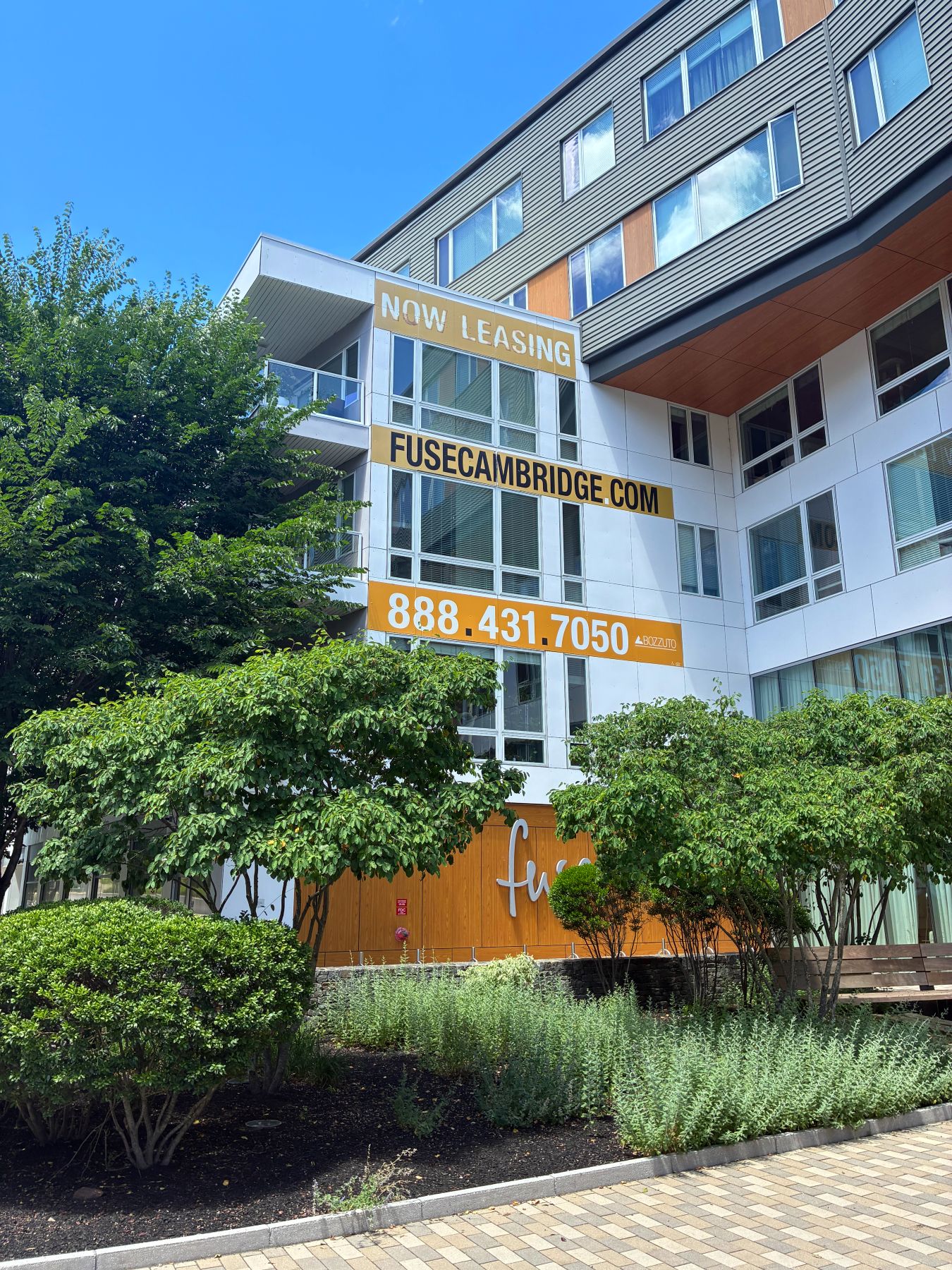
Investment sales activity in the apartment sector has plummeted in 2026 as the threat of rent control lingers over the industry. Pictured is the 244-unit Fuse apartment complex in Cambridge’s Alewife neighborhood, which is being marketed by brokerage CBRE. Photo by Steve Adams | Banker & Tradesman Staff
As lawmakers and real estate industry groups discuss a potential compromise over statewide rent control, the high-stakes political debate already has left its mark on Massachusetts’ apartment sector.
Sales of apartment buildings have plummeted amid a wide bid-ask spread. Development is harder than ever to finance, as equity investors sit on the sidelines.
“The big institutions are basically pricing in a significant amount of risk to the threat of rent control, which is causing them to not get to prices that are acceptable to sellers,” said Travis D’Amato, managing director of investment sales at Walker & Dunlop in Boston.
Walker & Dunlop has tracked 17 apartment properties that were brought to market since November in Massachusetts, only two of which resulted in transactions. The other 15, worth an estimated $2 billion, were pulled off the market after receiving disappointing bids. Typically, 90 percent of such listings proceed to a closing, D’Amato said.
“There’s definitely an impact. It’s probably the uncertainty coupled with the fact that interest rates have moved as well, so you have a little bit of a double whammy,” said Simon Butler, vice chairman and managing director of the Northeast region for CBRE and leader of its New England multifamily investment sales team. “There’s a subset [of buyer groups] that are on the sidelines until they get clarity.”
Because both rent control proposals currently under discussion are tied to the consumer price index, potential buyers also have to place bets on inflation along with the usual calculations such as future renter demand, housing supply and job growth.
“Let’s just say there’s a wide variety of opinions on [inflation],” D’Amato said.
The current environment appears to be poor timing to put properties on the market, but some sellers have no choice, capital markets brokers say. They may face a deadline to liquidate a fund that owns a property, or have an upcoming mortgage maturity and need to sell or refinance.
Bay Area Property Values Decline
Studies of rent control’s effects in other jurisdictions conclude that it diminishes property values. The question facing buyers and sellers in Massachusetts this year: how much?
A 2025 study of 9,578 property transactions in three Bay Area cities with rent control concluded that property values declined from 3.8 percent in Oakland to 4.1 percent in San Jose and 8.9 percent in San Francisco.
Economic researchers ECOnorthwest said the steep decline in San Francisco reflected its strict rent control policy, which caps annual rent increase at 60 percent of the consumer price index, up to a maximum 7 percent.
Declining property values create a domino effect that harms new development, the study concluded, exacerbating long-term affordability options for renters.
“As property values decline, the profitability of rental properties diminishes, making it harder for developers to secure financing and justify new projects,” the report said.
Between 2020 and 2025, median market value of apartments in Ramsey County, Minnesota declined nearly 13 percent, according to a separate study released this month by the Federal Reserve Bank of Minneapolis. The county’s largest city, St. Paul, enacted rent control in 2022.
“Moreover, many owners of apartment buildings have told us that they are actively appealing their property tax assessments because of their buildings’ falling sales prices,” the report states.
While industry groups and Bay State legislators discuss a potential compromise that could keep the original rent control question off the November ballot, the mere threat of caps on rental income has cast a pall over multifamily capital markets since late 2025.
The pro-rent control Homes for All Coalition and some developers have discussed a compromise version in recent weeks. Unlike the statewide mandate in the ballot question, the alternate version would only be imposed by local option. And it allows rent increases up to 10 percent, tied to inflation, while exempting new construction for 15 years instead of 10.
But investors are unlikely to make commitments without further clarity, multifamily specialists say.
“People have the ability to invest anywhere in the United States, so if there is an unknown, that is likely to drive people to look at other markets and wait to see what plays out in Massachusetts,” CBRE’s Butler said.
Development Deals Harder to Pencil
New development deals have been harder to finance since 2022’s Federal Reserve interest rate hikes. Now, the potential for rent control has added another layer of uncertainty for equity investors trying to gauge future returns for new apartment development as well.
“It’s affecting land pricing and our ability to put land under contract,” D’Amato said. “They all want to wait until November before they [submit a deposit] or close, because in their mind, if rent control passes, they’re not going to be able to capitalize it. All this noise has caused a significant amount of activity in New Hampshire and Rhode Island: a lot more capital looking at those markets.”

Steve Adams
Jeffrey Myers, research director at Colliers in Boston, said landlords under rent control also could struggle to cover already-rising costs of operations, utilities, maintenance and insurance.
“Those considerations are weighing high on a lot of investors’ minds in the Boston market, where we have a lot of older inventory,” Myers said. “Maybe some of the bigger players are staying on the sidelines and saying they want to see where this [rent control question] lands before they come to Boston. Investors are saying, ‘Massachusetts is hands-off right now before we understand more.’”